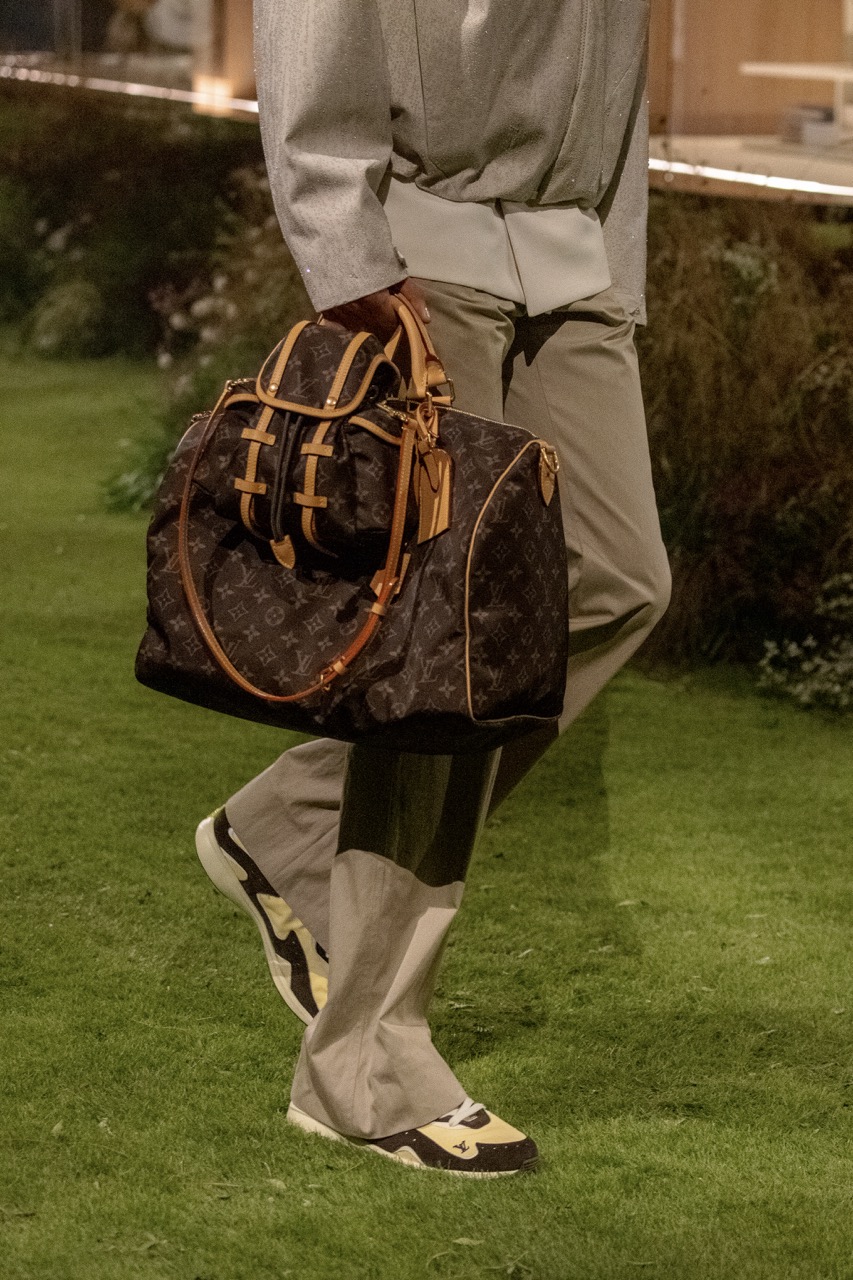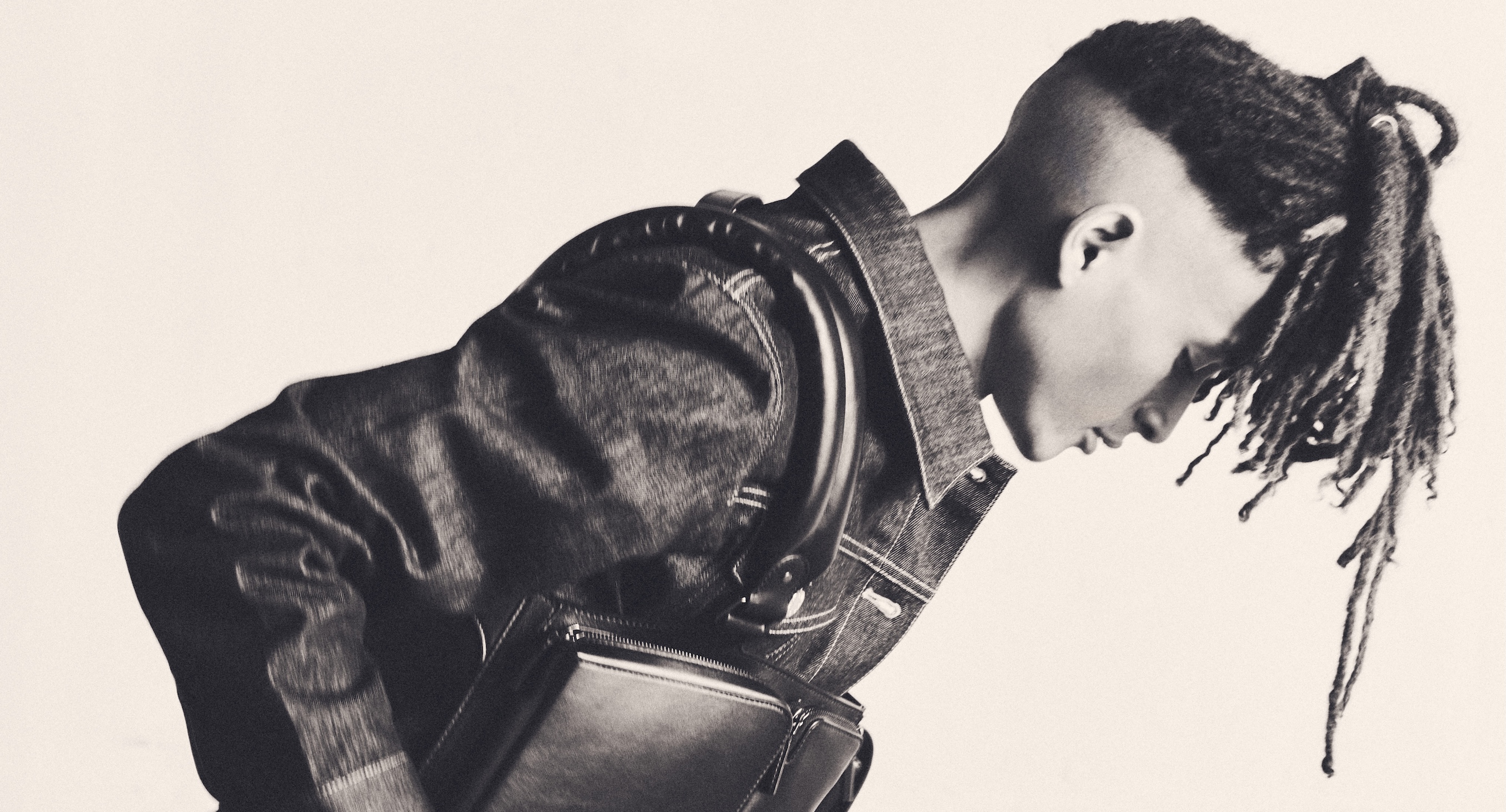
Epic. On 5 June 1940, The Sydney Morning Herald used the word to describe the evacuation of Dunkirk. The Guardian has called Moby-Dick “the grandfather of all whaling epics.” The Hollywood Reporter once wrote that Frank Herbert’s sci-fi classic received “epic screen treatment” in Denis Villeneuve’s Dune. Epic is an expression that describes immense scale and myth. But in fashion, the word is rarely used.
“Yes,” was Jaden Smith’s only answer when I asked if “epic” was the right word to describe his upcoming Christian Louboutin collection over a discreet video call from his office in Paris. It came up after I pressed him to name a specific sound to describe, even loosely, what we might see in his sophomore outing in June. To which Smith, Christian Louboutin’s newly appointed creative director of menswear, answered with a blockbuster reference: “Christopher Nolan movies, like the soundtrack to Inception. or maybe even the soundtrack of Tenet.”

You might expect him to reach for a more obscure reference, but Smith was earnest about his choice. “It’s cinematic. It’s a story,” he said. “Everything that we do starts and ends with a story. And our stories revolve around our main character: the colour red. Red is a really passionate, fiery, powerful colour. I think red needs to be preserved, but at the same time expressed. Just the fire of red, and the heat that even comes off the colour red. It’s a profound element of nature.”
I had said ‘epic’ because it seemed like the only word that might have been on his mind when he brought up those examples. When the dreams began collapsing in the final act of Inception, it was the pressurised, architectural, and ominous atmosphere that tensed you up in your seat. The building from pulse to impact until the music feels less like accompaniment than catastrophe taking form. In other words, it is the sound of a story becoming too large to contain.
And containing the story was never the point for Smith anyway.

He had just returned to Paris and took the call within hours of landing at Charles de Gaulle Airport. I asked if there was one particular habit he returned to in the de facto capital of fashion, some 5,650 miles from Malibu, California, where he was born and raised, to break the ice. “I love to watch the sunset. That’s my thing,” Smith said. “It grounds me. I would love to be as high up as possible, or just in a flat area where nothing is obstructing your view of the sky and the horizon.”
From another creative director, the answer might have scanned as a scripted nonchalance, the kind of offhand remark calibrated to become an eventual pull quote. From Smith, it felt more sincere than performative, less a bid for mystique than a small act of orientation, and a supposed sign of creative freedom, after crossing continents and sitting at a desk right across Christian Louboutin’s own office, separated only by a glass wall that allows each to see what the other is doing — a literal transparency that mirrors the mentorship and creative exchange that has taken place for a year.
Before the role came, Smith was still, in some ways, a Malibu kid raised in the spotlight. But he had already spent years moving beyond Hollywood’s frame, first through music and now, as he approaches 28, through fashion. At Christian Louboutin, where he leads menswear,that evolution has made him one of the youngest creative directors currently in the industry. “When I’m making an album, I can make a song just for myself that I want to make for myself as an artist, to express myself,” Smith said. “When I’m designing, I’m trying to really think about the next generation of men and working men in the world.”

Smith’s expertise as an artist is rarely questioned. But when his appointment as creative director for the maison was announced, it was, predictably, scrutinised by the Internet, and opinions split sharply. To some, his appointment was welcomed. To others, it raised a familiar question: has the celebrity creative director become one of fashion’s more exhausted tropes?
The criticism comes from an industry-wide outbreak, one where the hiring of non-traditional designers, in which institutions such as Parsons or Central Saint Martins are still treated as shorthand for design legitimacy, is becoming more prominent. Smith, though, seems aware of the scepticism. But his argument is not that his path resembles that of a traditional designer; rather, his creative education, through years of venturing into different artistic ventures, explains what was necessary for the role.
“What I do is really an overarching spanning of so many different things,” Smith explains. “It goes down to the design of the shoes, to the design of the websites, to the styling of each model. The multi-generational design philosophy that we’re carrying throughout the collection is how I approach my creative direction, and how I go about leading the team into the vision that we’re trying to create.”
He also adds that the image is fundamental. His debut collection for FW26 was revealed as an exhibition that takes photography and cinema as its starting point, two forms that feel natural to Smith’s world. A 360-degree installation of vintage television screens pulls together fragments from different moments in history, showing how images travel, repeat and eventually become part of the culture’s memory. “I’m very, very specific on the type of visual language that we create with our images,” he adds. “The image is a thousand words, and I’m trying to use specific words. There’s a specific message I’m trying to convey in each collection.”
During the interview, there was clearly excitement in the air. Fear, too. A lot is resting on this moment. In the six months since his debut showcase in Paris during men’s fashion week, the brand has been teasing its next instalment, while the first collection’s collateral, from campaigns to store activations, has begun appearing in boutiques around the world. Smith is now preparing for SS27, which, like any introductory directorial debut, becomes the moment when evolution is expected. The question was not so much why anyone would do it, but how. How do you renew something everyone thinks they already know? How do you build on a symbol as blunt and as perfect as the red sole?

The answer, funny enough, is to make shoes people would actually wear. Shoes, more than anything, can be seen as a symbol for fashion’s shifting values. But much is lost when design becomes about making money from a younger clientele through logos and sportswear, which kills it. For Smith, though, the approach is far less obvious than most suspect. Smith’s early years unfolded during a time when fashion shifted from hype. He grew up as the industry prioritised attention-grabbing moments — when a “drop” generated widespread attention and acquisition became more important than the clothes themselves.
But despite this, Smith’s most formative fashion memory stands out for its simplicity and sincerity. “I had these yellow Dr. Martens boots when I was a kid,” he recalls. “Those are the first shoes that I ever owned that made me feel like myself. I was, like, three years old with the yellow boots on.” He still keeps them as a personal talisman. “They actually inspire me so much because of how they made me feel.”
“I want to create something that makes people feel as comfortable as those shoes made me feel,” he says. “That’s my goal when I design and create things. It really felt like a superhero when I was wearing that, and a lot of the designs are designed to make people feel like superheroes.” You get the sense that, for Smith, the superhero is not a fantasy of escape but a way of explaining what clothes do to the body before they ever enter the world as product. The reference point, strangely enough, is Batman. “When I saw the Batman costume when I was younger, that’s when I realised that fashion could really change people’s behaviour,” he says.

“You put on the Batman costume, and you can’t go through your normal day the way that you would if you didn’t have the costume on.” He is not talking about costume in a theatrical sense, though there is theatre in everything he describes. He means transformation. “You start looking at yourself differently; walk, talk and act differently,” he continues. “I feel similarly when I put on a pair of red bottoms, where, when those go on, things change.”
“Transformation” is a word Smith keeps coming back to, even when he does not say it directly. The red sole, in his mind, is not only a symbol of desire, sex, glamour or status. To him, it is a behavioural device. A shoe can ask something of you. It can raise the stakes of an ordinary day. “What would I do if I were wearing red bottoms and I was role-playing as the highest, best, most fashionable, productive version and mature version of myself?” he asks. “What would that day look like then?”
It sounds almost like a self-help exercise until he says it with enough conviction that it begins to feel like design theory. “It begins to alter the course of your day and your behaviour,” he says. “What should I be doing? What would I do if I were the most productive version of myself now?” That might be why, in some ways, Smith’s vision of the Christian Louboutin man was not proposed as a passive consumer of fantasy, but as someone preparing for a life. When I asked him to describe this person, he diverted and spoke only of the wearer through sheer labour, discipline and history. “I’m thinking about the next generation of men and working men in the world, and the history of working men,” he says. “The stonemasons, the scribes, the doctors. People who wake up, put their clothes on, and really dedicate their entire life to what they do.”

It is an unusually earnest way to describe a luxury shoe collection, but earnestness might actually be the point that puts him on the map. Smith is interested in the working man as a lineage of self-definition. “I feel like the men of the future are Renaissance men that are doing so many different things,” he says. The fantasy, then, has to function. “When I design through this multi-generational lens, I try to include subcultures in the design,” Smith says. He talks about waterproofing with the same enthusiasm another designer might reserve for embroidery. “Whether that’s basketball, soccer, or hiking and being outdoors, creating waterproof things specifically for when it’s raining or when it’s outdoors really is a deep inspiration for me.”
This is perhaps the most interesting contradiction in Smith’s work for Christian Louboutin so far: the bigger the fantasy becomes, the more seriously he seems to take practicality. The shoe can look like a relic from the future, a science-fiction film prop, or a creature from a child’s dream, but it still has to withstand rain, movement, pavement, and years of use. But Smith is also careful to position that fantasy within the house and not above it. “This is Christian’s company,” he says. “He’s been doing this for a really long time, and I trust his mentorship and his direction with the company.”
Smith clearly knows the optics of his role, and he knows the weight of entering a house built completely around another person’s imagination. When I asked whether there was any pressure to do more, or even less, he said his goal was to avoid overstating his authorship. “I know what my role is and the things that I need to do,” he says. “I spend the majority of my time in the office, focusing on the collections, design, campaigns, social media, and the websites. All of these are within my jurisdiction.”

There is this. Jurisdiction. Responsibility. Smith sees his role as a caretaker of the maison’s possibilities, rather than someone hired to erase what came before. The archive, too, becomes a tool for him through memories rather than institutional research. “My friend Moises has been wearing Christian Louboutin for like, 15 years,” Smith says. “He has a specific piece with spikes all over it. It’s kind of this neoprene material that goes over the top of the shoe. He says they’re the most comfortable shoes ever.” He smiles at the memory. “Even the first time that I met Christian, Moises was with me, and he was wearing those shoes.”
Still, Smith’s relationship with craft is not at all sentimental. “We’re constantly pushing the boundaries of what the factories are capable of doing,” he says. “Pushing the boundaries of what shoes are in general.” He then poses a provocation that borders on the absurd, right up until it reveals itself as the existential core of modern luxury: “When does something become not a shoe? When does it become a sculpture that’s attached to your feet?” The answer, for now, seems to be found somewhere between the impossible and the wearable. “How do we push this? How do we evolve this? How do we go to the next level?” he asks. “We have so many shoes that take us so long to do the research and development on,” he explains further. “We just end up having to push it and push it and push it.”

And then, as if proof was needed, people began to wear them “Young Thug went on stage at Coachella wearing the collection. That was huge for me,” Smith says. “He’s a fashion icon throughout the world. One of my biggest inspirations and a close friend of mine as well. It really shows me the power of finding people in your life that can inspire you, help you grow, and support you.” By the end of our conversation, the red sole had become less a branding device than a kind of flare glowing from a distance. “[They] represent the vision, the passion for fashion, and for the creative spirit of humanity,” he says, when asked what he wants this chapter to stand for. “To really break boundaries and to do things that haven’t been seen or done before.”
But his idea of fashion is still attached to the oldest, most innocent idea of making something because some part of you needed to see it exist. “To start to grow and build my own community within the fashion industry is powerful. It’s exciting for me,” he says. And as this story concludes, while his continues, he naturally returns to a shoe. “The shoe I’ve made that I would send to my younger self would probably be the big red furry boots that I created,” he says. “I would send that back to him, because he would 100 per cent understand what was happening. I wouldn’t have to explain anything; I would know what was going on just by seeing that.”

Something is telling in his answer. He would eventually pause to think, as though his younger version was already looking back. “I’d be so proud, happy, nervous and scared that I was able to make something like that,” he said. “That shoe was so special to me, because I actually wouldn’t have to say anything to my younger self. My younger self would be attached to the part inside of them that always wanted to see something like that.”
Then came the simplest explanation of all. “It would be just like the yellow Dr. Martens boots,” he said. “I know what this is. I know who made this.”
And that is how legacy begins.
Once you are done with this story, click here to catch up with our June/July 2026 issue.

![日本科学未来館に行った日。友達の新たな一面を知れた[海谷遠音ブログ]](https://www.mensnonno.jp/wp-content/uploads/2026/07/blog-20260710_kaiya.jpg "日本科学未来館に行った日。友達の新たな一面を知れた[海谷遠音ブログ]")