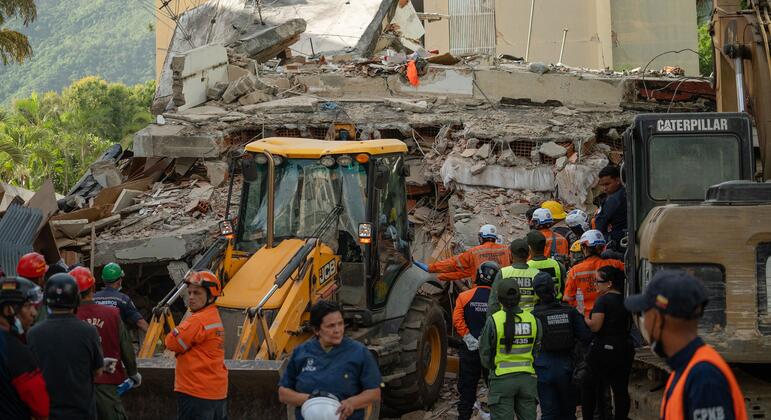
The death toll continues to rise, while a preliminary assessment estimates the direct physical damage caused by the disaster at $6.7 billion.
At the request of the Venezuelan Government, 44 international urban search and rescue teams, known as USAR, have deployed 2,245 specialists and 140 search dogs to extract possible survivors from collapsed structures and provide initial medical care, the UN Office for the Coordination of Humanitarian Affairs (OCHA) reported. reported on saturday .
OCHA has activated its emergency response mechanisms and is supporting the arrival and coordination of teams to the country.
The rescuers come from Argentina, Brazil, Canada, Chile, Colombia, Ecuador, El Salvador, Guatemala, Mexico, Panama, Peru and the Dominican Republic; as well as from Germany, Czechia, Spain, United States, France, Italy, Jordan, Lithuania, Netherlands, Qatar, United Kingdom, Serbia, Syria, Switzerland and Türkiye.
As of June 27, authorities have confirmed that at least 1,430 people have died and another 3,238 have been injured following the devastating twin earthquakes that hit the north of the country on June 24.
Damage equivalent to six percent of GDP
As rescue operations continue, a preliminary report satellite evaluation by the United Nations Development Program (UNDP) estimates that the earthquakes caused direct physical damage of about $6.7 billion, equivalent to approximately six percent of the country’s gross domestic product.
The estimate, calculated using the Rapid Digital Analysis tool known as RAPIDA, places the range of losses between $4.7 billion and $8.7 billion. This figure includes damage to homes and economic assets, but does not take into account damage to infrastructure, disruption to economic activity, or long-term reconstruction costs.
The earthquakes, of magnitudes 7.2 and 7.5, shook northern Venezuela and were felt in the capital Caracas and in the states of La Guaira, Carabobo, Miranda, Yaracuy and Aragua.
According UNDP About 8.6 million people were exposed to moderate to strong shaking, including about 2.1 million who experienced the strongest shaking. The assessment also estimates that 1.7 million structures were located in the affected areas.
Possible power outages
Satellite data also points to possible power outages in areas of Carabobo, La Guaira, Caracas and Aragua, after detecting a reduction in night lighting after the earthquakes.
“The speed and accuracy of initial assessments are essential for an effective response,” said Luis Francisco Thais, UNDP Resident Representative in Venezuela.
“Tools like RAPIDA help us make faster, evidence-based decisions to support affected communities,” he added.
The agency explained that it will continue to analyze higher resolution satellite images to help authorities assess victims, displacement and recovery needs.


