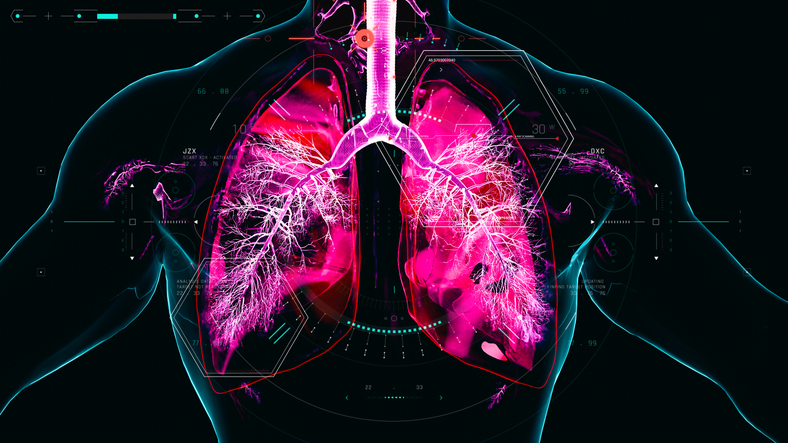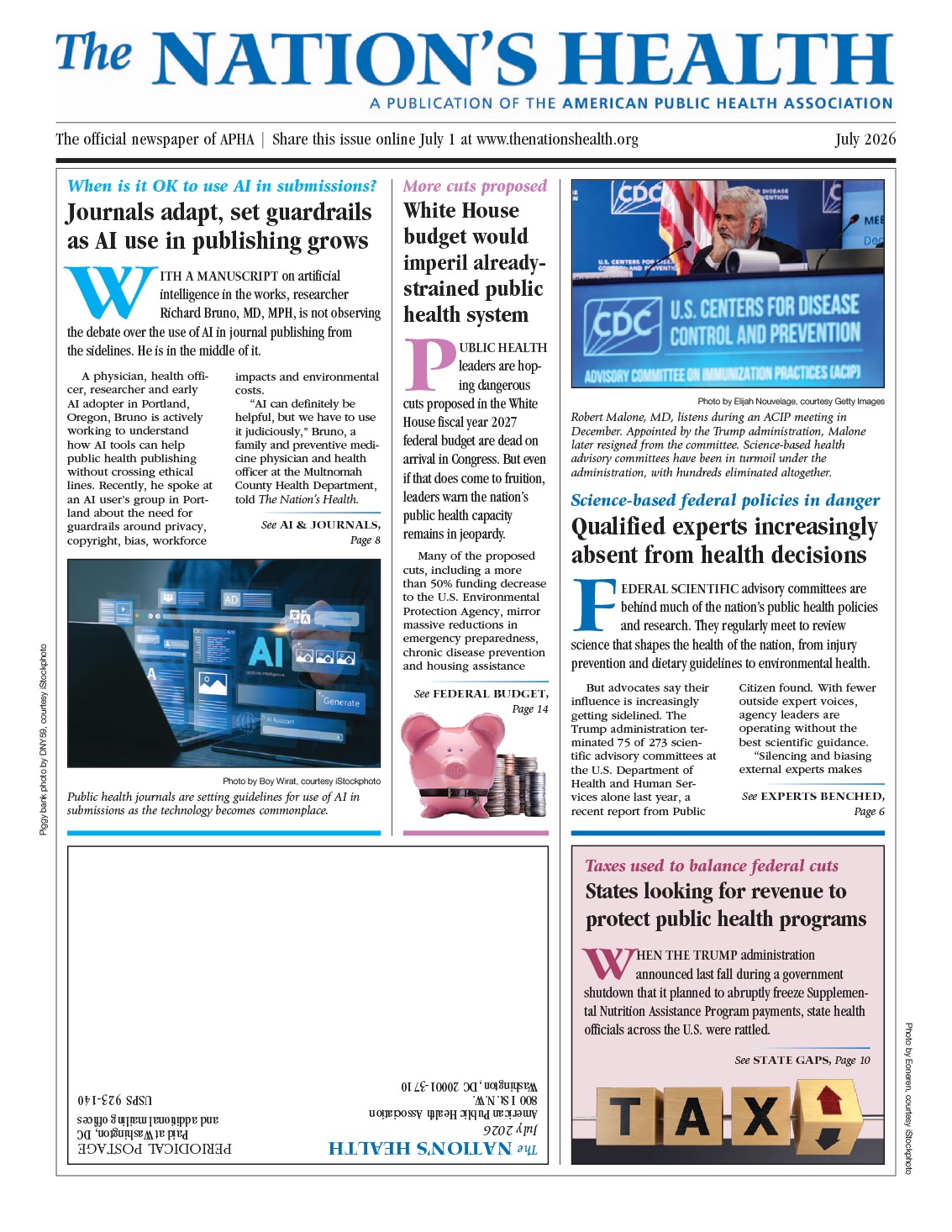

Health officials in Essex County, New Jersey, are using AI to map threats like the flu and rodents. The county’s geospatial AI uses geographic information systems to map public health data.
Images courtesy of iStockphoto, Frank Ramspott/Oxana Litvinova. For illustrative purposes only.
“Public health is different today. We are no longer a reactive public health system. We need to be proactive.”
—Maya Harlow
AI is changing the way public health departments and agencies operate. While some offices use AI for administrative tasks, others have expanded the technology to innovative demographic public health projects.
At the Essex County Public Health Management Office in New Jersey, staff are using AI to predict flu outbreaks, prepare for urban flooding and more in a county of more than 860,000 people. Essex County is taking advantage of geospatial AI, which uses geographic information systems to map public health data.
Maya Harlow, health officer and founding director of the Essex County office, speaks with The health of the nation about the ways the department has integrated AI into public health initiatives.
What are the public health challenges in Essex County?
Key public health issues in Essex County include mental health stigma, chronic illness, and access to care. Chronic diseases affect all area codes in Essex County and are closely related to preventive care. Preventive care is related not only to access to care, but also to self-efficacy.
We partner with Rutgers University, which has an extensive preventative cancer screening program that we work with.
Access to care has been identified as a major barrier, including challenges such as transportation. Additionally, with new Medicaid regulations scheduled for June 2026, eligibility requirements will change. Our top priority is to ensure that access to care does not worsen as these changes take effect.
How has Essex County used AI?
We partnered with one of our largest municipalities to apply GIS and machine learning to what some might call “predictive AI” in several key public health efforts.

Essex County may use AI maps for urban flooding.
Photo courtesy of RerF, iStockphoto
We use it to predict flu seasons and identify hotspots and also to forecast rodent activity.
By mapping and analyzing patterns, we were able to proactively mitigate high-risk areas for rodents, which ultimately led to a significant reduction in rodent complaints and allowed us to eliminate a $20,000 pest control contract.
We analyzed rodent complaints over a five-year period and mapped the data to identify hotspots in specific areas.
Through this process, we discovered that some of these hotspots were associated with natural water sources. We are working with our (Public Works Department) to mitigate those conditions.
Additionally, we take a proactive approach by anticipating seasonal increases in rodent activity. Before those periods, we send inspectors to affected neighborhoods to ensure proper conditions, such as keeping items off the ground, using trash cans with secure lids, and removing large piles of brush.
The goal was to reduce potential rodent harborage areas before activity was expected to increase.
How was AI used to predict flu outbreaks?
When we looked at where to locate our vaccination clinics, one of the most interesting findings from mapping five years of data was that our hot spots were concentrated around train stations.
We found that areas near train stations have a much higher level of activity, with many people passing through and using nearby services. Even if someone doesn’t live there, they can still interact with those spaces, while residents consistently use the same local businesses. As a result, disease transmission, especially respiratory diseases, occurs at a higher rate in these areas.
What about urban flood prediction?
This is actually one of our newest components and one we are most proud of.
We can use data from NOAA, a project called Giovanni from NASA, and data from FEMA. We were able to map out a live simulation in Bloomfield, New Jersey.
Let’s say the news predicts three inches of rain over four hours. We can put that into machine learning.
It is capable of creating that type of simulation, which will actually give you puddles of water. We can see the depth of the pool, the flow of the pool, so we will be able to make recovery efforts in case there is a flooding situation.
Public health is different today. We are no longer a reactive public health system. We need to be proactive.
What other ways does Essex County use AI in its work?
We are using AI in every way that makes sense for our staff to increase our workload and be more efficient. And again, I think AI will be integrated into our daily lives. We all need to understand how it works and make it work for us.
Essex County recently won an award.
We won the ESRI SAG Award, which is awarded once a year to outstanding projects. You are selected from 100,000 applicants worldwide. I think we are 100% at the forefront of public health.
What advice would you give to other public health agencies?
You must ensure that your data is correct, appropriate and vetted; This type of initiative is nothing without data.
You should also ensure you are properly complying with cybersecurity and HIPAA laws, especially in public health.
Before starting a (AI-based) program, you should have a very good relationship with your IT team and make sure the data is secure. You need to make sure you have a process for data collection, a process for sharing data, and you also need to make sure you have data sharing agreements.
For more, visit www.essexcountynjhealth.org. This interview was edited for length, clarity and style.
- Copyright The Nation’s Health, American Public Health Association