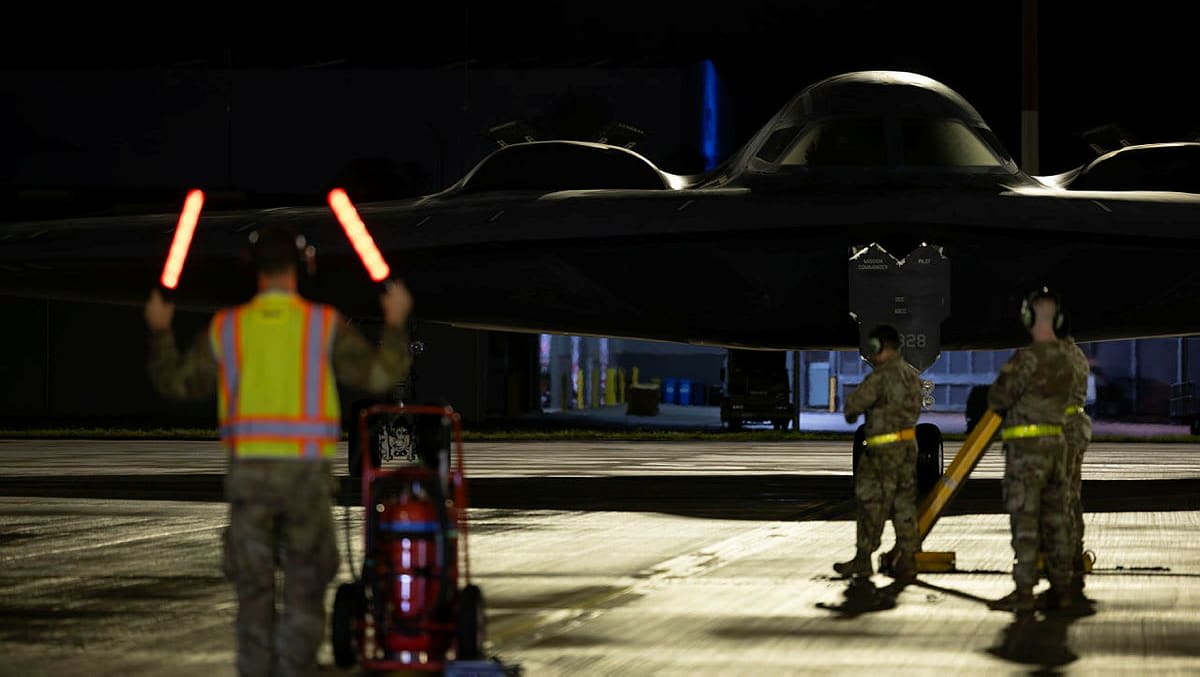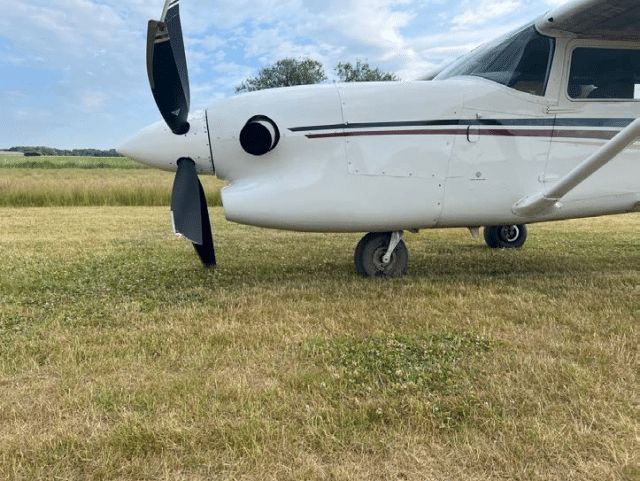
On June 15, 2023, a small plane crashed on the runway of the private Aversi airfield in Denmark. The aircraft, registered in Germany as D-EPRR, was a Cessna TU206G Stationair, a single-engine, six-seat aircraft that Soloy Aviation Solutions had converted to a turboprop (with a Rolls Royce 250 turboshaft). It was later converted again by Turbine Conversion Ltd to have a five-bladed MT propeller with a Pratt & Whitney PT6 engine.
In the right seat was a flight examiner with 22,500 hours, of which 390 hours were type. The student was a commercial pilot of piston-engine aircraft with 950 flight hours. He was also an experienced skydiver. That day, the pilot was flying with the examiner for a VFR skill test to obtain a class rating for the Cessna single-engine turbine.
A PT6 takes much longer to start than a piston engine and a large part of converting to a turbine engine involves getting used to the significant delay in increasing engine power.
The pair started the day with a navigation flight from Holbæk (EKHB) to Aversi private airfield, during which they completed the first part of the skill test. They refueled and the flight examiner briefed the pilot on the next part of the skill test they would perform on the grass runway, including a forced landing (simulating a landing after an engine failure) and an aborted go-around at low altitude. They then planned to fly to Kalundborg.
The pilot took off to make a circuit at 1,000 feet. At the end of the downwind leg, the textbook indicates to pull power for a planned landing, the pilot went through the emergency checklist for engine failure. The flight examiner reduced engine power to simulate a stalled engine, including feathering the propeller, which prevents the propeller from spinning and reduces drag.
The pilot continued, setting the Cessna on short end with low engine power. The examiner was impressed with how well the pilot was handling the engine-off landing and decided that this would be a good opportunity to abort the approach and perform a low-altitude go-around.
He waited until they were about 30 feet above the ground, checking that the airspeed was still reasonable, before making the call.
Der er a faldskærmsspringer foran dig på banen, du skal gå rundt.
“There is a skydiver in front of you on the runway, you need to go around him.”
There were no paratroopers. There was no one on the track. This was a technique the examiner had used before in skill tests, giving a plausible reason for aborting a low-level landing, such as: “There is a plane lined up in front of you, you need to go around it.” The pilot was an experienced skydiver, which may have been what reminded him of this particular scenario.
Part of the goal of the test is to create a startle effect: It’s one thing to prepare for a landing you know you’re going to abort, to be ready to start the engine and walk away. Another is to deal with an emergency that is developing.
In fact, the pilot was startled. Somehow he understood that there was a paratrooper in the airWhich, to be fair, is a logical place for a skydiver to be. He reacted to the situation, a paratrooper creating a situation, instead of the order to turn around. Possibly he was also thinking about the fact that the power was low and the propeller was feathered. The report does not comment on whether the pilot understood that the parachutist was imaginary.
He decided that the best thing was to fly. low The imaginary parachutist. He stepped on the accelerator from low power to idle and lowered the nose.
Reducing power from low to idle changed the angle of the propeller blade, causing the propeller to act as an air brake.
The six-seater Cessna with a large turboprop installation is a heavy beast and they began to sink quickly. The examiner and pilot attempted to stop the unexpectedly steep descent by pulling back on the control wheel, lifting the nose into the air, but they did not have the power or speed to achieve this. The Cessna fell the remaining five meters onto the runway.
The front landing gear collapsed on impact and was pushed up through the wheel well. The propeller hit the ground, bending and breaking the blades. The plane skidded forward and then stopped.
Conclusions
The student pilot misunderstood an instruction to abort landing and delayed the throttle to idle, causing an increase in descent rate.
The low flight altitude made it impossible for the flight instructor to avoid a forced landing on the runway in time, so the plane suffered an accident.
I have worked from an automatic translation of the report but the wording is clear enough to conclude that the misunderstanding was not specific to Danish. The phrase used was in banenthat is, on the track, but the pilot somehow understood it as I luftenin the air. The investigation concluded that the problem was much more the front load of the parachutist, faldskærmsspringer combined with dig foranin front of you/in front of you. This initial information could be interpreted as a parachutist danger in the air; Parachutists normally do not stay on the slopes. Once the pilot had this mental model of imminent danger, he reacted without properly analyzing the rest of the statement (on the runway, turn around).
This is why the ICAO and Eurocontrol (European Organization for the Safety of Air Navigation) recommend that when requesting that the landing be aborted, that instruction be given first, followed by the reason. For Air Traffic Control, the instruction is to give the reason only if time permits. It is the least important information that is imparted at that time.
The report barely mentions this, but I think the fact that the pilot was switching from piston engines to turbine engines is a major cause. The slow-reaction turbine engine adds a clear risk to the scenario of going from a low-power landing to a low-altitude turnaround. The instructor would not be able to quickly correct the amount of engine power available.
The report says the instructor could have mitigated the risk by covering the throttle before calling for a low-altitude turn to prevent the pilot from further reducing power. This seems like an odd point though – if the pilot had understood correctly, he would have pushed the throttle forward, so the engine would rev up and add power as they drove away. I don’t see why the instructor would have watched the throttle.
The instructor later said that the pilot probably would have been able to land the plane safely if it had been a piston engine.
Radiotelephony skills are not always taken as seriously as they could be and when on the air, variations are often used. I thought it was an interesting reminder that not adhering to those principles can have unexpected effects.