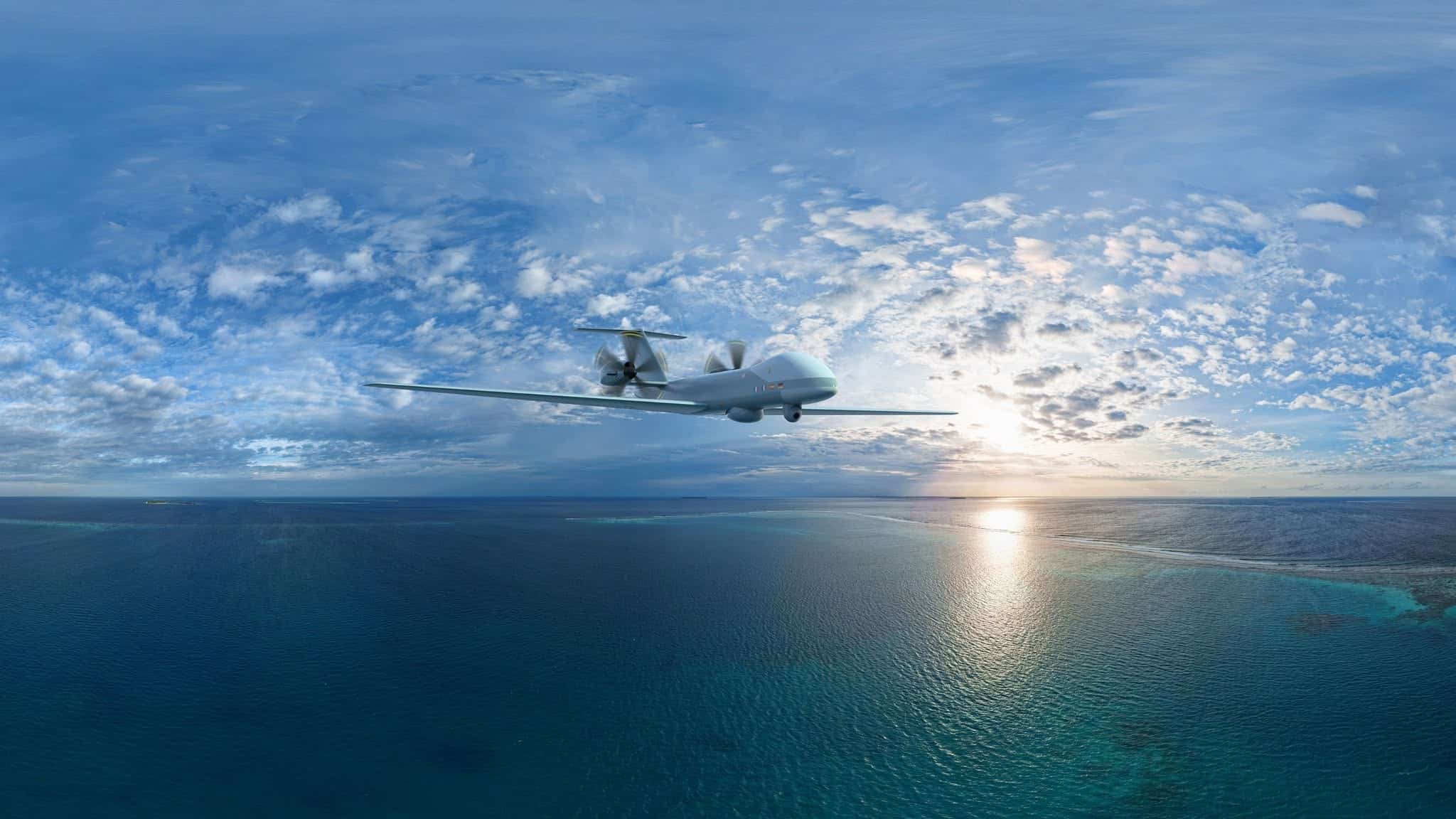
Airbus and Kawasaki Heavy Industries have signed a memorandum of understanding to cooperate on the development concept of a Eurodrone focused on anti-submarine warfare (ASW) and maritime patrol function.
The two companies will now begin work to decide any necessary modifications to the existing Eurodrone U950 design, including considerations on the payload and sensor packages needed for long-range ASW and other maritime missions. Conceptually designed for Japan’s defense needs, Japan itself has not yet placed a firm order for such an aircraft, but has maintained official partner status in the broader Eurodrone program since November 2023.
In #ILA24We are showing a 1:1 mockup of our #Eurodrone. It will guarantee operational superiority over partner countries, especially in the context of Intelligence, Surveillance, Target Acquisition and Reconnaissance (ISTAR) missions. It will be a key pillar in the future… pic.twitter.com/CNQIm5C8dV
— Airbus Defense (@AirbusDefence) June 6, 2024
Eurodrone is a twin-engine Medium Altitude Long Endurance (MALE) unmanned aerial vehicle (UAV) designed to serve a similar role to the US-made MQ-9 Reaper. Compared to the Reaper, the Eurodrone is 5-6 meters larger in both length and wingspan, and features a maximum takeoff weight more than double that of the MQ-9. The first Eurodrone flight is currently planned for 2029.
Germany is currently the main customer with 21 aircraft on order, followed by Italy with 15 on order and then France and Spain with 12 each. The four nations are collaborating on the development of the plane through prime contractor Airbus and manufacturers Leonardo and Dassault. France, despite criticism of the program and the change in financing plans, has confirmed that it still intends to proceed with its acquisition of the type.
France remains committed to Eurodrone but could delay its acquisition. @AirbusDefence says the official. “We had and still have four countries in this program,” Jean-Brice Dumont said at the ILA air show in Berlin. https://t.co/mWWiDslSyz pic.twitter.com/498xowd1n1
-Craig Hoyle (@FlightAcesHigh) June 17, 2026
With a planned endurance of up to 40 hours, the Eurodrone would be ideal for long overwater missions providing persistent ASW and intelligence, surveillance and reconnaissance (ISR) coverage, augmenting manned platforms.
Japan, with its direct access to vast expanses of the Pacific Ocean and its proximity to China’s ever-expanding submarine force, is a key focus of this development. The country already operates dozens of Kawasaki P-1 and Lockheed P-3 Orion maritime patrol aircraft, and is now beginning to use RQ-4B Global Hawks for long-range ISR.
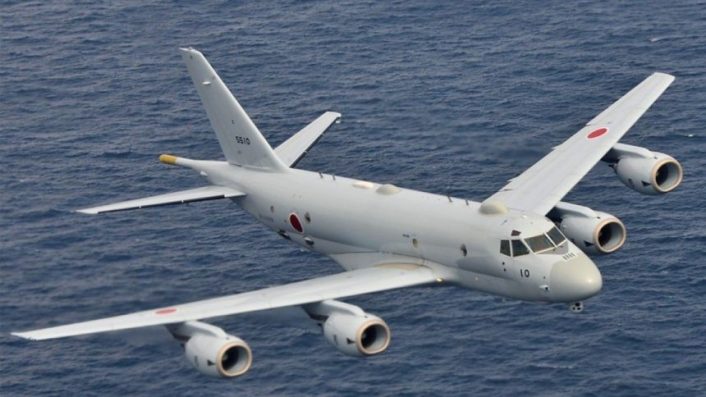
While the Global Hawk is more than capable of providing maritime patrol elements, it lacks any type of ASW or weapons carrying capability. Meanwhile, the planned maritime variant of the Eurodrone is expected to be able to use sonobuoys and torpedoes, much like recent developments of the MQ-9.
In particular, Kawasaki Press release mentions that the MoU will also include exploration of how the Eurodrone could operationally partner with the P-1 maritime patrol aircraft, hinting at manned and unmanned teaming (MUM-T) capabilities.
Maritime Missions
The Eurodrone’s twin-engine configuration, a requirement stipulated by Germany for safety in urban areas, has been maligned for adding weight and complexity to the plane. However, for this use case, the additional reliability over platforms like the MQ-9 could be a huge benefit.
Airbus and Kawasaki Heavy Industries have signed an MoU on the theoretical development of a Japanese adaptation of the Eurodrone. The idea focuses on deploying an ASW platform similar to the MQ-9B. Eurodrone may be attractive due to its dual-motor design and high payload. https://t.co/tQa9gxyB1A
– Alex Luck (@AlexLuck9) June 26, 2026
Although drones are considered more expendable than manned aircraft, the cost of their loss – particularly when equipped with additional ISR equipment and/or weapons loads – can still deal a blow to a force’s overall capability. This is especially true when lost aircraft cannot be replaced in time, as the US Air Force discovered after the loss of around 20% of the entire fleet during Operation Epic Fury. The MQ-9 has been described as the “most valuable player” in the United States war effort, even though it is often considered too vulnerable for modern high-intensity conflicts.
The US Air Force’s MQ-9 Reaper drones have been the “most valuable player” in Operation Epic Fury against Iran, Chief of Staff Gen. Ken Wilsbach said today. The United States has carried out “many, many strikes” with the Reaper against Iran, Wilsbach said. “No other platform is even close to…
– Chris Gordon (@ByChrisGordon) May 21, 2026
The complexities of ASW mean that manned aircraft will almost certainly be a major component for many years, but having access to unmanned aircraft to assist with ASW tasks would reduce the workload of each ASW aircraft and allow a larger area to be surveyed for underwater threats. A similar evolution is occurring in and under water, and expensive ASW submarines and frigates are now expected to simply be the tip of a broader spear encompassing a variety of automated and remotely controlled capabilities.