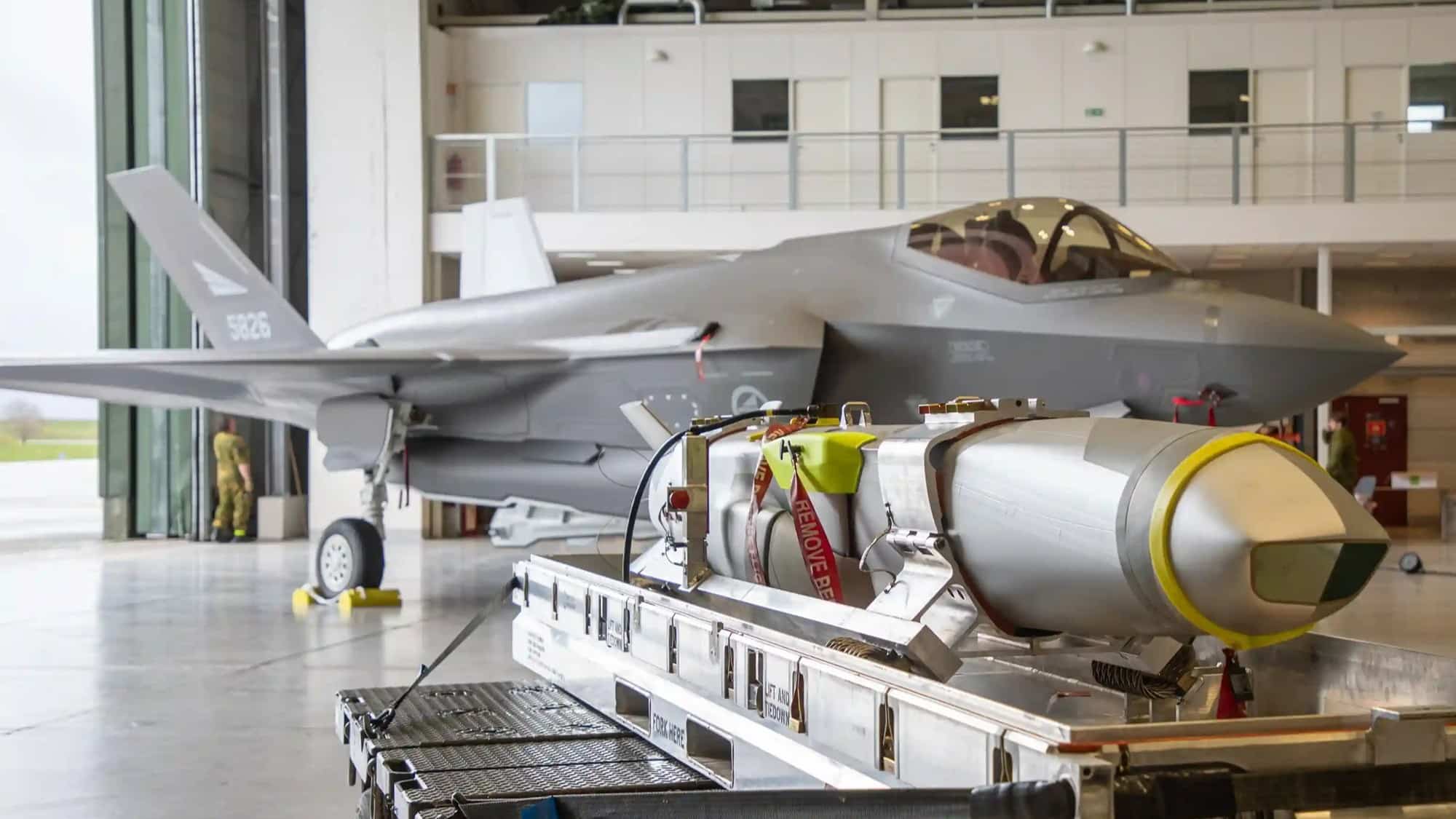
The joint strike missile will equip Canada’s F-35 fleet, giving it the capability to carry internal standoff weapons.
Canada has chosen the Kongsberg Joint Strike Missile (JSM) as its new air-to-ground engagement weapon. The compensation of 564 million dollars, according to a Press release July 8, 2026 of the Norwegian company, makes Canada the sixth operator of the weapon, after Norway, Japan, Australia, the United States and Germany.
Kongsberg said the integration of the JSM into “Canada’s next-generation fighter will provide the Royal Canadian Air Force with a critical operational advantage.” The company has also established broader local defense industrial investment within Canada in line with its Industrial and Technology Benefits (ITB) Policy.
“KONGSBERG also announced investments in Canada today, through the country’s Industrial and Technology Benefits (ITB) Policy,” the press release says. “These aim to build long-term industrial capacity by stimulating job creation, the development of dual-use technologies and strengthening the defense industry through collaboration between industry and academia.”
Canada and Norway @KOGDefence have announced a 4.7 billion NOK contract for the delivery of JSM (Joint Strike Missile) cruise missiles, making the Royal Canadian Air Force (RCAF) the sixth largest operator of air-launched missiles.
Full article:… pic.twitter.com/X3Tb3IXzYQ
— 𝕻𝖗𝖆𝖎𝖘𝖊 𝕿𝖍𝖊 𝕾𝖙𝖊𝖕𝖍 (@praisethesteph) July 10, 2026
Kongsberg CEO Erik Lie said the company is “pleased to welcome Canada as the sixth country to select the JSM. The acquisition of the Joint Strike Missile can fundamentally improve the operational range and effectiveness of Canada’s fighter fleet. In addition to offering world-class defense technology, KONGSBERG is committed to contributing to industrial growth in the country.”
Weighing 416 kg and measuring four meters in length, the JSM flies at high subsonic speeds and has a range of more than 350 km (189 nautical miles). The weapon is equipped with a high-precision navigation system that allows a low-altitude flight profile.
Kongsberg further states that the JSM uses an advanced mission planning system to exploit maritime and land geography. Automatic target recognition is supported by an advanced infrared image seeker.
🇨🇦 Canada has awarded a contract to the Norwegian company Kongsberg for the acquisition of the Joint Strike Missile (JSM) air-launched cruise missile for a value of 420 million euros. https://t.co/luH8X3F9V8 pic.twitter.com/CSL9SRlcHv
-Jeff2146🇧🇪 (@Jeff21461) July 9, 2026
Canada and American-made F-35s
The JSM, an air-to-ground derivative of the Kongsberg anti-ship naval strike missile (NSM), is the only air-launched weapon in its class that can be carried internally by the F-35. The American-made JASSM and LRASM can only be carried externally, as they are too large for the Lightning II’s internal weapons bays.
However, a major diplomatic dispute between Ottawa and Washington overshadowed the purchase of the fighter jet. Prime Minister Mark Carney’s government has been considering buying only the 16 planes it has paid for and not the entire fleet of 88.
In 2023, Canada signed a C$19 billion ($13 billion) deal to buy 88 F-35As, with deliveries to begin in 2026 and the fleet expected to reach full operational capability by 2034. Voices in Canada’s defense and strategic community have warned that a small F-35 fleet would be logistically and tactically even more deficient, while a certain section has pushed to abandon the program altogether.
F-35A + Joint Strike Missile (JSM) = Maritime dominance for #Norway and #Japan 😉 The long-range JSM is the only fifth-generation cruise missile designed to be launched from the internal weapons bay of an F-35. It was successfully tested last February. #avgeeks #aviation #news pic.twitter.com/VN3zzfVOv3
— Air Power (@RealAirPower1) December 16, 2022
It should be noted that Canada has not yet made a final decision on the F-35. As we have seen with other allies that have an on-again, off-again relationship with the United States, Canada could simply continue a defense trade relationship with Washington within a cooperative military alliance, while continuing to diverge on key foreign policy issues.
Other recent defense purchases outside the United States
At the same time, Carney has seriously indicated – without committing generally – an interest in the Saab Gripen. He push It also comes from Sweden’s own defense specialty, which has characteristically promised significant industrial and employment benefits at the local level. An important indicator was the Gripen’s participation in the CANSEC 2026 exhibition in May and the entry of the ruling Liberal Party deputy, Sima Acan, into its booth.
However, Carney has definitely decided on other important weapons of capital. These include Saab’s GlobalEye AEW&C aircraft, also based on the Canadian Bombardier Global 6500, which was selected instead of the Boeing E-7A Wedgetail.
“Ottawa plans to spend more than $5 billion on a fleet of six aircraft. By choosing the Saab/Bombardier bid, the Carney government hopes to make Canada a hub for the Swedish manufacturer’s ‘airborne radars’ by building approximately forty surveillance aircraft on Canadian soil, which could then be sold to NATO member countries.” The press reported. NATO itself recently selected the GlobalEye to replace the aging E-3 AWACS fleet.
A record crowd of 21,300 registered for the annual Cansec military fair, where Mark Carney announced billions in new spending and attendees could sit in a Gripen fighter. https://t.co/zZtbNjjuAw pic.twitter.com/PqeeCZn40c
– The Logic (@the_logic) May 29, 2026
Finally, Canada will also soon acquire nine (four new and five used) Airbus A330-200 refueling aircraft, designated CC-330 Husky, to replace the current CC-150 Polaris. Acquired within the framework of Strategic Tanker Transport Capability, the first of the CC-330 Husky completed its first test flight in Spain on July 2, 2026.
Milestone achieved for the Strategic Tanker Transport Capacity. ✅
On July 2, the first CC-330 Husky completed its first test flight in Spain, allowing teams to evaluate design, performance and safety. https://t.co/V2kvjM9jkj pic.twitter.com/LRNoJuRwh7
— National Defense (@NationalDefence) July 6, 2026
The JSM therefore comes on the heels of Canada’s new strategic defense relationship with non-US regions such as Europe. A Saab Gripen acquisition is also unlikely to create integration issues with JSM, given the European origins of both platforms.
However, it remains to be seen whether the Royal Canadian Air Force’s (RCAF) 70-75 CF-188A/B+ aircraft will carry the JSM, given diplomatic clearance and technical approval from original equipment manufacturer (OEM), Boeing.