
Meta has begun rolling out USDC payments to select creators in Colombia and the Philippines, marking the company’s most concrete return to crypto payments since the collapse of its Libra and Diem ambitions. The feature uses Solana and Polygon as supported blockchain rails, placing two major public networks within one creator payment flow through the Meta payment system.
According to Meta Business Help. pageStablecoin payments are currently available only to select creators on the two marketplaces. Fortune reported that creators who choose the option are asked to add a third-party crypto wallet address to Facebook’s payment platform, with payments made in USDC through Solana or Polygon. Meta does not provide its own USDC to local currency conversion service, meaning creators who want fiat money will have to rely on third-party wallets, exchanges, or payment services.
Meta turns to Solana and Polygon
The deployment is limited, but the signal is greater. Meta is not launching a new currency, nor reviving Libra, nor attempting to build a vertically controlled global monetary network. Instead, the company is testing stablecoin payments over existing crypto infrastructure, using USDC and established chains to transfer money to creators in markets where cross-border payments can be slow, expensive, or operationally uneven.
A Meta spokesperson said Fortune that the company is “exploring how stablecoins could become part of our options set,” framing the move as an expansion of payment methods rather than a full crypto strategy. Stripe is also involved, with Fortune reporting that the payments company is working with Meta on the launch and that Meta’s page references Stripe for cryptocurrency-specific tax reporting tied to payments.
For Solana, the integration gives the network another high-profile payments use case at a time when stablecoins have become a central battleground for blockchain adoption. The official Solana account mentioned the news directly on X: “BREAKING: Meta adds support for USDC payments on Solana for creators in Colombia and the Philippines.”
That publication was quickly amplified by the voices of the ecosystem. Vibhu Norby, interim chief product officer and chief marketing officer of the Solana Foundation, wrote: “All the money in the world will move to Solana. You just got there a little earlier than everyone else.”
Mert Mumtaz, CEO of Helius, framed the launch of Meta as part of a broader stablecoin stack forming around Solana. “Meta just added stablecoin payments through solana! Altitude just launched a complete platform for stablecoins and banking with solana. Ramp also recently added support for solana. And we have a privacy solution in the works. Quietly becoming the best place for payments and stablecoins.”
The inclusion of Polygon is equally notable. Fortune quoted Polygon Labs CEO Marc Boiron as saying that marketplace payments are increasingly built on blockchain infrastructure like Polygon, while adding that Meta’s stablecoin payments program is expected to expand to more than 160 countries by the end of the year.
The contrast with Libra is stark. Meta’s previous stablecoin effort, later rebranded as Diem, was abandoned in 2022 after sustained regulatory resistance. This time, the company is not attempting to issue a Meta-controlled currency. It is using USDC, a widely circulated dollar-backed stablecoin, and routing payments through existing public blockchain networks rather than trying to define the monetary layer itself.
At press time, SOL was trading at $82.92.
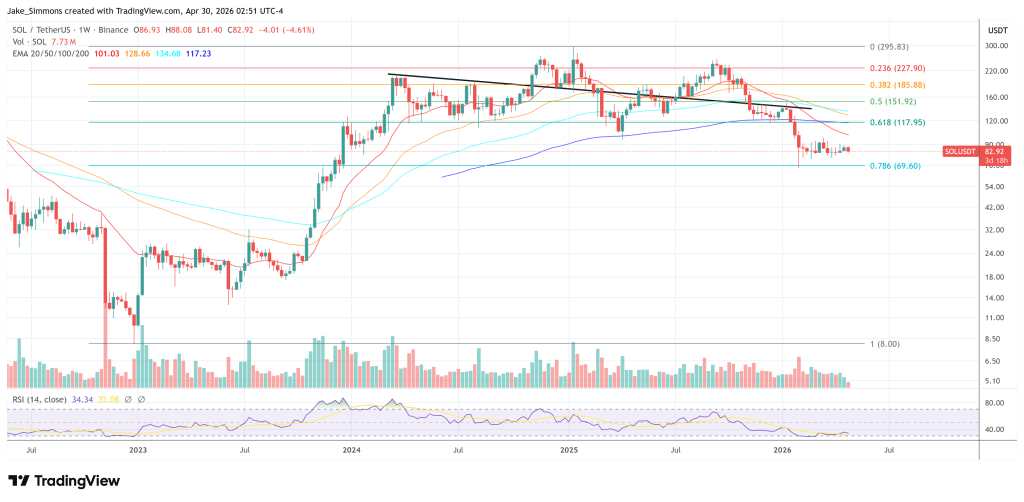
Featured image created with DALL.E, chart from TradingView.com
Editorial process for bitcoinist focuses on providing thoroughly researched, accurate and unbiased content. We maintain strict sourcing standards and every page undergoes diligent review by our team of technology experts and experienced editors. This process ensures the integrity, relevance and value of our content to our readers.