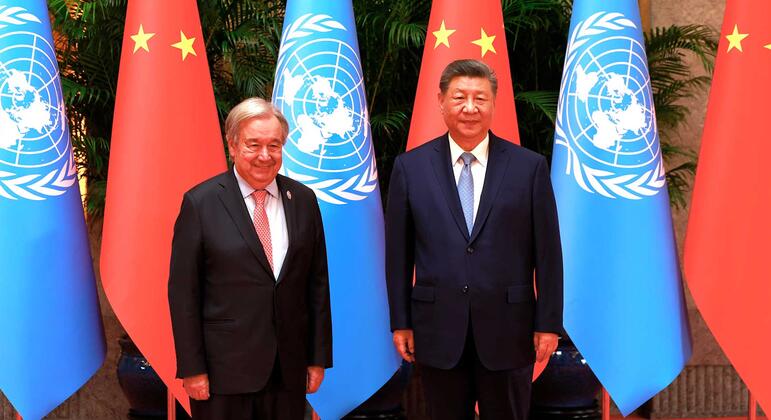
He warned that without international cooperation, technology could widen global inequality instead of promoting sustainable development.
Speaking at the opening ceremony of the World Artificial Intelligence Conference (WAIC) in Shanghai, Guterres described AI as “humanity’s greatest opportunity in the 21st century,” but warned that it could also become “one of its greatest risks.”
“The technology that will shape the future of humanity must be shaped by all of humanity,” he stated, stressing that AI governance “cannot be governed by a handful of countries or companies” and that “every nation needs a seat at the table”.
Pending progress
The UN has stepped up its work on AI governance over the past year, following the adoption of the Global Digital Compact and the establishment of the UN General Assembly supported Independent international scientific panel on AI – the world’s first scientific panel on this revolutionary technology.
The first session of Global Dialogue on AI Governance was held in Geneva earlier this month, where governments and stakeholders came together for open, transparent and inclusive discussions on AI governance.
These recent initiatives aim to help countries share expertise, promote common standards, and ensure developing nations have a stronger voice in shaping the future of technology.
Mr. Guterres said The next phase must focus on turning those commitments into practical support so that all countries can benefit. of the rapid development of AI.
Closing the gap
The Secretary-General said AI has enormous potential to accelerate medical advances, transform education, strengthen food systems and create jobs, helping to drive progress towards Sustainable Development Goals (SDG).
But he warned that many developing countries remain at risk of being left behind.
“A third of humanity remains offline“he noted, while computing power, technical expertise and investment remain heavily concentrated in a small number of countries and companies.
Unless those disparities are addressed, AI could lead to “greater inequalities, greater divisions in income, opportunity and security.”
To help close those gaps, Guterres said more than 20 countries, including China, have already nominated centers for a UN-backed Global Exchange and Cooperation Network for AI Capacity Building.
He also announced that he will soon present recommendations for a Global Fund for AI and called on governments to support both initiatives.
Three priorities
The Secretary General outlined three priorities to ensure that AI benefits everyone: expanding capacity in developing countries, setting international safety standards, and making AI more environmentally sustainable.
He said developing countries should have the tools to build AI systems using their own data, languages and expertise, while governments should adopt common approaches to testing and risk management based on international law.
“Human rights must be protected,” said the UN chief. “Humans must maintain control over every life and death decision.” He also stressed that “no AI system should be put in the hands of a child before it has been proven safe.”
On sustainability, Guterres called on leading AI companies to disclose the environmental footprint of their systems and power their operations with renewable energy by 2030, urging governments to integrate clean energy for AI into national plans.
“The defining question is whether this transformation will reduce inequalities or reinforce them,“he said. “Whether it will concentrate power or expand opportunities.”