Nanogenerator Electrical Pulses Provide Beneficial Results Without Side Effects: Rat Study
Although electrical stimulation has therapeutic potential for various disorders and conditions, ungainly energy sources have hampered practical applications. Now bioengineers have developed wearable, implantable nanogenerators from special materials that create electrical pulses when compressed by body movements. Pulses controlled weight gain and improved skin wound healing in rat models.
The work was performed by a research team led by Xudong Wang, Ph.D., professor of Engineering and Materials Sciences in the College of Engineering at the University of Wisconsin-Madison, and supported by the National Institute of Biomedical Imaging and Bioengineering (NIBIB).
The researchers used what are known as piezoelectric and dielectric materials, including ceramics and crystals, which have the special property of creating an electrical charge in response to mechanical stresses.
“Wang and his colleagues have designed solutions to a number of technical obstacles to create piezoelectric and dielectric materials that are compatible with body tissues and can generate a reliable, self-sustaining energy supply. Their meticulous work has enabled a simple and elegant technology that offers the possibility of developing electrical stimulation therapies for a number of important diseases that currently lack adequate treatments,” explained David Rampulla, Ph.D., director of the Biomaterials and Biomolecular Constructs Program. of the NIBIB.
Lose weight by curbing your appetite
Worldwide, more than 700 million people (more than 100 million of them children) are obese, leading to health problems such as cardiovascular disease, diabetes, kidney disease and certain types of cancer. In 2015, approximately four million people died from obesity-related causes.1.
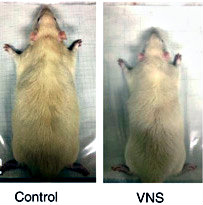
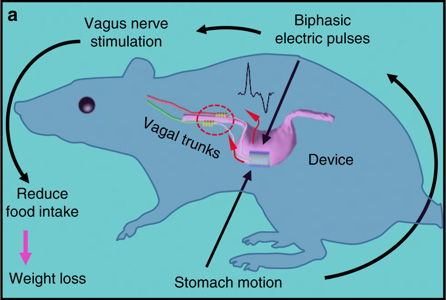
To address this crisis, Wang and colleagues developed a vagus nerve stimulator (VNS) that dramatically improves appetite suppression through electrical stimulation of the vagus nerve. The approach is promising and has not been practical until now because patients must carry bulky battery packs that require proper programming and frequent recharging.
The VNS consists of a small patch, about the size of a fingernail, that carries small devices called nanogenerators. Minimally invasive surgery was used to attach the VNS to the stomach of the rats. Movements of the rat’s stomach resulted in the delivery of gentle electrical pulses to the vagus nerve, which links the brain to the stomach. With VNS, when the stomach moved in response to food, the electrical signal told the brain that the stomach was full, even if only a small amount of food was consumed.
The device curbed the rat’s appetite and reduced body weight by a remarkable 40 percent. “The stimulation is a natural response to regulate food intake, so there are no unwanted side effects,” Wang explained. When the device was removed, the rats resumed their normal eating patterns and their weight returned to pre-treatment levels.
“Given the simplicity and effectiveness of the system, along with the fact that the effect is reversible and carries no side effects, we are now planning to conduct tests in larger animals with the hope of eventually moving to human trials,” Wang said.
Accelerate wound healing
In another NIBIB-funded study in an experimental rat model, the researchers used their nanogenerator technology to determine whether electrical stimulation would accelerate the healing of wounds on the skin surface.
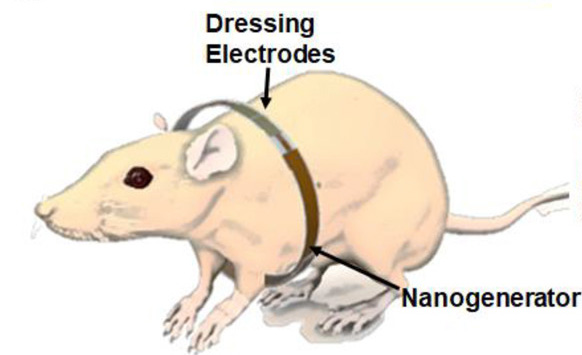
For this experiment, a band of nanogenerators was placed around the rat’s chest, where the expansion of breathing created a gentle electric field. Small electrodes in a bandage-like device were placed over skin wounds on the rat’s back, where they directed the electric field to cover the wound area.
The technique reduced healing times to just three days compared to nearly two weeks for the normal healing process.
As with appetite suppression, it was known that electricity could improve wound healing, but the devices that had been developed were large and impractical. The nanogenerator-powered bandage is completely non-invasive and produced a mild electrical field similar to the electrical activity detected in the normal wound healing process.
The researchers observed electrical activation of normal cellular healing processes that included the movement of healthy skin fibroblasts toward the wound, accompanied by the release of biochemical factors that promote the growth of fibroblasts and other cell types that expand to repair the wound space.
“The dramatic decrease in healing time was surprising,” Wang said, “We now plan to test the device on pigs because their skin is very similar to that of humans.”
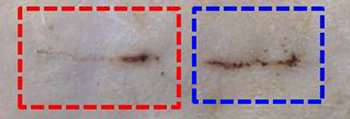
The team believes that the simplicity of the electric bandage will help bring the technology to human trials quickly. Furthermore, Wang explained that the device is very inexpensive to manufacture and that a product for human use would cost approximately the same as a normal bandage.
The experiments on appetite suppression were published in the December issue of Nature Communications.2. The wound healing studies were reported in the December issue of ACS Nano3. Both studies were supported by grant EB021336 from the National Institute of Biomedical Imaging and Bioengineering and grant CA014520 from the National Cancer Institute.
1. Health Issues of the World Health Organization. Obesity and Overweight. https://www.who.int/news-room/fact-sheets/detail/obesity-and-overweight
2. Effective weight control using an implanted self-powered vagus nerve stimulation device. Yao G, Kang L, Li J, Long Y, Wei H, Ferreira CA, Jeffery JJ, Lin Y, Cai W, Wang X. Nat Commun. 2018 9, 5349 December 17
3. Effective wound healing thanks to discrete alternative electric fields from portable nanogenerators. Long Y, Wei H, Li J, Yao G, Yu B, Ni D, Gibson AL, Lan X, Jiang Y, Cai W, Wang X. ACS Nano. 2018 12, 12533–12540 November 29.