Today we have a guest post from the CIA! In his archives, researching something completely different, I found the answer to a question I never thought to ask. I immediately knew that you would be interested too. It was originally published in cia.gov in 2019 and reprinted with permission.
I did my best to recreate the images, which are barely readable on the CIA site, and the titles are mine, not theirs (especially the corpse part).
Flying with sharks: a plan for every outcome
Picture this: It’s early 1961 and you’re a pilot for the CIA’s U2 aerial reconnaissance program. Its U2 unit, Detachment G, is responsible for flyby photography and intelligence gathering on targets of interest in Asia.
Detachment G, currently stationed in California, has just been called into action by the Eisenhower Administration, which remains cautious about the U2 program given the recent, and remarkably public, incident involving the downing of Francis Gary Powers’ U2 plane over the Soviet Union.
However, you and four other pilots have been tasked with a unique and daring mission: covertly capturing high-altitude regional imagery to confirm Laos’ claims of an imminent North Vietnamese invasion. Policymakers need the latest information, so they should plan frequent regional flyovers.
And do it all with the “cover” of altitude. Seventy thousand feet should be enough (for reference, that’s twice the altitude of a modern commercial airliner).
There’s a lot to think about, isn’t there?
Beyond the inherent risks of operating highly complex machinery 13 miles in the air, while traveling at speeds in excess of 500 mph, the U2 pilots faced great danger upon entering the cockpit.
The downing of Powers’ U2 aircraft in 1960 revealed that anti-aircraft weaponry could now reach heights that had been impossible just a few years earlier.
The pilots knew that their missions were critical and that failure was not an option. But they also knew that their high-flying missions had been publicly revealed and that adversaries would look to the sky in hopes of catching another U2 in the act.
Pilots trained to be the best, but prepared for the worst: what to do in case of mechanical failure or a successful anti-aircraft offensive.
Turns out the CIA had thought of everything, even…sharks.
There is something in the water
While unlikely, the threat of a shark attack was very real (and frightening) for the pilots of U2, and later A12, who flew high-risk surveillance routes that would take them through miles and miles of shark-infested waters.
In fact, it was quite real that the CIA felt especially motivated to defeat the threat.
After considering a number of options, and given the mixed results of a shark repellent developed by the CIA’s predecessor, the Office of Strategic Services (OSS), the CIA decided that a physical barrier might be the best option. In 1968, the Agency placed an order for 50 “shark screens.”
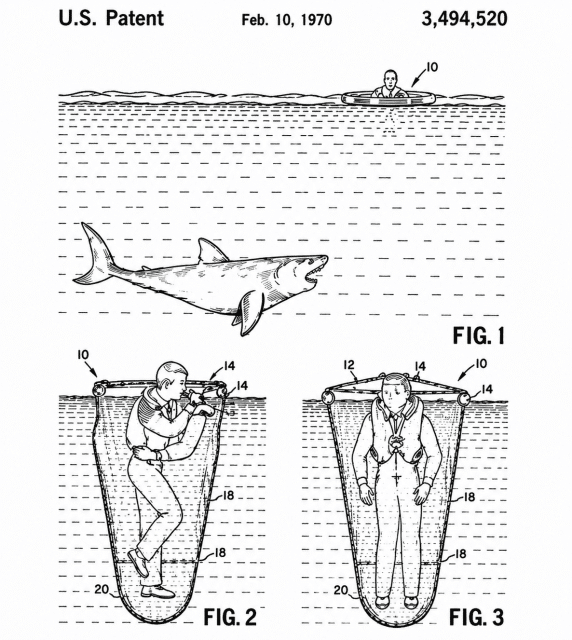
Created by Dr. Clarence Scott Johnson, project manager at the Naval Underwater Research and Development Center, in the spring of 1969, the Shark Screen was a small, expandable protective device that a pilot could carry and deploy in the event of a water landing.
When packaged, the screen was small enough to fit in a flight suit pocket or a box about the size of a cigarette pack.
In the unlikely event of a water landing, the pilot could remove the vacuum-packed Shark Screen, which would unfold into a large bag. From there, the pilot would inflate a large tube around the opening of the bag and then climb inside. Once inside, they could fill the bag with water, completely extending the bag and thus protecting themselves inside.
The inflatable tube at the opening of the bag would keep the Shark Screen afloat and provide its structure, and a standard life jacket would keep the pilot afloat inside the bag. Its head would float just above sea level, giving the pilot a low profile on the surface, further protecting him from potential enemy fighters.
Sharks, usually attracted to the dangling appendages, perhaps mistaking them for fish, would instead see a large, bulky object. Hopefully this would leave the shark uninterested, but if not, the shark screen meant there wouldn’t be an easily accessible point of attack.
The physical barrier created by Shark Screen also served another purpose: preventing blood from wounds sustained in the accident from spreading and attracting marine life.
paint it black
Initial prototypes of the Shark Screen were made of neoprene, but demands for weight reduction and packability pushed designers to opt for aluminized mylar and polyester, a durable fabric combination that was both lightweight and strong.
The design was modified in the early 1970s to change the color of the submerged section to a dull tone.
The dull hues, according to the researchers, “were approached much more reluctantly by sharks searching for bait than those with lighter, more reflective colors.”
In light of the new information, the CIA’s Office of Special Activities issued a service bulletin to officers with a simple instruction: Paint the underwater portion of your Shark Screen matte black. It could save your life.
The “Swiss Army Knife” of shark barriers
It turns out that the life-saving possibilities of the Shark Screen extended beyond its maritime intent.
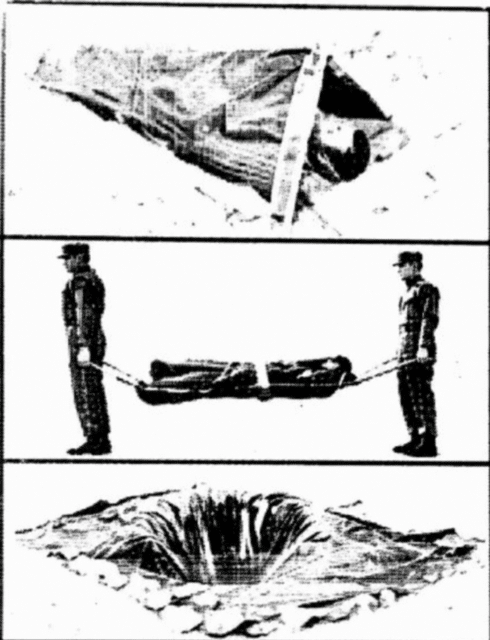
Researchers at the Naval Missile Center, while conducting initial tests of the prototype in 1969, discovered that the device also proved useful on land and issued guidelines for its potential use as a sleeping bag, tent, shed (temporary shelter), stretcher, and solar still.
This little pocket shark barrier seemed to have a big impact.
The verdict
So, let’s move on to the real question; did it work?
Fortunately, the pilots of U2 and A12 never reported using the Shark Screen in the line of duty, but according to researchers from the U.S. Department of the Navy, Cornell University, and the University of Hawaii, the Shark Screen “proved to be the most effective shark attack deterrent ever tested.”
They came to this conclusion after extensive testing with several dangerous shark species in the Pacific and Atlantic oceans.
The documents further prove that Shark Screen was the preferred method of defense against shark attack, even over the “Shark Chaser” repellent developed by OSS, which had been adopted for deployment by the US Navy.
Well, there you have it, the CIA’s solution to defeating the shark menace. Still not convinced? Don’t worry, the contract documents show that the CIA even assumed the guarantee, just in case.
Good luck, pilot!
Aviation history has a habit of producing wonderfully improbable true stories. Of all the things a U2 pilot expected to worry about, getting eaten by a shark after surviving everything else was probably pretty low on the list. Somewhere in a warehouse, there is probably still a Shark Screen with a lifetime of unused use.
But it might be comforting to know that if you ever find yourself ejected from a spy plane over shark-infested waters, someone thought about your situation half a century ago.