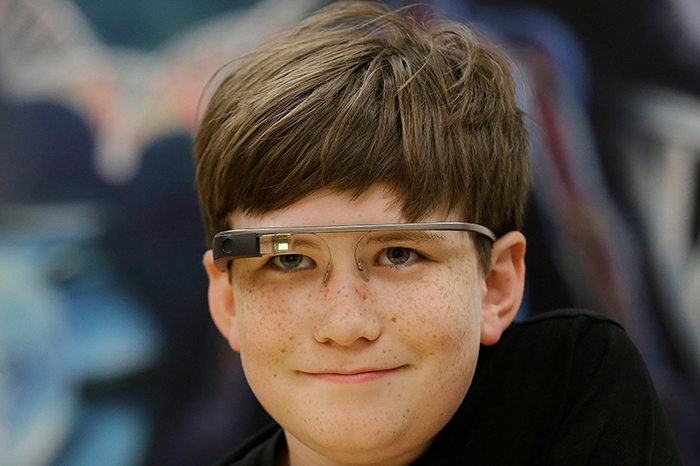
An NIH-funded team of researchers at Stanford University School of Medicine found that children with autism improved significantly on a test of socialization and learning when their therapy included an at-home intervention using Google Glass. Google Glass is a headset that is worn like glasses and provides augmented reality on a miniature screen, with sound. The smart glasses and mobile phone game system helped children with autism understand the emotions conveyed by facial expressions.
Autism is a complex neurological and developmental spectrum disorder that affects the way children interact with others, communicate, and learn. Many children affected by autism spectrum disorder (ASD) cannot discern facial expressions, so they miss important cues that aid in learning and socialization.
The Stanford team, led by Dennis P. Wall, Ph.D., associate professor of Pediatrics, Psychiatry and Biomedical Data Sciences, used Google Glass’ built-in camera along with software customized to run on a smartphone as an intervention that caregivers used with their children at home to complement clinical therapy. The study was published March 25, 2019 in JAMA Pediatrics.
“Technology can be a great asset to the therapy process, both for physical and neurodevelopmental benefits,” said Tiffani Lash, Ph.D., director of the NIBIB programs in Connected Health (mHealth and Telehealth) and Point-of-Care Technologies. “This is a moving achievement and a promising example using a bioengineering approach. The innovative software and hardware solution, along with the therapeutic component, meets a pressing need for many children and their parents.”
Google Glass is lensless, non-invasive, and peripheral: it sits on the right side of the child’s vision. “The system acts as a true augmentation of their reality, keeping them in their natural social world, rather than removing them from it,” Wall said. “Unlike virtual or mixed reality, augmented reality is potentially a powerful vehicle through which we can teach children social skills to rescue some of these deficits in the early stages of their development.”
A camera on the device captures the facial expression of family members in the glasses’ field of view, reinforcing what the child sees by providing an image and audio message. Detects up to eight emotions: happy, sad, angry, scared, surprised, disgusted, “meh” and neutral. The glasses are wirelessly connected to a smartphone device that can operate in three different game modes. There is the “find the smile” game, in which the child is asked to say something that causes an expression on the family member’s face; the ‘guess the emotion’ game, where the family member asks the child to guess the emotion from the family member’s face; and free play, an unstructured way of identifying facial expressions.
The device also records a video that parents can watch later to monitor the progress their child is making with activities. “Our hope was that playing the video would be a good source of reinforcement learning for children,” Wall said. “It gives the student an opportunity to focus on certain human emotions that they may or may not be understanding well, so that they can become more adept at detecting those emotions in real time.”
The researchers recruited 71 children between the ages of six and 12 who had been enrolled in an applied behavior analysis therapy program, the standard of care for most children with ASD. Experts recommend 20 hours a week of standard therapy, in which the child interacts with a therapist who leads learning activities to improve social, motor and verbal behaviors, as well as reasoning skills through observation and positive reinforcement. The authors cite the current cost of this standard therapy to be between $40,000 and $60,000 per year, and note that parents can often wait up to 18 months for their child to have access to the therapy.
Experts suggest that it is important for children with ASD to receive an early diagnosis (assessable as early as age two) so that they can begin treatment as soon as possible. According to the authors, learning aids like the type tested in the study could begin to address this difficult challenge of accessing therapy more immediately, outside of the clinic.
Of the 71 enrolled in the study, 40 children also received the augmented reality device to play programmed games or free play during 20-minute sessions four times a week. After six weeks, the team evaluated the 71 children on a standard socialization scale.
The researchers found that children who received the smart glasses intervention along with standard therapy scored significantly better on the post-study assessment than those in the control group. Children who used smart glasses improved 4.58 points on the standard scale above those who did not use the Google Glass intervention. Authors unrelated to the work of Wall and his colleagues recently published in Autism Research that changes of 2 to 3.75 points on the scale represent a clinically important difference.
“This is based on a statistically rigorous approach to data analysis,” Wall said. “We should be excited about the result. While the overall effect is modest, the positive change seen in treated children is significant and points to a new direction that could help more children get the care they need, when they need it.”
Wall noted that the device represents a short-term learning aid and predicts that a wider range of wearable augmented reality devices will be available in the not-too-distant future. “After a while, they take off their glasses and grow on their own in more complex social settings.”
Although it was a playful intervention, families in the treatment group missed a portion of the prescribed hours practicing with Google Glass, and most preferred structured games to the unstructured free play option. But the activity was received positively to the point that children who participated in the study created a new name for the tool, calling it Superpower Glass, a nickname the authors adopted when writing their report on the study. The researchers have begun planning a larger follow-up study.
For more information about autism spectrum disorder, visit: https://www.nimh.nih.gov/health/topics/autism-spectrum-disorders-asd/in…
The research was conducted with support from NIBIB (EB025025) and the Eunice Kennedy Shriver National Institute of Child Health and Human Development (HD091500), both at the NIH.
The study: Effect of Wearable Digital Intervention to Improve Socialization in Children with Autism Spectrum Disorder: Randomized Clinical Trial. Voss C, Schwartz J, Daniels J, Kline A, Haber N, Washington P, Tariq Q, Robinson TN, Desai M, Phillips JM, Feinstein C, Winograd T, Wall DP. JAMA Pediatrics. March 25, 2019