Injected neuron-like electronics stably and seamlessly integrate into mouse brain
Standard neural probes for recording brain function are eventually considered foreign and degraded by immune system attacks. Now, NIBIB-funded researchers have designed neuron-like probes that can be implanted and remain viable for long-term use to study and treat the brain. Potential applications include treatments for neurological disorders such as Parkinson’s and Alzheimer’s.
A primary goal of neurological research is to track and map the pattern of neural signals moving through the brain during normal functions and in pathological states. The neural probes currently used in animal studies and for some human procedures are relatively large and rigid. When these large, rigid devices are inserted into the brain’s delicate, winding neurons, they can cause damage to adjacent cells. An inflammatory response generates scar tissue around the probes, greatly reducing the ability to closely monitor these patterns of neuronal activity.
Now, biomaterials scientists at Harvard University, led by Charles Lieber, Ph.D., of the Center for Chemistry and Chemical Biology, the Center for Brain Sciences, and the John A. Paulson School of Engineering and Applied Sciences, have made neural probes that physically mimic neurons in the brain, evade the immune response, and continue to function for months. The work is described in the February issue of Nature Materials.1
“Designing high-resolution neural probes that remain viable in the brain has been a goal of researchers for decades,” explains Michael Wolfson, Ph.D., director of the NIBIB program for Therapeutic Medical Devices. “Dr. Lieber and his group are at the forefront of this effort. In this latest work, they have created neuronal probes that have the size, shape and flexibility of real neurons. These new probes seamlessly integrated and recorded the function of adjacent neurons in mice over relatively long periods of time without inducing the damage and disruption that has hampered this type of work in the past.”
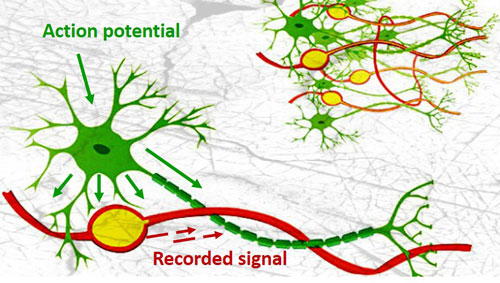
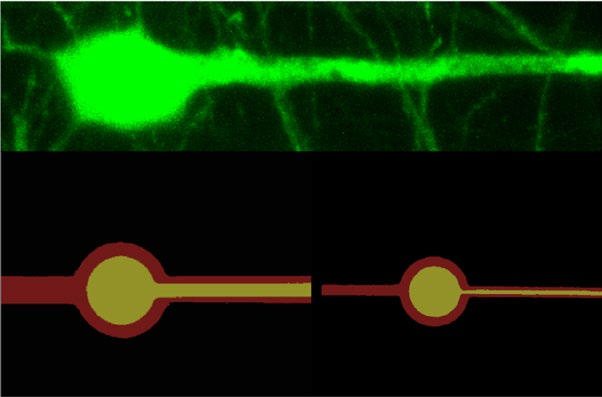
The team built their tiny neuron-mimicking probes using photolithography, the same technique used to make the tiny, complex circuits on computer chips. The technique allowed researchers to create neuron-like electronics (NeuE) with a metal center for conducting electricity surrounded by two insulating layers with a total width of a typical neuron, which is about 1/200th the width of a human hair.
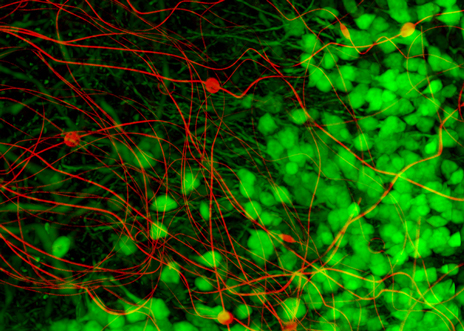
Sixteen strands of NeuE were pooled and injected into the hippocampus of mouse brains, which is involved in learning, memory, and aging. The threads unfurled and mixed discreetly with the brain’s neurons.
From one day after implanting the 16 NeuE e-neurons to 90 days later, when the experiment ended, the researchers were able to stably capture brain signals from each individual neuron without losing contact with a single one. This is in stark contrast to larger, more rigid neural probes, typically five to twenty times the size of neurons, which initially pick up clear signals from neurons until the immune system builds scar tissue around the probe, blinding researchers to brain activity.
In fact, each of the 16 NeuE electrodes not only picked up electrical signals from 2 to 3 different neurons on the first day, but also picked up additional signals over the first two weeks, suggesting that additional neurons are connecting to the electrodes. Additional studies revealed that the scaffolding created by the NeuE electronics network actually attracted newborn neurons that migrated and interacted with the NeuE electrodes.
Lieber says, “This was an advantage we did not expect and strongly suggests that NeuE networks could be implanted in areas where there are degenerative neurological diseases and act to attract new neurons to repopulate the damaged region.”
Lieber emphasizes that the stability of the system – the ability to integrate discretely into the brain and record brain function over long periods – is the key. The healthy fusion of NeuE with delicate neurons opens potential for long-term implantation and treatment in the brain. He also notes that the brain changes with learning and experience and that these long-term stable implants offer the opportunity to study this phenomenon as it progresses over time.
As for future directions, Lieber says, “Frankly, this is the most interesting research I’ve ever been involved in. Members of my lab, my collaborators, and I have a wealth of ideas for practical applications of this new ‘stealth’ technology. Ideas range from understanding brain development over time to targeting specific neurons involved in diseases such as addiction, depression, Parkinson’s, and Alzheimer’s to assessing disease progression, while accelerating recovery with electrical stimulation in the area.” damaged”.
This work is supported by the National Institute on Drug Abuse of the National Institutes of Health (1R21DA043985-01), an NIH Director’s Pioneer Award (1DP1EB025835-01) from the National Institute of Biomedical Imaging and Bioengineering, the Air Force Office of Scientific Research, the Simmons Awards, the American Heart Association Postdoctoral Fellowship, and a Camino Award to the Independence of the NIH.