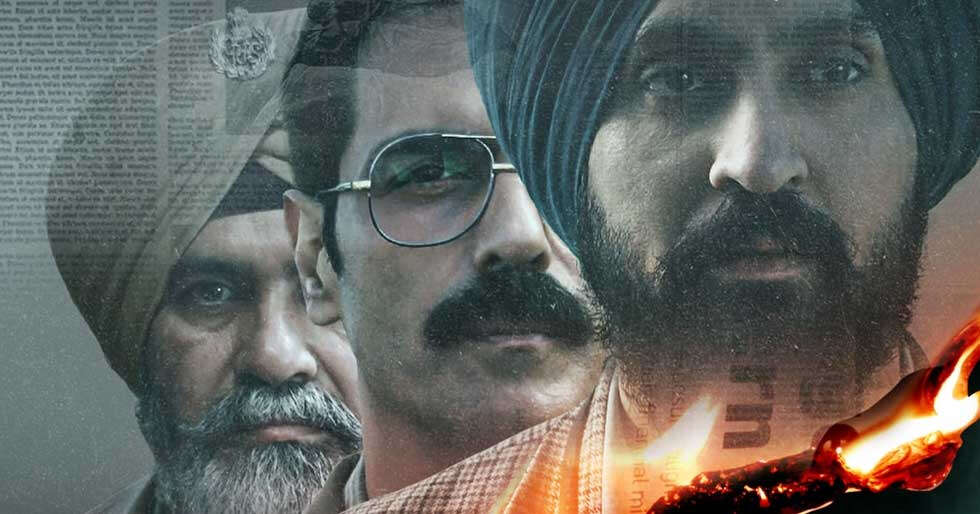
After spending almost three years stuck in certification limbo and undergoing multiple title changes before finally arriving on ZEE5, Satluj carries an importance that extends beyond cinema. The fact that it has finally reached the public is a victory in itself. More importantly, it’s a reminder that some stories are too important to stay buried.
Instead of presenting itself as a conventional biopic, Satluj unfolds as a slow-burn investigative thriller. Set during the turbulent years of militancy in Punjab in the early 1990s, it traces Jaswant Singh Khalra’s transformation from an ordinary citizen to a determined investigator after he discovers evidence suggesting that thousands of unidentified bodies were secretly cremated following alleged fake encounters and enforced disappearances. As he goes deeper, the dangers become more and more personal, but his determination never wavers.
Honey Trehan wisely avoids melodrama. There are no over-the-top speeches or feel-good moments designed to manipulate emotions. Instead, the film relies on calm observation and patient narration, allowing the horror of the events to emerge gradually. Moderation works in the film’s favor. The emotional impact comes not from the spectacle but from the chilling normality with which the injustice is carried out.
The narrative is framed by CBI Additional Director Samudra Singh, played with measured authority by Arjun Rampal, who arrives to investigate Jaswant’s disappearance. Even if one is familiar with the real-life case, the inevitable conclusion has considerable emotional force. Knowing the history does little to soften its impact. The film never allows the audience the comfort of emotional distance.
The themes running through Satluj remain painfully relevant. Explores human rights, state power, institutional accountability, enforced disappearances, and the enormous personal cost of standing up to abuses. However, it never becomes a sermon. Instead, it asks difficult questions and trusts viewers to come to their own conclusions. In an era where nuance often gives way to noise, that confidence is refreshing.
Diljit Dosanjh gives one of the best performances of his career. There is a notable restraint in his portrayal of Jaswant Singh Khalra. He doesn’t try to create a gigantic hero. Instead, he plays an ordinary man driven by an extraordinary sense of duty. His quiet determination says it all, making the character feel deeply human rather than symbolic. It is a performance built on small gestures, contained emotions and unwavering conviction.
The supporting cast is equally impressive. Arjun Rampal brings dignity and quiet authority to the investigating officer, while Suvinder Vicky and Kanwaljit Singh leave a lasting impression as police officers who come to represent the darker side of institutional excess. Neither of them resorts to theatrical villainy. Their controlled performances make the threat seem even more credible.
Geetika Vidya Ohlyan is excellent as Paramjit, Jaswant’s wife, and captures the fear, anxiety and resistance of someone forced to watch a loved one put principle before personal safety. Saurabh Sachdeva also shines as Satnam Singh, Jaswant’s childhood friend in the police force, whose quiet acts of bravery prove that humanity can survive even within deeply compromised systems.
One of the film’s greatest strengths is that it refuses to sensationalize the tragedy. Honey Trehan never exploits suffering for dramatic effect. Instead, treat the topic with sensitivity and respect, allowing the facts to carry their own weight. In many ways, the approach is reminiscent of films like Schindler’s List, not because the stories are identical, but because both seek to document painful chapters of history through the lives of ordinary people who demonstrated extraordinary moral courage.
At nearly two hours and forty-three minutes, Satluj is undeniably deliberate in its pacing. There are stretches where the narrative perhaps could have been tighter. However, the measured pace also reflects the painstaking nature of Khalra’s investigation and the emotional toll borne by those involved. This is not a thriller interested in quick thrills; It is invested in the truth.
Visually, the film maintains a low-key, understated aesthetic that perfectly complements its subject matter. There is no glamor associated with their world. The atmosphere remains tense, solid and authentic throughout, helping to immerse viewers in one of the darkest periods of Punjab’s recent history.
More than anything else, Satluj deserves recognition for his bravery. Bringing politically sensitive stories to the screen is never easy, and the protracted fight surrounding the film’s release only reinforces that reality. Honey Trehan and her team deserve immense credit for persisting with a project that many would have considered too difficult or too controversial. Their determination ensures that an important chapter in history continues to be remembered and debated.
Satluj is not conventional entertainment nor does it aspire to be. It is a film that educates, disturbs and moves in equal parts. Honor the memory of a man who chose truth over safety and conscience over silence. In a time when meaningful cinema often struggles to find space, films like this become even more valuable.
More filmmakers should have the courage to tell stories like Satluj. It may leave viewers emotionally drained, but it also leaves them with something much more lasting: the reminder that courage often belongs to ordinary people who simply refuse to stop asking difficult questions.
Also read: Everything we’ll see this week: Alpha, Elle and more