This article was taken from the NIH Director’s blog on June 6, 2019. The work was funded by NIBIB and NICHD.
For people whose spinal cord has been injured in traffic accidents, sports mishaps or other traumatic events, cell-based treatments have emerged as a potential avenue to promote healing. Now, taking advantage of advances in 3D printing technology, researchers have created custom implants that can increase the power of cell-based therapies to repair the injured spinal cord.
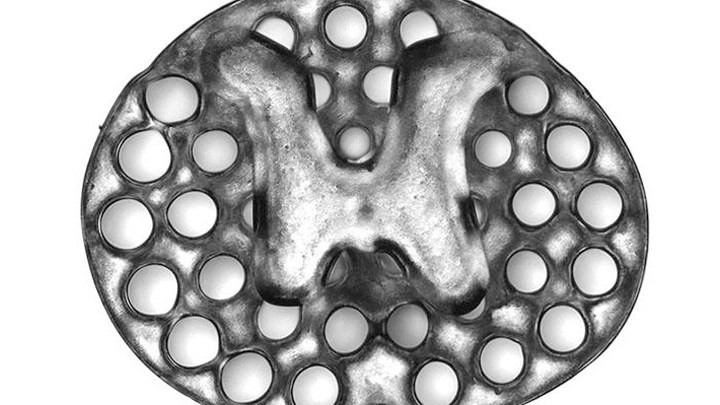
Credit: Jacob Koffler and Wei Zhu, University of California, San Diego
Made from soft hydrogels that mimic spinal cord tissue, the implant shown here measures just 2 millimeters wide and is about the thickness of a penny. It was specially designed to promote healing in rats with spinal cord injuries. The small open channels surrounding the solid “H”-shaped nucleus are designed to guide the growth of new neuronal extensions, keeping them properly aligned with the spinal cord.
When left alone, neuronal cells tend to grow randomly. But the 3D-printed implant is designed to act as a scaffold, keeping new cells directed toward the goal of repairing the injured part of the spinal cord.
For the new work, an NIH-funded research team, led by Jacob Koffler, Wei Zhu, Shaochen Chen, and Mark Tuszynski of the University of California, San Diego (UCSD), used an innovative 3D printing technology called microscale continuous projection printing. This technology is based on a computer projection system and precisely controlled mirrors, which direct light into a solution containing polymers and photosensitive cells to produce the final product. Using this approach, the researchers made finely detailed, rodent-sized implants in less than two seconds. That’s about 1000 times faster than a traditional 3D printer!
In a study recently published in Nature Medicine, researchers placed custom-made implants loaded with rat embryonic neural stem cells into the injured spinal cords of 11 rats. Other rats with similar lesions received empty implants or stem cells without the implant. Within five months, the rats with cell-laden implants had new neural cells bridging the injured area, along with spontaneous new growth of blood vessels to feed the new neural tissue. Most importantly, they had regained the use of their hind limbs. Animals that received empty implants or cell therapy without an implant showed no such recovery.
The new findings offer proof of principle that 3D printing technology can be used to create implants tailored to the precise shape and size of a lesion. In fact, researchers have already expanded the process to produce 4-centimeter-sized implants that match several different and complex spinal cord injuries in humans. These implants were printed in just 10 minutes.
The UCSD team continues to work on further improvements, including the addition of growth factors or other ingredients that may further encourage neuronal growth and functional recovery. If all goes well, the team hopes to begin human clinical trials of their cell-based treatments for spinal cord injuries within a few years. And that should give hope to the hundreds of thousands of people around the world who suffer serious spinal cord injuries each year.