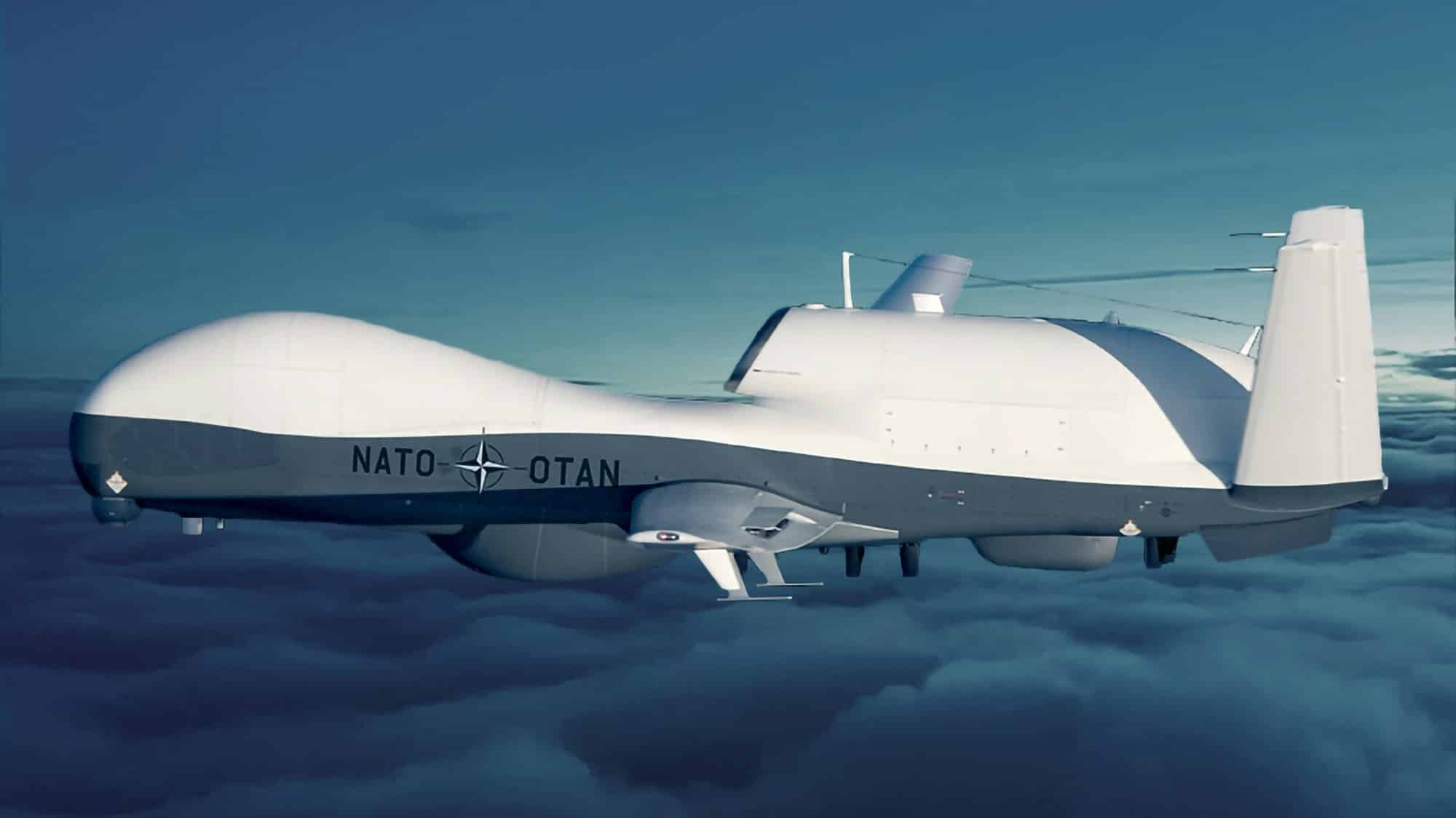
As part of the new acquisitions announced at the Ankara summit, NATO will purchase up to five MQ-4C Tritons to complement the RQ-4Ds of the AGS Fleet and reinforce maritime surveillance.
Following the selection of GlobalEye for the airborne early warning and control (AEW&C) role, NATO also says Denmark, Finland, Germany and Norway announced the acquisition of up to five MQ-4C Triton drones from Northrop Grumman. The announcement was made at the NATO Summit Defense Industry Forum in Ankara, Türkiye, on July 7, 2026.
The aircraft will reinforce NATO’s Intelligence, Surveillance and Reconnaissance (ISR) Force and complement the RQ-4Ds of the Alliance’s Ground Surveillance Fleet (AGS) operating from the Sigonella air base in Italy. NATO says the MQ-4C “will increase Allies’ ability to detect threats early, protect our maritime lines of communication and support operations in demanding regions, such as the Arctic and High North.”
🆕 NATO’s Intelligence, Surveillance and Reconnaissance Force has just been strengthened
The Alliance is adding up to 5⃣ Triton unmanned aircraft that will help detect threats early, protect maritime lines of communication and support operations in the Arctic.
🔗 https://t.co/jrSCfDfdXR#NATOSummit pic.twitter.com/VyJPJIbKHE
— NATO (@NATO) July 7, 2026
In particular, the acquisition will see deep participation from European industry, in what NATO has described as a “transatlantic industrial consortium.” In fact, while Northrop Grumman will build the Tritos, Airbus Defense and Space and other European companies will provide the ground segment, data management services, command and control, infrastructure and mission support. says the statement.
The Triton MQ-4C
The MQ-4C Triton is the U.S. Navy’s newest intelligence, surveillance and reconnaissance maritime patrol asset and augments the capabilities of the P-8 Poseidon maritime patrol aircraft. The aircraft is based on the US Air Force’s RQ-4B Global Hawk, while its sensors are based on components (or complete systems) already included in the Department of Defense inventory, according to NAVAIR’s description.
Also known as Wide Area Maritime Surveillance (BAMS), the MQ-4C platform complements the P-8A Poseidon within the Navy’s family of Maritime Patrol and Force Reconnaissance systems. Aircrew collect and process surveillance information using data fusion tools that integrate sensor data from multiple aircraft into a comprehensive networked image to further help create an accurate representation of threats.
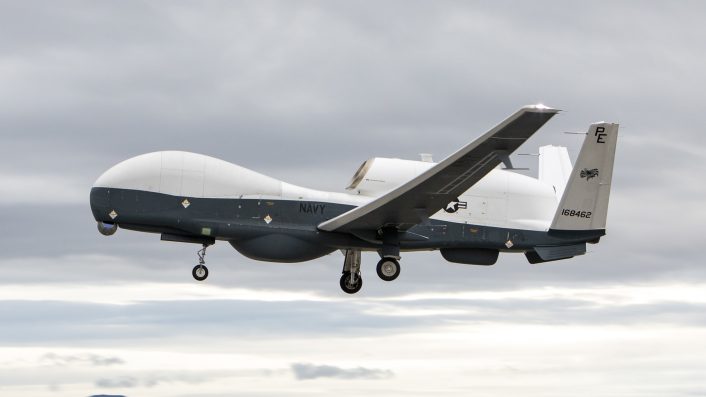
After gathering lessons learned from Triton’s initial deployment to Guam in 2020, the MQ-4C received significant upgrades, including an improved sensor suite. These upgrades increase Triton’s ability to provide a persistent maritime intelligence, surveillance, reconnaissance and targeting (MISR-T) capability.
The MQ-4C is believed to be some sort of Block 20 and Block 30 Global Hawk hybrid, carrying a Navy payload that includes an AN/ZPY-3 multi-function active sensor (MFAS) radar system. This gives Triton the ability to cover more than 2.7 million square miles in a single mission that can last up to 24 hours at a time, at altitudes above 50,000 feet, with an operational range of 8,200 nautical miles.
Expanded strategic airlift
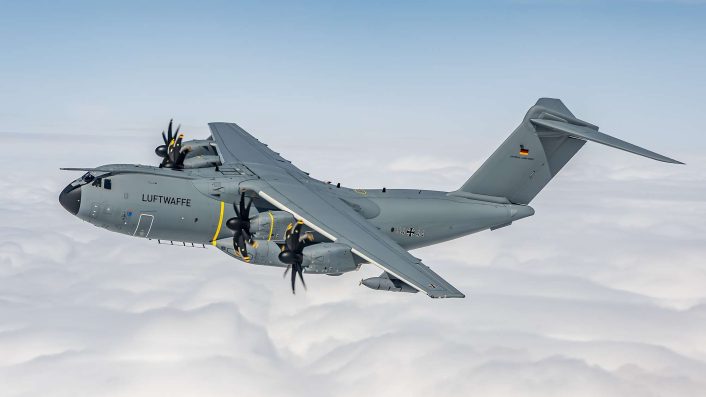
As part of the new programs and acquisitions announced during the summit, a new Multinational High Visibility Project will involve a fleet of Airbus A400M transport aircraft. The program was launched by Belgium, Croatia, France, Poland, Spain, Turkey and the United Kingdom.
To the #NATOSummit in Ankara, Türkiye 🇹🇷, @NATO paves the way towards a multinational #A400M Fleet with European governments designed to address strategic airlift capability gaps among European allies.
The goal is to establish a ‘group and share’ strategy similar to… pic.twitter.com/Q8loR4H1Wd— Airbus Defense (@AirbusDefence) July 7, 2026
The NATO statement says the new program will follow the same “pool and share” concept of the A330 MRTT-based Multinational Multi-Role Tank Transport (MRTT) Fleet (MMF). In this way, participating countries will pool aircraft and share costs, benefiting from economies of scale.
He statement It further says that the “Airbus A400M provides NATO and allied forces with much greater operational flexibility and enables the movement of military assets across the Alliance in times of peace, conflict and crisis.” These aircraft will complement NATO’s three Strategic Airlift Capability (SAC) C-17 Globemaster II aircraft based at Pápa Air Base in Hungary.
Additionally, NATO said Finland joined the MMF program, which now has nine members, along with Belgium, Czechia, Denmark, Germany, Luxembourg, the Netherlands, Norway and Sweden. The statement also mentions the imminent delivery of the 10th Airbus A330 MRTT, bringing the fleet closer to its total capacity of 12 aircraft.
Counterdrone capabilities
Another major program announced at the summit is the investment of more than $40 billion in anti-drone capabilities over the next five years. NATO says it will establish “a counter-drone market that will ensure systems are NATO tested, NATO compatible and available for purchase.”
Furthermore, the Alliance aims to form five times more drone operators by the end of 2027. This will be done by taking advantage of NATO’s multinational Flight Training Europe (NFTE) initiative, the statement said.
The initiative was created in 2020 to facilitate aircrew training, with full operational capability to be reached in 2024 and a total of 16 locations across eight countries participating. These include the International Flight Training School (IFTS) in Italy and the Pardubice Flight Training Center in the Czech Republic, which were the first two selected.

The initiative will now be expanded to cover the training of drone operators. Additionally, Finland, France and Sweden announced during the summit that they would join the other seventeen members of the NFTE.
High-end space capabilities
Multinational initiatives and partnerships to develop new NATO space capabilities have also been announced. Among them is a new multinational initiative called HALO (Hybrid Alliance Layered Operations in Space), launched by eight allies.
“HALO will focus on improving connectivity and integration of sovereign, nationally owned and controlled military satellites into a networked mega constellation,” NATO says. The initiative “aims to enhance the Alliance’s resilience and military advantage in space” by enabling high-speed communications, intelligence and missile tracking, while overcoming the cost, time and coverage limitations of single-nation satellite constellations.
NATO’s multinational STARLIFT initiative was expanded with the entry of Canada as the fifteenth member. The goal is to explore “ways to develop a network of launch capabilities that help allies launch assets on short notice from spaceports across the Alliance,” allowing them to “react more quickly to threats from space.”
STARLIFT was launched in 2024, with information on a possible accession proposal also sent to Japan, South Korea, Australia and New Zealand. Meanwhile, German company Isar Aerospace has signed a contract with Canada’s Maritime Launch Services to ensure access to launch infrastructure and services at the Nova Scotia spaceport and improve its preparation for orbital launch.
In addition, Spain became the nineteenth country to join NATO’s Alliance for Persistent Surveillance from Space (APSS). The initiative, launched in 2022, has been defined as “the largest multinational investment in space capabilities in NATO history.”
By December 2025, the APSS reached initial operational capability, allowing commanders to access timely and relevant information for decision-making. Spain will contribute by increasing coastal surveillance through images from its “Atlantic Constellation” satellites.