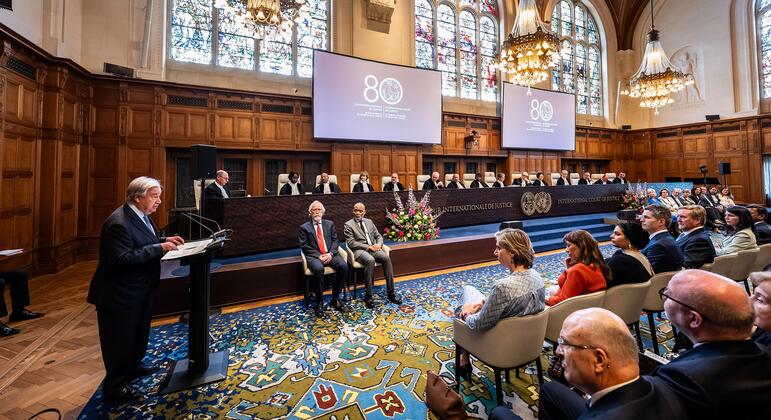
He ICJ – the highest court of the UN: resolves disputes brought by States and provides advisory opinions on legal issues referred by UN bodies and agencies. Known as “the world court,” it is located in the Peace Palace in The Hague.
Speech From the Dutch city, the Secretary General reflected on the creation of the court after the Second World War.
Cornerstone for peace
In the midst of this “dark and difficult time,” world leaders chose to “reject a future governed by coercion and violence” for one based on UN Charter and international law.
“They built a Court”based on a fundamental conviction: the force of law must always prevail over the law of force“, said.
“In doing so, they did more than create the principal judicial body of the United Nations. laid the cornerstone of a more peaceful world.”
Learn more about the ICJ in our explainer.
Trust and respect
Over the past eight decades, the judgments and advisory opinions of the ICJ have shaped the modern world and the growing number of cases before the Court today are “a clear sign of confidence in your authority and independence”said the Secretary-General, while efforts to modernize its working methods and increase gender representation on the court were signs of progress.
“The Court remains a guarantor that sovereignty and equality are not mere words on paper. It is also a reminder that not even overwhelming force can – and should not – replace legal obligation,” he continued.
He stressed that the Court’s decisions, including provisional measures, are binding and respecting them is not optional but an obligation under the UN Charter.
Erosion of international law
The Secretary-General warned, however, that this rules-based system is under pressure.
“Violations of international law are unfolding before our eyes. Military operations trample the basic rules that govern conflicts. “Humanitarian obligations are ignored,” he said.
Furthermore, the norms of international law protecting the United Nations are violated, while the ICJ and other justice institutions are increasingly questioned and challenged.
“This erosion is not happening at the margins of the international system. It is happening at its core, including States entrusted with unique responsibilities for the maintenance of international peace and security,” he said, warning of the consequences.
“When the law of force replaces the force of law, instability becomes contagious.
“Conflicts transcend borders and economic crises have repercussions throughout the world.
“And the most vulnerable always suffer first and suffer the most.”
Make the right decision
The Secretary-General said that the international community today faces “our own moment of crisis” as it chooses between a future governed by the rule of law or pure power, and insisted that the choice is clear.
“It is precisely because the international system is under such pressure that adherence to international law is more important than ever, especially in this era of changing power relations,” he said.
Guterres urged countries to strengthen international law, recommit to the peaceful resolution of disputes, respect the rulings of the ICJ, comply with its advisory opinions and uphold the United Nations Charter.
“In this time of crisis, that is the only right option,” he said. “Let us have the courage to achieve it.”