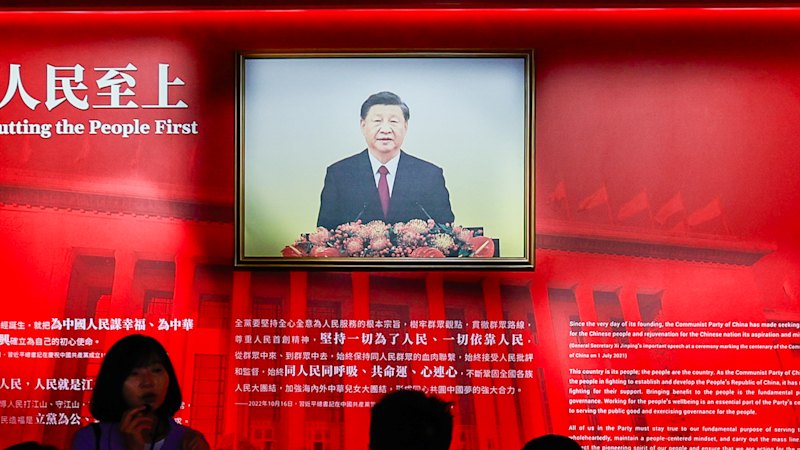
Hong Kong: Australia’s foreign interference laws once angered China. They are now enshrined in Hong Kong’s main history museum, where they are used to help justify Beijing’s national security crackdown, which led to the imprisonment of dozens of democracy activists and the persecution of others abroad.
Among those being hunted are Australian activists Ted Hui and Kevin Yam, whose names appear in a museum exhibit showing a wall of “fugitives” with police rewards of HK$1 million ($182,000) on their heads.
The reward list was installed as a permanent display in recent months and carries the warning that the Hong Kong government will pursue them “for life” for violations of national security.
“It’s ridiculous because the world knows that I am a political refugee persecuted for my peaceful defense of freedom and democracy in Hong Kong,” says Hui, a former Hong Kong politician who was granted asylum by the Australian government last year.
“Yet the regime has now placed me in a museum exhibit, as if I were somehow the threat. It feels less like history and more like an attempt to fabricate an alternative reality for the people of Hong Kong.”
The “fugitives” wall, which contains the names of more than two dozen activists who have fled abroad, is part of a larger national security exhibition that opens as a permanent gallery at the Hong Kong History Museum in 2024.
It is dedicated to telling the official narrative of the government’s crackdown after mass protests shook the city in 2019 and sometimes erupted into violent clashes with police.
It frames the protests not as a pro-democracy uprising in which millions of Hong Kongers took to the streets to resist Beijing’s growing control over the city, but as a destructive “color revolution” fueled by anti-China Western forces.
This week marks six years since Beijing imposed the National Security Law on the city in July 2020, creating new crimes of secession, subversion, terrorism and collusion with foreign forces. Since then, hundreds of people have been arrested under that law, as well as a related local law passed in 2024, and many of them have served long prison sentences related to their activism.
Last week, two owners of the Hunter Bookstore in the city’s Sham Shui Po neighborhood became the latest high-profile arrests. They were arrested, and later released on bail, for allegedly displaying and selling publications with “seditious” content and receiving funds from foreign political organizations.
The museum gallery celebrates successful prosecutions in high-profile cases to date as a triumph of the rule of law and the courts in bringing “destabilizing anti-China elements” to justice, while framing this crackdown as consistent with legal practices in Australia and elsewhere.
One exhibit highlights the “Hong Kong 47” case, in which Gordon Ng, a dual Australian citizen, was jailed for seven years and three months for subversion for participating in an unofficial primary election. Also featured is the case of media mogul and dual British citizen Jimmy Lai, who was jailed for 20 years in February for “collusion with foreign forces” and publishing “seditious” materials in his stridently anti-communist newspaper, now closed. daily apple.
His imprisonment has been condemned by the Australian government, other Western countries and human rights bodies as an attack on the freedoms Hong Kongers once enjoyed.
A nearby corner of the exhibition is dedicated to rejecting this criticism.
It cites Australia’s foreign influence and interference laws – and those of places such as the United States, Britain and Canada – to support its claim that Hong Kong’s legal framework is “consistent with the practices of countries around the world.”
“The criticisms made by some countries,” the exhibition states, “are baseless, double-standard and baseless political smears.”
These are the same foreign interference laws that angered China after they were passed by the Australian parliament in 2018. When diplomatic relations plummeted in 2020, Chinese officials highlighted the laws as one of 14 grievances Beijing had with Australia. At the time, a Chinese diplomat told a journalist that if Australia were to withdraw from the policies on the list, it would “lead to a better atmosphere.”
Yam, an Australian citizen who worked as a lawyer in Hong Kong for 20 years before leaving permanently in 2022, said it was misleading to equate the city’s national security laws with those of Australia.
“The content of the laws is not the same, the procedural guarantees are not the same, the systemic guarantees are not the same,” Yam said.
“Australia has no designated national security judges, no deprivation of jury trial, no presumption against bail in national security cases, and no barriers to judicial review or constitutional challenges to national security laws and decisions.”
Foreign Minister Penny Wong had no comment, but the Department of Foreign Affairs said in a statement that Australia would continue to object to the broad, extraterritorial reach of Hong Kong’s national security laws and the targeting of democracy advocates in Australia.
Hui and Yam’s rewards were awarded in 2023 and their faces appear on wanted posters posted on bulletin boards throughout Hong Kong. They have been the subject of anonymous poster campaigns circulating in their home cities of Adelaide and Melbourne.
The museum’s rewards board also includes University of Technology Sydney academic Feng Chongyi, an Australian citizen, who last year received an arrest warrant and a HK$200,000 ($36,000) reward from Hong Kong authorities for his defense of democracy.
A Hong Kong government spokesperson said the list was first displayed in 2025 as part of a temporary museum exhibit before being updated and relocated to its current position this year to convey its “relentless search for fugitives.”
“No person or country should harbor these fugitives or provide them with any assistance to evade their criminal responsibilities,” he said in a statement.
Despite its emphasis on the rule of law, the gallery makes no mention of the mass exodus of senior Western judges from Hong Kong’s Court of Final Appeal in recent years. Some have cited national security measures and the worsening political environment for their departure, while others have continued to express confidence in the independence of the judiciary.
Three Australians are among six foreign judges who continue to serve on the court on a rotating basis: former High Court judges Patrick Keane and William Gummow, and former Federal Court chief justice James Allsop. Foreign judges do not hear national security cases, but they have faced heavy criticism from democracy advocates for legitimizing a failed legal system.
The Australian judges declined or did not respond to a request for comment.
After Ng’s sentencing in 2024, Wong urged the judges to reconsider their positions on the court.
Get the story straight from our foreign correspondents on what’s making headlines around the world. Subscribe to our weekly What in the World newsletter.
 Lisa Visentin is the North Asia correspondent for The Sydney Morning Herald and The Age based in Beijing. He was previously a federal political correspondent based in Canberra.Connect via unknown either email.