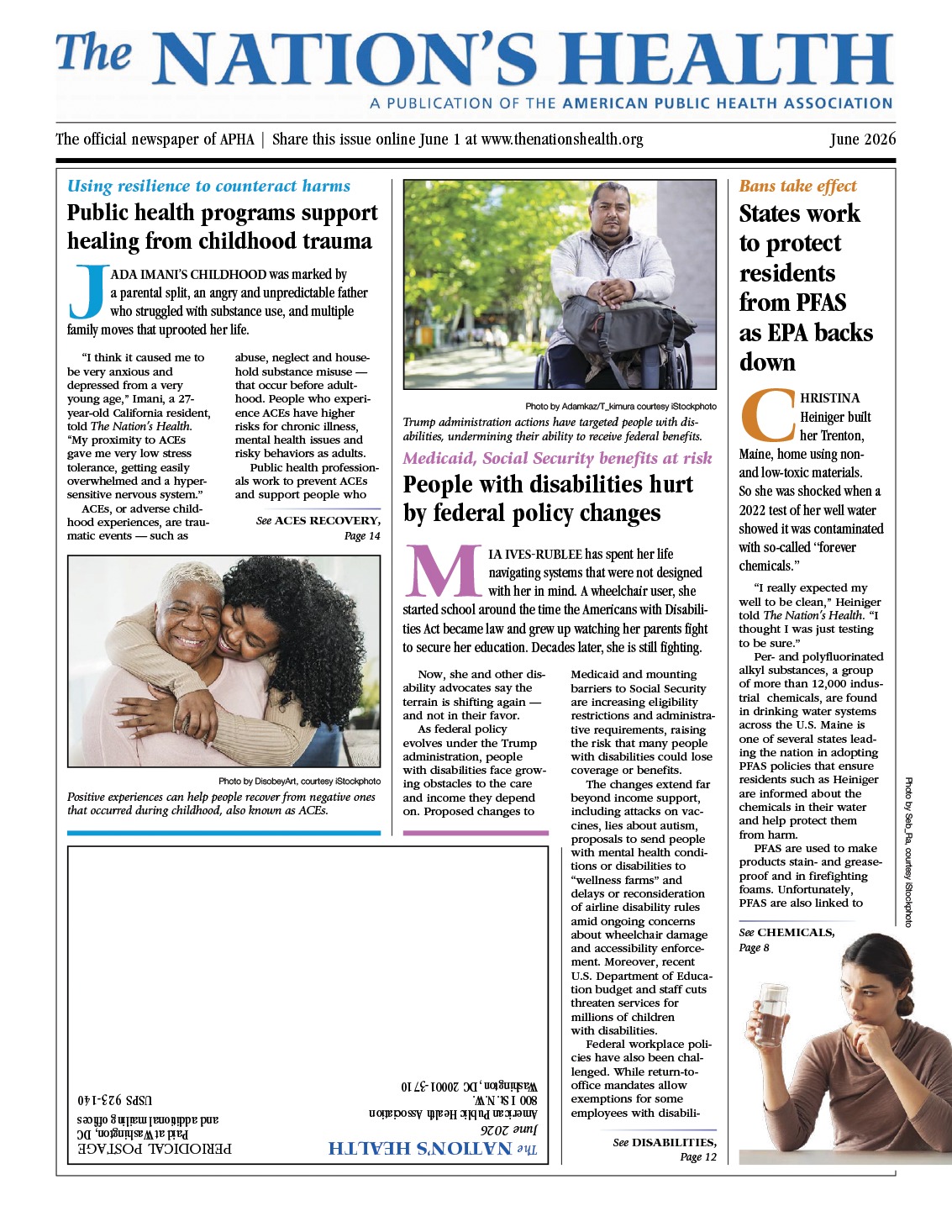

The Trump administration’s actions have targeted people with disabilities, undermining their ability to receive federal benefits.
Photo by Adamkaz/T_kimura courtesy of iStockphoto
Mia Ives-Rublee has spent her life navigating systems that weren’t designed with her in mind. A wheelchair user, she began going to school when the Americans with Disabilities Act became law and grew up watching her parents fight to secure her education. Decades later, she is still fighting.
Now, she and other disability advocates say the terrain is shifting again, and not in their favor.
As federal policy evolves under the Trump administration, people with disabilities face increasing barriers to the care and income they depend on. Proposed changes to Medicaid and increasing barriers to Social Security are increasing eligibility restrictions and administrative requirements, increasing the risk that many people with disabilities will lose coverage or benefits.
The changes extend far beyond income support, including attacks on vaccines, lies about autism, proposals to send people with mental health problems or disabilities to “welfare farms,” and delays or reconsideration of airline disability rules amid ongoing concerns about the harms of wheelchairs and enforcement of accessibility regulations. Additionally, recent budget and staffing cuts at the U.S. Department of Education threaten services for millions of children with disabilities.
Federal workplace policies have also been questioned. While return-to-office mandates allow exemptions for some employees with disabilities, reports suggest accommodations are often not being met, requiring some to return in person.
The actions have unfolded as the nation is led by a president who continues to publicly mock and belittle people with disabilities, further raising concerns among advocates about the direction of federal policy and social attitudes.
Medicaid, the nation’s largest source of health coverage for people with disabilities, is at the center of those concerns. New federal requirements are expected to reshape eligibility rules in the coming years. Starting in 2027, many Medicaid users will have to report about 80 hours of work, or similar activities, per month to maintain coverage.

Administrative changes and staff cuts have made it more difficult for people to apply for disability benefits designed to help them.
Photo by DragonImages, courtesy of iStockphoto
Although people with disabilities are generally expected to qualify for exemptions, experts warn that the reality is more complicated due to bureaucracy, paperwork, inconsistent state definitions and administrative hurdles. All of that could result in eligible people losing coverage, not because they don’t qualify, but because they can’t navigate the system.
Disability leaders say tying benefits to work requirements reflects a broader shift in how people with disabilities are viewed in society.
“We’re seeing the resurgence of an ableist mentality: that your value is tied to what you can produce,” said Ives-Rublee, MSW, senior director of the Center for American Progress’s Disability Justice Initiative. “When you add more administrative hurdles or tie coverage to work requirements, you’re not promoting independence — you’re putting people at risk of losing the care that makes independence possible.”
Medicaid plays a critical role in supporting independence. It is the primary payer for long-term services and supports, including home care that allows people with disabilities to live outside of institutions. But a long-standing gap complicates the program’s operation. About a third of Medicaid enrollees report having a disability, but far fewer qualify under the program’s strict definition tied to Supplemental Security Income. That gap could become more significant depending on job requirements.
Many people with disabilities qualify for Medicaid through income-based pathways rather than disability determinations. As rules tighten, some may be required to prove they meet federal disability criteria to maintain coverage.
“As far as I know, there is no specific mechanism for this test to occur,” said Jean P. Hall, PhD, MS, research professor emeritus at the University of Kansas. The health of the nation. “In addition, eligibility redeterminations every six months could be difficult, especially if they work in nontraditional or seasonal occupations, or if they have an episodic disability.”
Loss of coverage will lead to adverse health outcomes and higher long-term costs for health systems and federal programs, he said, and people who lose home and community-based services may be forced to turn to institutional care, which costs Medicaid about five times more than community care.
Medicaid is often the only source of essential services for families, health advocates warn.
“There is no corresponding set of services in the private market that provides home and community services to someone,” said Katy Neas, CEO of The Arc of the United States. “When those programs are cut, there is no safety net for the safety net.”
In light of recent Medicaid cuts, the responsibility for determining how the reductions will be implemented has shifted to individual states. To address the challenge, The Arc is collaborating with chapters across the country to support efforts to inform state legislators and governors about the implications of the cuts.

Photo by AnnaStills, courtesy of iStockphoto
“Our work is focused on ensuring that key stakeholders fully understand the impact these reductions will have on the communities they serve,” Neas said. The Health of the Nation.
A federal spending bill enacted in July 2025 also substantially reduces federal matching funds for states that expanded Medicaid coverage under the Affordable Care Act, said APHA Disability Section Chair Katherine Froehlich-Grobe, PhD. Medicaid covers both medical services and long-term services and supports for children, low-income parents, and older adults and adults with disabilities.
As a result, states that expanded Medicaid eligibility now face difficult decisions as large deficits force lawmakers to decide where to cut services. In Colorado, where Froehlich-Grobe lives, cuts to Medicaid have already created a projected $1.5 billion budget gap tied to changes in federal Medicaid funding, she said.
“As states weigh cuts, the outcome will determine whether people with disabilities can continue to live independently or face reduced supports and fewer care options,” Froehlich-Grobe said. The Health of the Nation.
The challenge is not unique to Colorado; 41 states have expanded Medicaid and currently face similar funding concerns. To balance their budgets, states will have to reduce spending on Medicaid, Froehlich-Grobe said. Strategies being considered in Colorado include adjusting eligibility criteria, reducing reimbursement rates for Medicaid providers, limiting dental and vision benefits and reducing hours paid for home care services that help older adults and people with disabilities perform self-care tasks such as toileting, bathing, dressing and eating.
For families, that gap can mean not receiving care or shouldering the burden themselves, a reality that underscores how policy decisions made in Washington are increasingly being reflected in homes across the country.
“Current policy priorities seem to focus on the needs of the healthy and wealthy, and often neglect those who are truly underserved,” Froehlich-Grobe said.
Medicaid is only part of the picture. At the same time, the Social Security Administration (another critical lifeline for people with disabilities) has undergone significant changes. Since 2025, the agency has implemented significant staff reductions and consolidated many regional offices. Those actions have reduced access to in-person services and increased reliance on online systems, making an already complex system even more difficult to navigate.
A recent report from researchers at Binghamton University and others found that administrative changes, staff cuts and innovative technologies have created additional barriers for people applying for or maintaining disability benefits.
Based on interviews with benefits specialists across the country, the report found consistent patterns across regions, with specialists reporting longer wait times, difficulties communicating with agency staff, and increasing challenges resolving errors.
“We found that access to Social Security benefits in 2025 will have gotten much worse,” said study lead author Katie Savin, PhD, MSW, assistant professor of social work at California State University, Sacramento.
Some respondents described the system as a “black hole” where applicants and advocates struggled to get answers or assistance, Savin said, noting that the consequences can be serious. Administrative delays and obstacles can leave people without income or support during critical times, including periods of serious illness or housing instability.
“We cannot run the Social Security Administration without staff,” he said. “There are always people who die as a result of waiting for Social Security benefits.”
The shift toward online systems and automation has also created new challenges. As the agency emphasizes digital tools and artificial intelligence to assist applicants, people with disabilities may face additional barriers, particularly those with cognitive, psychiatric or communication disabilities.
The effects of changes to Social Security may also affect Medicaid, Savin said. In many states, Social Security disability status is used to determine eligibility for Medicaid waivers. If people lose benefits, are unfairly denied, or remain stuck in lengthy appeals processes, they may also have difficulty maintaining health coverage.
“It could be much more difficult for them to prove that they are disabled and keep their Medicaid,” Savin said.
For more information, visit www.americanprogress.org/disability-justice-initiative and https://thearc.org.
- Copyright The Nation’s Health, American Public Health Association