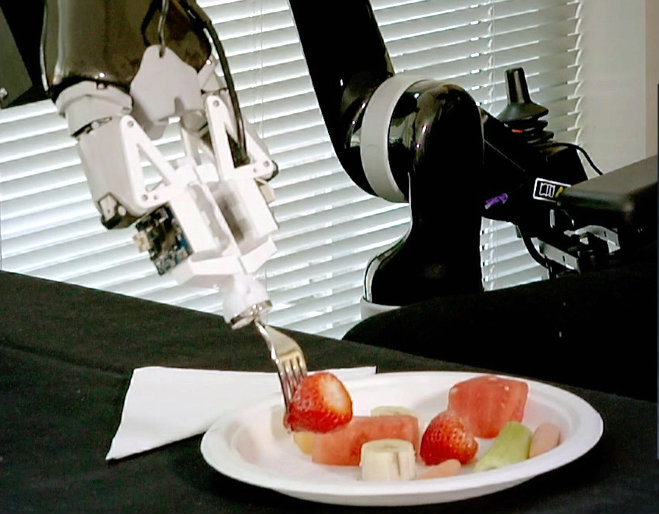
Robotic system offers independence to people who need help eating
About one million Americans with age-related injuries or disabilities need someone to help them eat. Now, NIBIB-funded engineers have taught a robot the strategies needed to pick up food with a fork and cautiously bring it to a person’s mouth.
Siddhartha Srinivasa, Ph.D., professor at the University of Washington School of Computer Science and Engineering, is known as a passionate roboticist who builds complete robotic systems that integrate perception, planning, and control to perform practical functions in the real world. Currently, Srinivasa and his team have dedicated themselves to helping the million people in the United States alone who need someone to help them eat.
Their development of a robot called ADA, which refers to its dexterous assistive arm, is reported in the April issue of IEEE Robotics and Automation Letters.1
Says Grace Peng, Ph.D., NIBIB program director in Modeling, Simulation and Mathematical Analysis: “We have supported the excellent work of this group in developing systems for wheelchair control based on understanding user intent. This current paper provides an excellent picture of the parameters that need to be considered from an engineering point of view to develop a feeding robot.”
Early in the design of ADA, engineers realized they had to start from scratch. In this case, ground zero was skewering pieces of food on a fork. They started by observing, measuring and cataloging how people do it. Not entirely surprising to trained engineers, different skewering strategies were employed depending on the size, shape, stiffness, flexibility, and other physical properties of the foods, which included strawberries, banana pieces, melon cubes, celery strips, and baby carrots.
The team used data collected on the strategies people use to eat different foods to program ADA to accurately identify each item on a plate and then perform the optimal movements that result in successfully threading each item and bringing it to the recipient’s mouth. For example, unlike a strawberry, which is sturdier, the softness of a piece of banana required skewering it at an angle to prevent the piece from simply sliding off the fork.
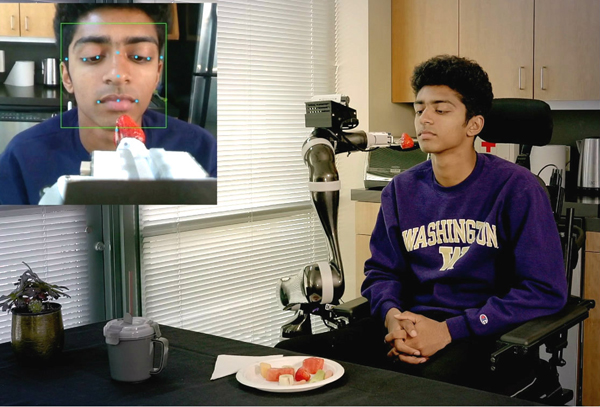
The celery strips required a specific approach to both skewer and get the food into your mouth correctly. The robot was taught to stick the fork into one end of the strip and then lift and rotate the piece so that the opposite end of the celery, free of the sharp points of the fork, was presented cleanly to the recipient.
The group’s work aims to help people who cannot perform essential tasks live more independently. Srinivasa says, “We believe our technologies can help those who depend on a caregiver to feed them every day regain some independence and control over their lives.”
In addition to that important goal, Srinivasa notes that ADA can also be of help to often overburdened caregivers, who, in this case, might set up the food and the robot and then attend to other tasks or focus on socializing with clients. “In this way, we believe the ADA is beneficial to caregivers and their clients and will ultimately improve the experience of everyone involved, especially as the country’s population ages and the need to optimize strategies for their care increases.”
Prior to the publication of the research team’s results in April, the development of ADA won the award for best demonstration at the Neural Information Processing Systems Meeting in December 2018, and the award for best technical paper at the joint international conference on human-robot interaction of the Association for Computing Machinery and the Institute of Electrical and Electronics Engineers in March 2019.2
The work was supported by Grant No. R01EB019335 from the National Institute of Biomedical Imaging and Bioengineering NIBIB, the National Science Foundation, the Office of Naval Research, Amazon, and Honda.
1. Towards robotic feeding: role of haptics in manipulating food with a fork. Tapomayukh Bhattacharjee, Gilwoo Lee, Hanjun Song, and Siddhartha S. Srinivasa. IEEE Robotics and Automation Letters. vol. 4, No. 2, April 2019.
2. Transfer depends on acquisition: analysis of handling strategies for robotic feeding. D. Gallenberger, T. Bhattacharjee, Y. Kim and S. S. Srinivasa. ACM/IEEE International Conference on Human-Robot Interaction. 2019.