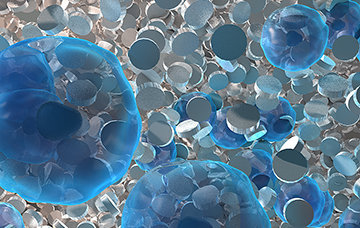
NIBIB-funded researchers have designed a new class of two-dimensional (2D) nanomaterials that have a disc shape and a flat surface, similar to a coin, to aid in cartilage repair treatments. The surface of the nanomaterial is negatively charged, while the edges are positively charged. This unique charge arrangement allows nanomaterials to trap proteins or growth factors, which can be slowly released over time. The experiments were performed in a laboratory dish, but the results showed potential for clinical application in repairing damaged cartilage.
Healthcare advances are allowing people to live longer, leading to an increased rate of osteoarthritis in the aging population. The CDC reports that 30 million American adults suffer from osteoarthritis, a degenerative disease in which the cartilage in a joint begins to deteriorate due to normal daily activity. Cartilage tissue has no natural mechanism to repair or rebuild itself, so pain, stiffness, and swelling can occur over time, reducing function and mobility. “Tissue engineering is complex and researchers are taking a variety of approaches to solve health problems such as cartilage repair. It is difficult to identify which approach will work best in the end, so it is vital that researchers continue to build and expand the field,” said Seila Selimovic, Ph.D., director of the NIBIB program in Tissue Engineering.
Current clinical treatments consist of painful surgeries, including joint replacement for severe cases, or various types of physical therapy combined with anti-inflammatory medications for more moderate cases. A promising, less invasive treatment in which key proteins and growth factors are delivered directly to injury sites has shown improvement in cartilage repair, but adverse side effects prevent its widespread use. Recent clinical studies using this treatment revealed inflammation, uncontrolled tissue formation, and degradation of small amounts of bone tissue at sites where high doses of growth factors were released.
Akhilesh K. Gaharwar, Ph.D., assistant professor in the Department of Biomedical Engineering at Texas A&M University, said, “Once growth factors are administered, they tend to break down quickly, so to achieve a therapeutic dose you need a large amount.” Akhilesh explained that 2D nanomaterials developed in his lab can help solve this problem because growth factors can be stored in the nanomaterial and released slowly over time, thereby curbing the negative side effects seen at higher doses.
The results, published in the American Chemical Society’s journal Applied Materials & Interfaces, indicated that in cellular studies, 2D nanomaterials successfully bind to growth factors and then slowly release them over a four-week period. Akhilesh and his team believe that the nanomaterials will break down naturally in the body, allowing the sustained release of growth factors. The results also showed an increase in other proteins that are critical in cartilage regeneration after prolonged release.
A common concern with this type of study is the possibility that the structure of the protein will be modified upon binding to the nanomaterial, which may lead to unwanted alterations in the normal function of the protein. Fortunately, the researchers did not observe any changes in the protein structure after binding to the nanomaterial.
Akhilesh says the next goal is to inject the nanomaterial into the small spaces between cartilage in an animal model to determine if similar results are achieved without provoking an unfavorable immune response. Currently, nanomaterials are loaded with manufactured growth factors, but Akhilesh believes that growth factors naturally produced by the body’s cells can also attach to nanomaterials. The team will also investigate the validity of these mechanisms in future studies.
The work was supported by grants from NIBIB (R03EB023454 and DP2EB026265) and the National Science Foundation.
Sustained and prolonged delivery of protein therapies from two-dimensional nanosilicates. Lauren M. Cross, James K. Carrow, Xicheng Ding, Abhay Singh, and Akhilesh K. Gaharwar. ACS Applied Materials Interfaces. 2019, 11, 6741-6750.