Northrop Grumman announced the completion of autonomous taxi testing of the YFQ-48A Talon Blue, the company’s launch for the US Air Force’s Collaborative Fighter Aircraft program.
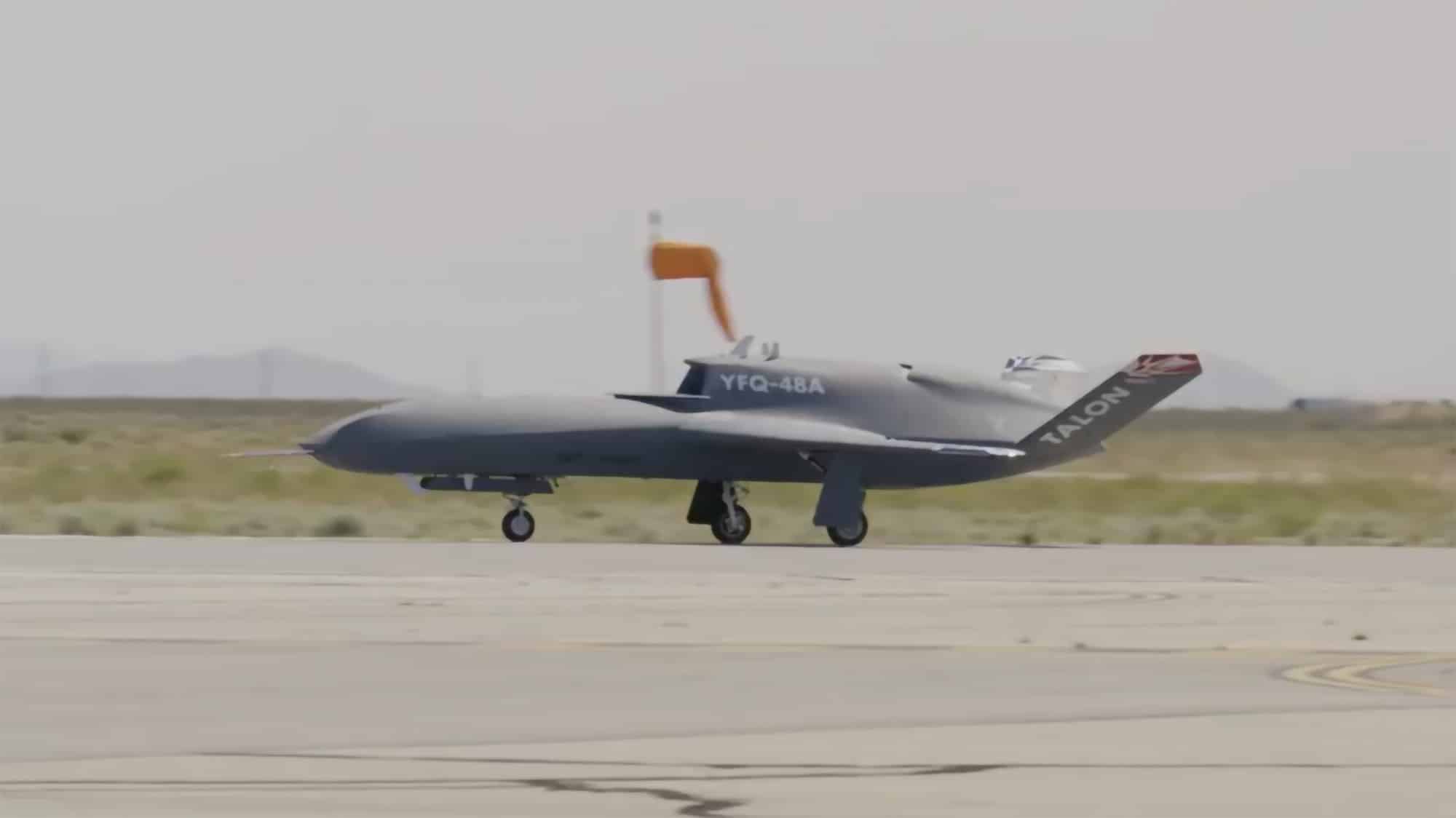
Northrop Grumman announced in a social media post on May 18, 2026 that it completed autonomous taxi testing of the YFQ-48A Talon Blue unmanned aircraft. The YFQ-48 is the company’s launch for the US Air Force’s Collaborative Combat Aircraft (CCA) program.
Along with the announcement, Northrop Grumman also released a short video showing the plane moving down the runway, followed by a van likely carrying safety observers. The company says that, following this milestone, the plane is now accelerating toward first flight.
Self-driving taxi test completed.
YFQ-48A Talon Blue accelerates progress toward first flight in partnership with the @usaairforce. pic.twitter.com/8N5czGkMun
-Northrop Grumman (@northropgrumman) May 18, 2026
No details have been provided about when and where the test was performed. The plane has been undergoing ground testing for at least a month, according to a previous report of global flightpossibly at the Mojave Air and Space Port, where it was first introduced.
YFQ-48A
Northrop Grumman first unveiled its new unmanned platform on December 3, 2025 at the Mojave Air and Space Port, after developing it largely in secret. On December 22, the US Air Force announced that it had assigned the Mission Design Series (MDS) YFQ-48A to the aircraft, which was initially known only as Project Talon.
— TaskForce23 (@Task_Force23) May 18, 2026
As explained above, this MDS defines the semi-autonomous aircraft as an unmanned fighter. In fact, YFQ means prototypes (as indicated by the status prefix ‘Y’) of UAVs (as indicated by the vehicle type code ‘Q’) with the intended role as fighter (indicated by the basic mission ‘F’).
The service said at the time that the designation “highlights the ongoing partnership between the Air Force and Northrop Grumman and recognizes the continued progress of the YFQ-48A as a strong contender in the CCA program.” The Air Force is currently preparing to select designs for Increment 2 of the program, with the YFQ-48A being one of the possible contenders.
— TaskForce23 (@Task_Force23) April 24, 2026
The YFQ-48A joined the other two CCAs, the YFQ-42A and YFQ-44A, which received the same unmanned fighter prototype designation in March 2025. These two aircraft, currently in flight testing, are part of the CCA’s Increment 1 program.
Northrop Grumman initially defined the YFQ-48A as a new autonomous aircraft demonstrator built to validate faster and more affordable manufacturing methods for large unmanned platforms. The company also described the program as a response to lessons learned from its failed bid for the US Air Force Collaborative Combat Aircraft (CCA) Increment 1.
Talon aimed to find the right balance between capability and cost, and Tom Jones, president of Northrop’s aeronautical systems division, said the result was a design that is both cheaper and more capable. The aircraft features a blade-shaped nose, a long, thin fuselage, a low-aspect-ratio lambda wing planform, top-mounted engine air intake and exhaust, and twin sloping tails.
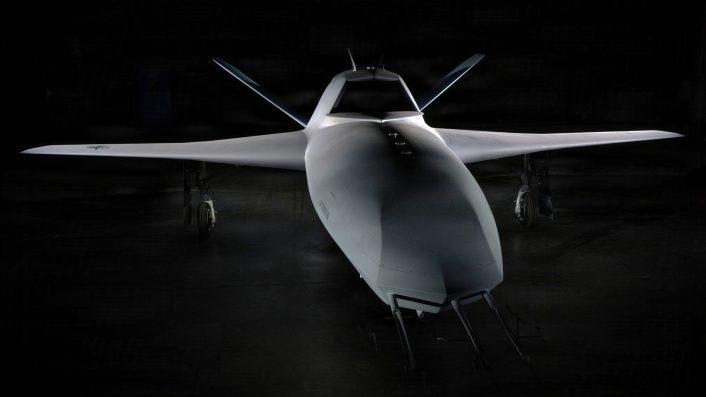
The design appears optimized for high performance and agility, with low-observable features also visible. Regarding the engine, Northrop Grumman only confirmed that Talon uses a single turbofan engine, but declined to identify the manufacturer or thrust class.
In April 2026, the company announced that Pratt & Whitney would provide the enginespecifically the PW500. The engine manufacturer conducted an extensive engine test program to push the commercial boundaries of its PW500 engine family for Talon Blue, testing simulated flight and operating conditions unique to CCA missions.
The engine receives air through a trapezoidal dorsal inlet mounted on the rear of the fuselage, while the exhaust is positioned between the sloped tail surfaces. The nose section features test instrumentation typical of early flight test articles, including three air data probes extending forward of the radome.
The company did not comment on whether the demonstrator is intended to transport stores internally. However, a large trapezoidal panel at the bottom of the fuselage could indicate space for an internal bay.