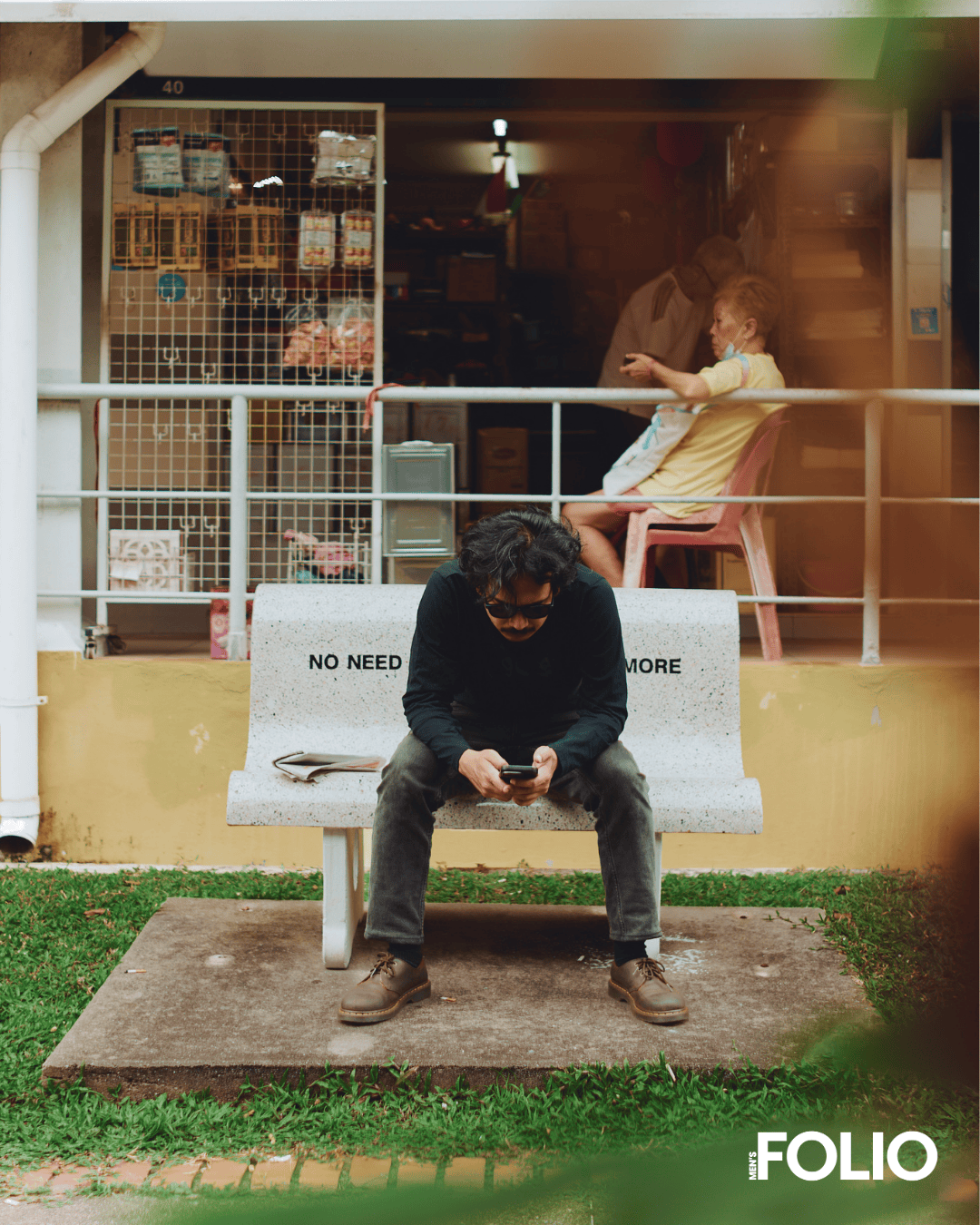
Kuala Lumpur-based artist Izat Arif is no stranger to Singapore’s art community. But for the rest of the country, our presentation to him is still unfolding before our eyes. For an artist of his caliber, it is a gradual process of coming to know each other marked by moments of discomfort, stretches of awkward silence, and space for introspection.
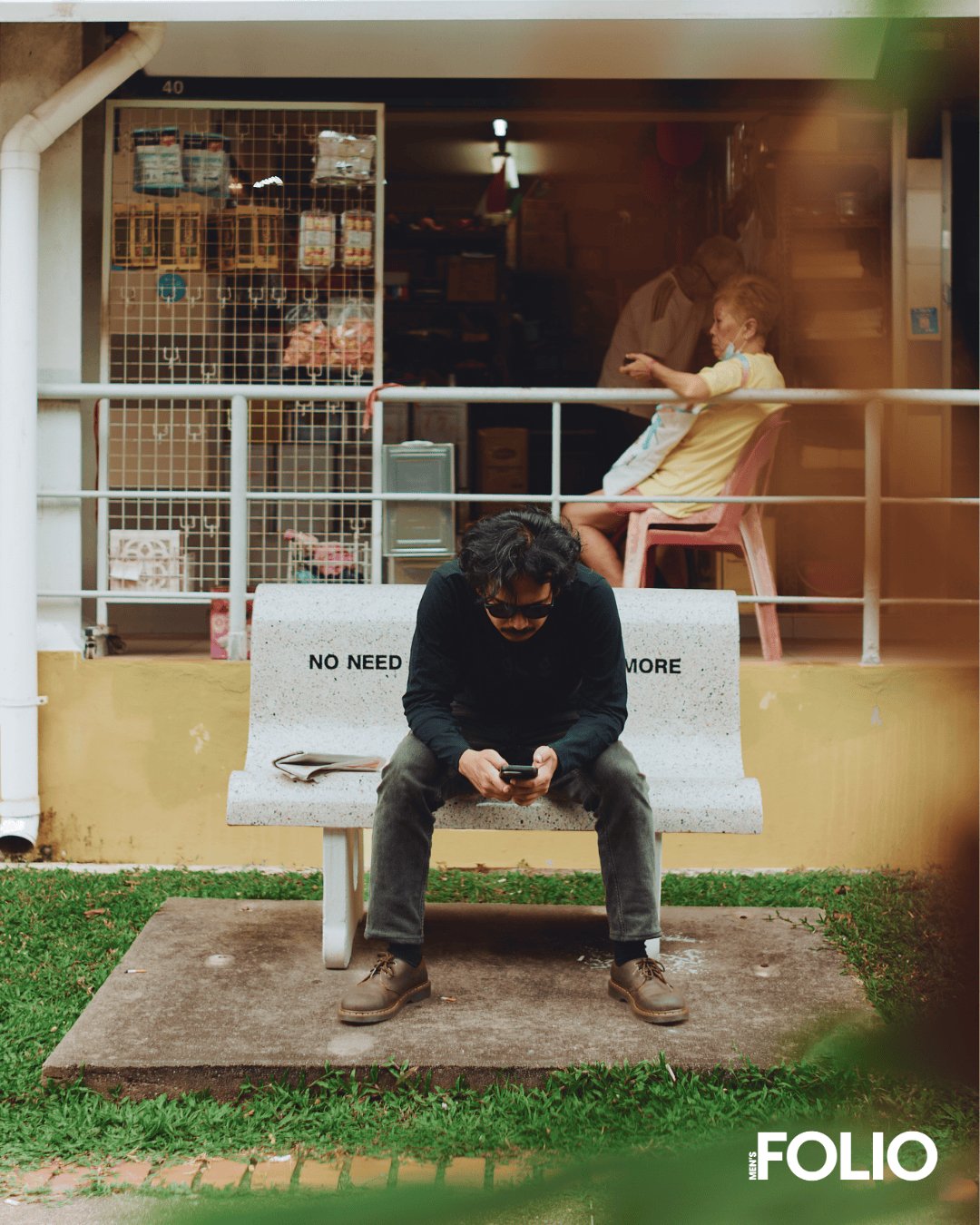
At the eighth Singapore Biennale (October 31, 2025 to March 29, 2026), Izat’s work generated polarized reactions from both the art community and the general public. “Soon you will no longer remember that this was a swamp”, “Jangan Malas Tapi Jangan Lupa Jati Diri” and “There is no need to feel poor anymore” are some of the quotes scattered throughout various places in
the country as part of a 10-piece installation titled, In loving memory.
Some were outraged, others amused, but regardless of where they were, the work persisted. Discourse (online and offline) emerged and seeped into everyday conversations. You may hear him provoking heated debates in the bar of a posh hotel, or receiving quiet, informal praise in the final hours of a humble kopitiam. Word spreads far and wide, and whatever the reaction, that lingering feeling is almost intentional. How can such a simple act evoke such a force of energy exchange? Izat Arif explains.
IZAT: Then I found a strategy for making art: sindiran (sarcasm). Sindiran is at my work. In my practice, sindiran says one thing, but means another. But then, the real interpretation can be multiple. I’m not really looking for political satire. Of course, sometimes the work is in that area, but the starting point is not only that. This is how the Malays talk. I grew up with my grandmother and my mother; They would talk to you in that same sense.

IZAT: Previously, I made a four-chair artwork called Terima Kasih Banyak-Banyak YB (Thank you very much YB). ‘YB’ stands for Yang Berhormat (The Honourable), a greeting to address Malaysian politicians. The work was inspired by an image circulating online of a politician who had donated a pair of marble benches to a mosque, with his name engraved in large Helvetian capitals to commemorate the contribution. I thought that gesture was funny. You want people to remember their contributions to their neighbors, to the community, to society, to the country, etc. In response, I created my own version using banquet chairs wrapped in linoleum, a very inexpensive flooring material.
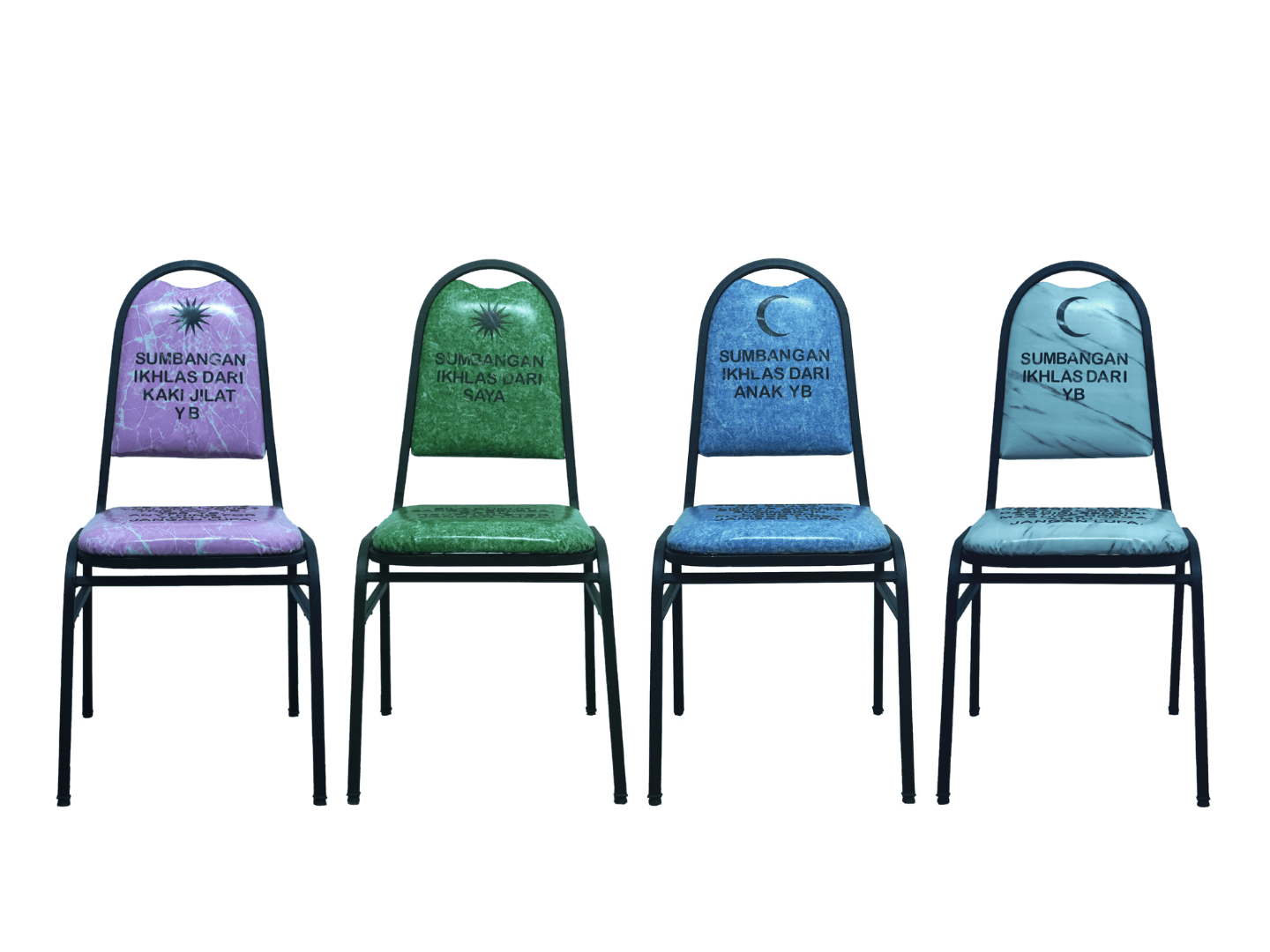
Terima Kasih Banyak-Banyak YB (Thank you very much, YB)
IZAT: Each of the four chairs is attributed to a different figure. One chair was YB’s own, the second was from the YB’s children, the third was from people trying to curry favor with the YB, and the fourth was mine. when he [Singapore Biennale] The curators contacted me, they referred to this work. In my practice, I am interested in the figure of the contemporary Malay man: his contradictions, personality and social position. A lot
Much of my work involves role-playing games, where I play different versions of this character.
I often examine these characters as part of my methodology. When [the curators and I] We were discussing the Singapore Biennale, one of the themes that came up was the idea of progress. The notion of progress is always linked to the recognition of those responsible. The use of these styles of benches as a memorial was the response to this notion.
DHANÍ: This is your first time creating and exhibiting artwork in a public setting. Showing art on the street is, in fact, a different interface compared to a “white cube” gallery or the walls of a public institution. Did this change change your usual methodologies or did you follow your process as you normally would, knowing that your audience would not necessarily be
Of the immediacy of the artistic community, if not of everyone?
IZAT: I always have a broader audience in mind. I always want to be involved not just in the “white cube” space. One of the most accessible tools we have is humor. It can reach everyone. So wherever my artwork ends up, whether it’s a gallery or a national museum, I’m always working to find a language that can be read by the general public. Instead of a traditional gallery setting, the artwork (In Loving Memory) is located in public spaces without clear boundaries.
That changes the context, but the method remains the same: make the work as accessible as possible and use immediate and recognizable references. However, sometimes there are works of art that are not accessible and in the end become too complex. I think conversations can only start once you give people access. People can talk to each other, and even if they don’t agree with me, what matters is that they can talk.
I don’t know and can’t control whether they have a good conversation about it, but I like the compromise. The next question I am asked is whether I do these works on purpose only for speech. That’s not the case because I have jobs where I try really hard to create a conversation, but nothing happens. So for In Loving Memory I didn’t really think this would become what it has become. I wasn’t the one thinking, “Okay, how can we get under people’s skin?” I’ve definitely done work that I’m obsessed with…
DHANÍ: Provocation?
IZAT: Yes, but nothing happened.
DHANÍ: And this was not the case?
IZAT: I didn’t mean to provoke, but I still wanted something to happen.
DHANÍ: A reaction.
IZAT: I wanted a reaction.
DHANÍ: After months of displaying In Loving Memory, it seems that the artworks have built an almost symbiotic relationship between the context in which they sit and the text painted on the benches. Of the 10 activations held in the city, which ones do you resonate with the most?
IZAT: It’s a strange thing for me that I don’t feel attached to anything or all of my work. I want to do it and see what happens.
DHANÍ: Were there reasons you chose these locations specifically? What about “No Need to Feel Poor Anymore”, located in Tanglin Halt?
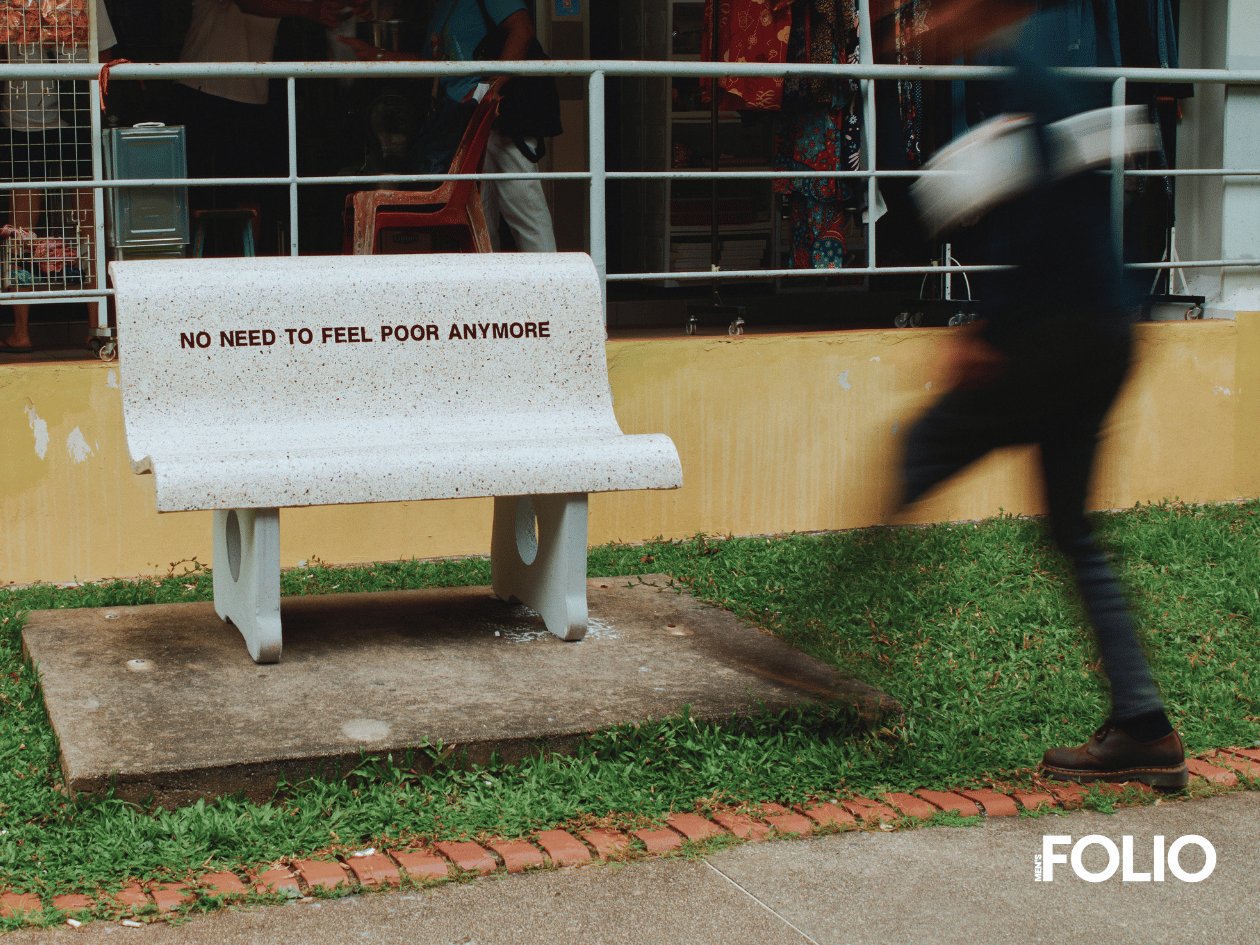 IZAT: “There is no need to feel poor anymore” refers to the Federal Land Development Authority of Malaysia (FELDA). In 1956, FELDA used the motto “There is no need to be poor”: it was about improving life, about progress. Because [Tanglin Halt] It is currently being remodeled, the idea was that once everything is finished, you will no longer have to feel poor. You may be poor, but you don’t have to feel it. We changed it from “There is no need to feel poor” to “There is no need to feel poor anymore.”
DHANÍ: A popular publication found his work distasteful. It’s really surprising to see
someone write a full page review in response to your work. Did that level of scrutiny surprise you or was it something you expected?
IZAT: [At the beginning of the Singapore Biennale] I was waiting for something to happen, but nothing happened. Before this story, I thought my work had failed.
DHANÍ: Did you see this review as a success?
IZAT: Yes. And an inability on his part to think about what it was. Of course, it’s not the fanciest neighborhood. “There is no need to feel poor anymore” is sindiran. What is the cost of progress? Will these people be displaced? Can they afford to live there longer?
DHANÍ: I think the Singapore Biennale received mixed reviews from critics in general. It feels like they are reluctant participants in a task, if you know what I mean.
IZAT: Well, I mean, at the beginning of the review they wrote: “I’m not a fan of contemporary art.” So, I really feel good about your response. I think this is a genuine answer. [to my work].
DHANÍ: This scrutiny also reached Internet forums, such as Reddit. There were threads of people discussing your work, calling you communist, elitist and intolerant. How did you read these reactions?
IZAT: It was entertaining. There were many interpretations. [of my work]. It was very fun.
DHANÍ: They negatively assumed you were a Singaporean woman.
IZAT: I was like, wow. Because? This is perfect. I mean, it’s so good.
DHANÍ: Do you think these comments are more reflective of your work or do they reflect the anxieties of the people discussing it?
IZAT: They are projecting. They are finding a goal.
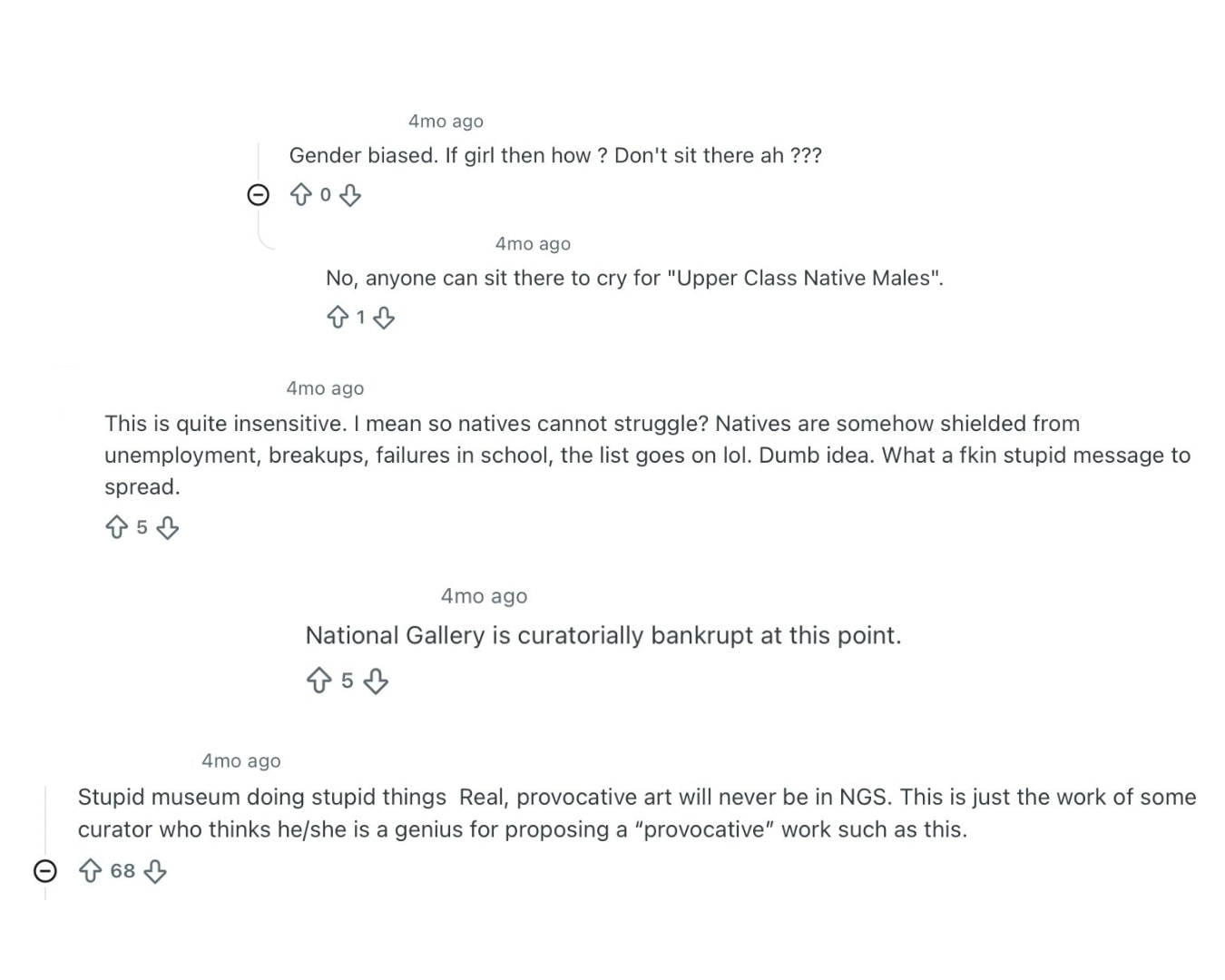
A forum post about In Loving Memory.
DHANÍ: In that same discussion, there was a comment that said, “Real, provocative art will never be in the NGS (National Gallery of Singapore),” yet In Loving Memory became the most talked-about piece at the Singapore Biennale. What do you think provocation means in Singapore’s art scene?
IZAT: Sometimes you don’t know what people want or like. So you just do what you do and hope for the best. You swing, swing, swing, until you hit a home run. But I don’t know if In Loving Memory is considered provocative. For many people, there are many interpretations and ideas about what it could be and what to do with it. But ultimately, it’s just a bank. If people get so stressed about a bank, then it’s time to
to ask a different question.
IZAT: There is no scale to determine it. If crowd-pleasing Instagram art can be seen as “provocative,” then the term loses all real meaning. There is nothing to measure with. You don’t know what people think now. But I like that. Multiple interpretations and different levels of commitment are happening simultaneously. There are so many things you can’t control.
That is contemporary art. It involves risk. As a contemporary artist, you have to take risks. You must disturb something. It is very important in my work to be as rooted in reality as possible. For example, I am also putting myself in a position where I can be criticized when I make my artwork. I’m not trying to give a solution or an answer to the world’s problems. I think it is unfair to depend on artists to provide answers to all the world’s problems. There are more powerful people who can do that. But if you are here making something, a comment, an idea or an idea, you are taking a risk.
 That’s the spirit of being a contemporary artist, because you have no idea how it will develop. I get a buzz when I don’t know what’s going to happen if I post something. Uncertainty is addictive to me. It makes you work harder.
DHANÍ: Historically, all of these disruptive artistic moments, artists, and artworks have almost always driven the canon.
IZAT: Yes, but the art world loves stability. Non-disruptive moments.
DHANÍ: Last question. Many artists, like you, move between Kuala Lumpur and Singapore. Do you see them as distinct and separate ecosystems, or as part of a shared regional dialogue?
IZAT: Singapore and Kuala Lumpur share the same regional dialogue. I believe that at the regional level, all ASEAN countries can work with each other. The ASEAN region is a powerhouse. All the artists from this region are being collected by many museums around the world. It is not just art, it is also music, architecture, theater and cinema. the number of things
being produced in real time is amazing.
Once you’re done with this story, click here to catch up on our April 2026 issue.


![最近ゲットした「ケンゾー」。ナチュラルなベージュでモノトーンコーデからも卒業![鈴々木 響ブログ]](https://www.mensnonno.jp/wp-content/uploads/2026/07/blog-20260707-hibiki.jpg "最近ゲットした「ケンゾー」。ナチュラルなベージュでモノトーンコーデからも卒業![鈴々木 響ブログ]")
