Arthur Scott Geddes
Researchers in Uganda have discovered a complex network of animals that feed on bats infected with Marburg virus, capturing for the first time surprising images of possible contagion risks.
The observations, captured with camera traps placed outside the entrance to “Python Cave” in Queen Elizabeth National Park in western Uganda, are the first confirmation “of a dynamic network of exposure to multiple species at a known Marburg virus site,” the researchers say.
In a preprint of their findings, they write that the discovery of so many animals feeding on bats “may represent a Rosetta Stone for interpreting the real-time mechanics of zoonotic spillover.”
Over a five-month period between February and June last year, researchers recorded at least 14 different vertebrate species visiting the cave to feed on the bats, including leopards, several primate species, birds of prey and monitor lizards.
In one clip, an adult leopard can be seen approaching the cave entrance, punching the bats as they fly away in large numbers before leaving with one in its mouth.
Other images captured at the site in the Maramagambo forest showed a troop of monkeys feeding on bats, along with civet cats and genets, another small predatory mammal.
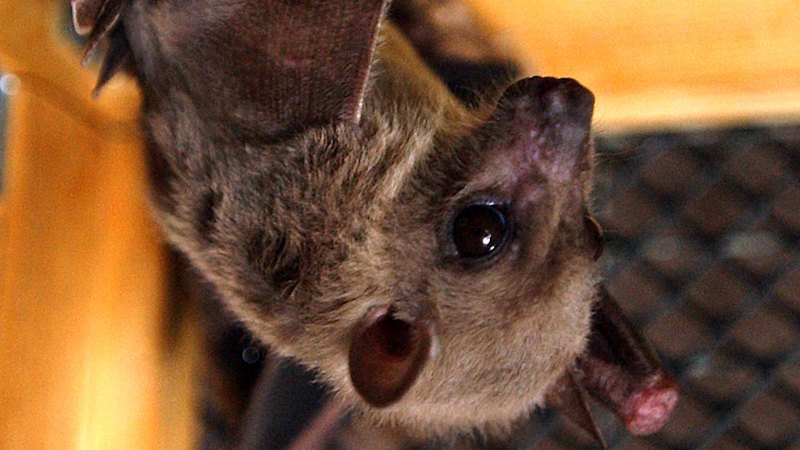
The cave is home to approximately 56,000 Egyptian fruit bats and is located in an area that has long been important for the study of Marburg, a close cousin of Ebola.
The virus can have a mortality rate of up to 90 percent, and while there are several vaccines in development, none have been approved yet.
In 2008, a Dutch tourist who visited Python Cave was trapped and died in Marburg. An American tourist also became ill with the disease after visiting the cave, but survived.
And in 2009, scientists at the U.S. Centers for Disease Control and Prevention (CDC) first isolated Marburg virus from fruit bats found in a nearby cave.
The camera traps were originally placed in the cave as part of a project to collect data on lions and hyenas living in Queen Elizabeth National Park.
Orin Cornille, field coordinator for the Kyambura Lion Project, said it was a surprise to capture so many different species feeding on bats, about 7 per cent of which are known to carry Marburg.
“What surprised me is that we were seeing blue monkeys, baboons, vervet monkeys, going in there and hunting bats. From a virological standpoint, I think that’s the crazy part.
“The leopard is really cool, and all the genets and the civets, and all the different species of birds, are really cool to see. But I think from a virus standpoint, it’s probably the monkeys that are the scariest.”
The researchers were keen to emphasize that they had seen no evidence of an actual overflow.
“This could be something that has been happening for millennia: the Rift Valley and the Albertine Rift are ancient systems,” said Alexander Braczkowski, scientific director of the Kyambura Lion Project.
“We’re seeing a lot of the same species and, in fact, some of the same individuals go to this cave and feed, you know, for months and months and months.”
One particular leopard that visited the cave repeatedly over the five-month period was caught on camera eating numerous bats. He received the nickname Akahaya, a term in a local language that means “untouchable.”
The researchers hope their findings can be the starting point for further research into contagion risks.
“For the first time in nature, there is essentially a site where you have the ability to repeatedly see animal interactions between the filovirus reservoir and then these predators, clearly mixing body fluids and eating each other,” Braczkowski said.
“We’re going to work with some collaborators in the future to try to map more of this entire interface and determine if animals are becoming infected,” he said.
Bosco Atukwatse, another Kyambura Lion Project field coordinator, first came up with the idea of installing cameras next to the cave.
He told London Telegraph Those features of the cave made it especially suitable for predators hoping to get an easy meal.
The entrance to the cave is partially sunken and close to the ground, while piles of guano (bat droppings) that have accumulated over years mean that even the smallest animals can reach the bats.
“A monkey can simply stand on two legs, grab a handful of bats and run away with them,” he said, adding that it wasn’t always clear where the dead bats ended up.
While bats are believed to be the main reservoir of the virus in nature and can transmit Marburg virus without getting sick, there is evidence to suggest that other animals, including some primates, can transmit the virus after interacting with bats.
‘Crucible Overflow’
The researchers described the cave as an “overflow melting pot,” noting that many of the species they observed preying on bats are consumed by humans as bushmeat.
“There are many pathways through which a disease of international importance can spread through a population undetected,” Atukwatse said.
Camera traps also recorded about 400 humans visiting the cave “including school groups, tourists and local trainees, most without personal protective equipment.”
Braczkowski, scientific director and one of the authors of the paper, said Ugandan authorities were well aware of the risk posed by the site and had posted signs warning of the danger and installed an observation platform about 40 meters from the cave.
The researchers’ findings add to a growing body of evidence documenting never-before-seen interactions between animal species that are shedding light on zoonotic risks.
Last year, researchers in Germany documented for the first time that rats were feeding on bats, raising concerns about pandemic risks.
However, in their report, the researchers who focused on Python Cave note that much of what we think we know about zoonotic spillover remains largely theoretical: Documentation of complex interactions between multiple species in known zoonotic reservoirs “remains exceptionally rare.”
The Telegraph, London
Get a note directly from our foreigner correspondents about what’s making headlines around the world. Subscribe to our weekly What in the World newsletter.