NIBIB-funded University of Minnesota (UMN) researchers created a new dynamic 3D bioprinted tumor model in a laboratory dish to screen for anticancer drugs and study cancer spread and tumor growth at the primary site. A major problem in translating laboratory drugs into a viable treatment is delineating the differences that occur within a 2D Petri dish versus the human body, which is inherently 3D. Often, what is seen in a plastic Petri dish fails to accurately replicate the conditions and outcomes surrounding tumor growth in a person.
“A 3D system is more effective than 2D at modeling events in the body and informing the drug discovery process. The research community has been moving toward 3D models because they are simply better predictors of what will work in the body,” said Seila Selimovic, Ph.D., director of the NIBIB program in Tissue Engineering.
Fanben Meng, Ph.D., principal investigator in the UMN College of Science and Engineering, used a custom 3D bioprinter to inject protein capsules into a soft hydrogel. The researchers designed the hydrogel to mimic the composition and rigidity of physiological structures to allow cells to behave similarly outside the body.
The 3D bioprinting technology used for this project originated in the UMN laboratory of Michael C. McAlpine, Ph.D., Benjamin Mayhugh Associate Professor of Mechanical Engineering. It previously demonstrated that 3D-printed capsules could release their contents “on demand” with control over where, when and in which tissues they target.
The success of this first project led McAlpine and his collaborators to tackle another project, this time combining these 3D-printed biochemical capsules with 3D-bioprinted tumor cells. Co-senior author Angela Panoskaltsis-Mortari, Ph.D., vice president of research and professor in the Department of Pediatrics at UMN, said, “Blood vessels help cancer cells migrate to other sites in the body, a process called metastasis, which complicates treatment strategies. I believe our model has the key components to push the boundaries of in vitro cancer research.”
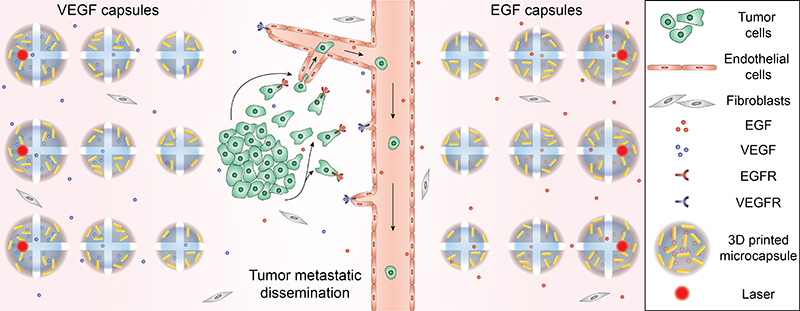
Three-dimensional bioprinting technology was used to precisely place melanoma or lung cancer cells, normal cells, and blood vessel-like structures on the lab plate based on their normal functions. Additionally, hydrogels contain cores filled with chemicals to guide cancer cell migration or blood vessel growth, as well as an encapsulating outer layer composed of gold nanorods. The gold nanorods are activated by a laser that heats the nanorod causing it to break down the hydrogel core and release its contents. This creates a chemical gradient that guides specific cell growth. Fluorescence imaging allows researchers to visualize these cancer cells migrating through the blood vessels built after their release.
“All of these features give us the ability to have 4D control, that is, control of both space and time,” McAlpine emphasized. “Cells and capsules are precisely printed at biologically relevant sites and chemical reservoirs drive movement upon triggered release. This is a dynamic 3D tissue engineering system that provides the user with control over the diffusion process at some point after the printing process.” In 2D drug testing systems, cells lie flat on a surface, completely exposed and vulnerable to an anti-cancer drug on one side and protected by the dish on the other. In this new model, the drug diffuses through the 3D system before reaching its intended target, cancer cells.
Results from the UMN study, published in Advanced Materials, found that in the 3D bioprinted model, drugs take longer to kill fewer cells than previous studies have shown, but the results likely offer a more accurate representation of the body’s processes than 2D drug-screening platforms. The published study also demonstrated that immunotoxins can effectively kill cancer cells using this model as a proof of concept.

Panoskaltsis-Mortari explained: “Other 3D models are not perfusable in the same way. We have created a system where we can collect the cells that have self-selected to enter the blood vessel and become metastatic.” Researchers believe that collecting these cells in this model can help them better understand how cancer spreads and how to formulate better treatments.
Discussing the manufacturing potential, McAlpine says it is a scalable process because only one bioprinter is needed to print multiple cell types in addition to the hydrogel, biochemical capsules, and gold nanorods. Panoskaltsis-Mortari added: “Since the 3D models are bioprinted, it is a very robust and reproducible process and can be used to quickly perform thousands of tests.”
“As a program director, I want to support research projects that continue to evolve. The evolution of the McAlpine lab’s 3D bioprinting technology is a great example of how many NIBIB-funded technologies have numerous applications,” Selimovic said enthusiastically. In the future, Panoskaltsis-Mortari and McAlpine plan to develop other models besides melanoma and lung cancer. Additionally, they will begin to incorporate components of the immune system into their 3D models.
The work was supported by grants from NIBIB (R21EB022830 and DP2EB020537), a seed grant from the Institute of Engineering in Medicine at the University of Minnesota, and a Pilot Project award from the University of Minnesota Prostate and Urologic Cancer Translational Working Group.
3D bioprinted in vitro metastatic models by reconstructing tumor microenvironments. Fanben Meng, Carolyn M. Meyer, Daeha Joung, Daniel A. Vallera, Michael C. McAlpine, and Angela Panoskaltsis-Mortari. Advanced materials. 31, 1806899 2019.