On June 15, 2026, a B-52 Stratofortress crashed at Edwards Air Force Base shortly after takeoff. There were eight on board and no survivors.
The B-52 Stratofortress is a long-range heavy bomber built by Boeing. It has eight jet engines mounted in four capsules with a maximum takeoff weight of 488,000 pounds. The B-52 entered service with the US Air Force in 1955 as a Cold War nuclear deterrent, designed to hit targets deep inside the Soviet Union. A total of 744 were built in eight variants, called AH.
Several bombers have been designed to replace the B-52 and it has outlived them all. As of early this year, the Air Force operated 76 B-52Hs, the only variant still in service, of the 102 delivered between 1961 and 1962. The fleet is expected to remain in service until 2050. When a B-52 is destroyed, the Air Force can only replace it by removing a stored airframe from the Boneyard in Arizona.
This B-52H had the serial number/tail number 60-0061 (fiscal year 1960 + aircraft number 0061) and was nicknamed Spirit of Aggieland II while in the 307th Bomb Wing in the mid-2010s. Aggieland refers to Texas A&M University (originally known as the Texas Agricultural and Mechanical State College). The B-52 Stratofortress uses a “Spirit of [name]” naming convention, with the aircraft officially named “Spirit of [state]“Spirit of [city]” or “Spirit of [institution]”.
But in this case it is a play on words, since Spirit of Aggieland is the name of the official song of Texas A&M Universitybased on a poem written in 1925. The B-52 was named in 2015, when the commander of the 307th Bombardment Wing was inspired by a photograph of a P-51 fighter with the “Spirit of Aggieland” painted on the nose during World War II.
Scramble wrote that the plane had previously carried “Die Laughin’ Jester” and “Man-O-War II” on the port side before “Spirit of Aggieland II”, but arrived at Edwards without any markings.
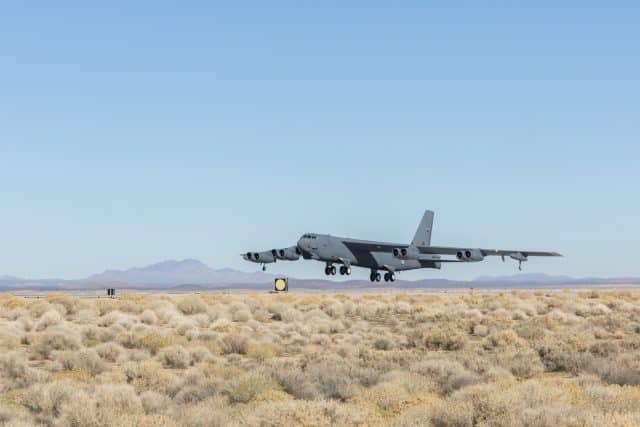
Spirit of Aggieland II It was on loan to the 412th Test Wing, based at Edwards Air Force Base, for a series of tests supporting the B-52 Radar Modernization Program.
The B-52 is being modernized because there is nothing to replace it with yet. The B-21 Raider is in development but not in service. The B-1B Lancer is being retired. The B-2 Spirit fleet is small and expensive to operate. The B-52, the oldest of them all, is the one the Air Force retains, and to keep it flying until 2050, the service is subjecting the fleet to upgrades that affect nearly every major system. The largest is the Commercial Engine Replacement Program replacing the eight Pratt & Whitney TF33 turbofans, which date back to the 1960s and are increasingly difficult to maintain, with Rolls-Royce F130 engines. In December 2025, Boeing was awarded the contract modify and test two B-52s with the new engines ahead of a planned fleet-wide modernization. The redesigned aircraft will carry the designation B-52J.
Radar is an independent program. The B-52’s existing radar is old enough that replacement parts are difficult to come by. He $3.3 billion radar modernization program replaces it with a new system: the AN/APQ-188, built by Raytheon and integrated by Boeing. The new radar is solid-state, meaning it has no moving parts to wear out and can track multiple targets simultaneously. The upgrade also includes new mission computers and displays for navigation stations.
In December 2025, Spirit of Aggieland II went to the Boeing facility in Kelly as the first to receive the AN/APQ-188 radar modification. From there, it flew directly to Edwards Air Force Base for extensive testing throughout 2026.
Edwards is home to one of the longest paved runways in the US, at 15,024 feet. (The longest active paved runways are Shigatse Peace Airport in Tibet, China, and Ulyanovsk Vostochny Airport in Russia, at 16,404 feet or 5,000 meters. The longest in the US is 16,000 feet in Denver, Colorado.)
The B-52 took off from the 15,000-foot runway and then fell sharply, impacting the ground along the runway.
The base confirmed the mishap on social media after images emerged online showing a huge plume of black smoke rising from the site. The smoke was visible from weather satellite. The B-52H carries up to 48,000 US gallons of fuel (312,197 pounds/141,610 kilograms).
The B-52H has a standard crew of five: aircraft commander, pilot, radar navigator, navigator and electronic warfare officer. The plane that crashed at Edwards had eight people on it, including two Boeing employees.
One of the first reports on the Edwards crash called it the deadliest B-52 crash since 1982. When I went looking, I found two fatal B-52 crashes just a year apart. In October 1981, A B-52D on a low-level night training mission crashed into sand dunes near La Junta, Colorado.killing all eight crew members. A witness driving to his bakery in the pre-dawn darkness saw the explosion: “At first I thought it was the northern lights. But then I thought something had exploded, like a gas station. But it was too big for that.”
Then, on November 29, 1982, a B-52G caught fire on the ground at Castle Air Force Base in California. No one was injured, but the runway was severely damaged and Castle AFB’s training operations were moved 100 miles north to Mather Air Force Base.
A few weeks later, one of those training aircraft, a B-52G, crashed after takeoff, killing all nine people on board.
The archived version of the now defunct Get Out and Walk Projecta site dedicated to the history of aircraft ejection systems, cites email from retired USAF Sergeant Jeff Noeker:
This incident involved two Castle training aircraft. They took off like MYTH (Takeoff at minimum intervals). The lead aircraft was a B-52 H with TF-33 fan jet engines. Aircraft number 2 was a B-52G with J-57 turbojet engines. Typically, the turbofan engine generates about 5,000 pounds more thrust than the J-57 and that’s why the Model H came first. But in this case, the Model G was using water injection, which makes the J-57 meet or exceed the thrust of a TF-33. 1,200 gallons of demineralized water are injected into two points in the engines and are exhausted in less than two minutes. This fact was not taken into account during the planning of this mission, since the problem explained above rarely or never occurred. However, in this case it did. After takeoff, the Model G quickly began to overtake the Model H. To avoid the collision, the student pilot decelerated without regard to the water injection being used. This shouldn’t have mattered, as the water injection system is supposed to automatically cut off when the throttles are reduced beyond a certain point, since the engines can’t tolerate as much water at less than optimal power settings. Due to a malfunction, the water was NOT cut off and the engines could not handle it. They started to burn. The plane was almost at its maximum gross weight of 250 tons and there was not enough altitude to recover, so it took off shortly after.
The loss of life in an accident is always tragic. And yet, somehow, I find the loss of Spirit of Aggieland II particularly sad. It will be quite some time before we know exactly what happened; The plane was destroyed and largely consumed by fierce fire after impact. The rest of the Stratofortress fleet was due to be upgraded after extensive testing and validation at Edwards, but whether the upgraded B-52J will lead the fleet for the next 25 years is again an open question.