This article was taken from the NIH Director’s blog on April 11, 2019. The work was funded by NIBIB and other NIH institutes.
Using a screwdriver on the tiny microcircuits arranged inside a computer’s hard drive can cause real eye strain. Even more challenging is building microcircuits or other electronic components at the nanoscale, a billionth of a meter or less. That’s why researchers are always looking for new tools to help them work on such a small scale. But some of these incredibly small tools and scaffolds can derive from very unexpected sources.
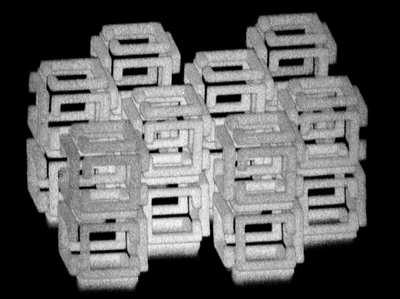
As reported in the journal Science, an NIH-funded team has developed a technique called implosion manufacturing to build impressively small and intricate nanoscale components. [1]. Their secret ingredient: water-swellable gels that you’d find in a baby’s disposable diaper. A baby’s disposable diaper? If this sounds familiar, a few years ago my blog highlighted a related technique called expansion microscopy that uses water-swollen gels generated from a compound used in diapers called sodium polyacrylate.
The previously described microscopy technique, from the laboratory of Edward Boyden, Massachusetts Institute of Technology, Cambridge, embeds biological samples in a fine network of sodium polyacrylate. When water is added, the gel expands, bursting the sample up to 100 times its original size. This innovative technique, called expansion microscopy, has allowed laboratories around the world to use conventional microscopes to obtain high-resolution images at the nanoscale.
In the latest work, Boyden’s team, including co-authors Daniel Oran and Samuel Rodriques, asked a simple question: What would happen if they applied the sample preparation technique used for expansion microscopy, only in reverse? To find out, Boyden’s team created millimeter-sized blocks of sodium polyacrylate super-absorbent diaper compound. After using a clever trick to join molecular anchors into a 3D pattern, they dehydrated the gel and voila! The structures imploded and shrank to a thousandth of their original size, maintaining their 3D shape. During the process, they can add a variety of molecules or functional elements to the anchors. These include DNA, nanoparticles, semiconductors or almost anything that is necessary.
While more work is needed to perfect the new technique, researchers have already shown that it can create objects one cubic millimeter in size, designed to include intricate details down to about 50 nanometers. In comparison, a virus measures between 30 and 50 nanometers.
These latest findings serve as a reminder that advances in biomedicine often lead in new, wonderful, and unexpected directions. As a result of NIH-funded efforts related to The Brain Research Through Advancing Innovative Neurotechnologies® (BRAIN) initiative, Boyden Lab members wanted to get a better look at the brain using basic microscopes. We now have a promising new nanofabrication approach with wide application.
[1] 3D nanofabrication using volumetric deposition and controlled shrinkage of patterned scaffolds. Oran D, Rodriques SG, Gao R, Asano S, Skylar-Scott MA, Chen F, Tillberg PW, Marblestone AH, Boyden ES. Science. December 14, 2018; 362 (6420): 1281-1285.