
Ethereum faces a decline below $1,700 as selling pressure and market uncertainty combine to test support levels that have not been visited since the depths of the previous correction. The price action is alarming, but CryptoOnchain data has applied a sophisticated analytical framework to the current market structure and arrived at a ranking that directly challenges the bearish interpretation offered by the price chart.
A four-state hidden Markov model trained on 336 days of Ethereum on-chain data has classified the current market regime as Neutral and Accumulation, with 99.6% confidence in that classification and an 88.7% probability that the regime persists rather than transitioning to a more bearish state. The model does not describe a distribution or capitulation market. It describes a market in a specific structural phase that has historically preceded recovery rather than continuing downward.
The Binance metrics that inform that ranking tell the story accurately. Open interest on Binance stands at 5.68 billion, the lowest reading in the entire data set and below the average of 6.11 billion for this specific regime. Leveraged positions are quietly unraveling rather than collapsing violently. The funding rate at 0.0087% is effectively flat – neither bulls nor bears are paying a premium to maintain directional exposure.
Ethereum model reading below $1,700 is not panic. It is not distribution. It is a market that has stopped acting and started waiting, and CryptoOnchain’s analysis is designed to identify the distinction between those two states.
99.6% Confidence in Ethereum Accumulation
The cryptocurrency report identifies the only variable that separates the current accumulation regime from the recovery phase that would follow. Coinbase’s premium gap stands at -2.73, significantly more negative than this regime’s historical average of -1.57. The Recovery and Base regime that preceded Ethereum’s previous significant advances averaged +0.99 in this metric.
The distance between where the gap currently is and where it needs to be for a regime transition is the most precise measure available of how far US institutional demand must travel before the structural conditions for recovery are in place.

Ethereum Market Regime Detection | Source: CryptoQuant
Regime comparison adds historical context that makes transition conditions credible rather than speculative. Ethereum’s last significant bull phase in the data set was characterized by relatively low funding rates, averaging 0.0015% and a modest open interest of 6.19 billion, not a leverage-driven euphoria but an organic demand-driven expansion. The next genuine bull phase is likely to come in the same way and not through derivatives glut.
The probability of persistence of the regime of 88.7% means that the current accumulation structure is rigid. It will not make a quick or random transition. Two specific conditions must be aligned before the model classifies a regime change. Coinbase’s premium gap should recover towards zero or positive, confirming that US spot demand has returned to a significant scale. Open interest on Binance should expand gradually without a corresponding increase in funding rates, confirming that the expansion is driven by demand and not leverage.
Until both conditions appear simultaneously, Ethereum will remain in a low-conviction accumulation zone with slight structural selling pressure. The model says the bottom is forming. Coinbase Premium says the catalyst is not yet here.
Ethereum remains under intense pressure in the weekly period, with the price trading around $1,670 after losing over 16% this week alone. The chart shows a decisive break below the long-standing $1,800-$1,900 support zone that contained the price for much of the first half of 2026. More importantly, ETH has now fallen below February lows near $1,750, invalidating a key support level that many bulls were defending as the last major bottom before a deeper correction.
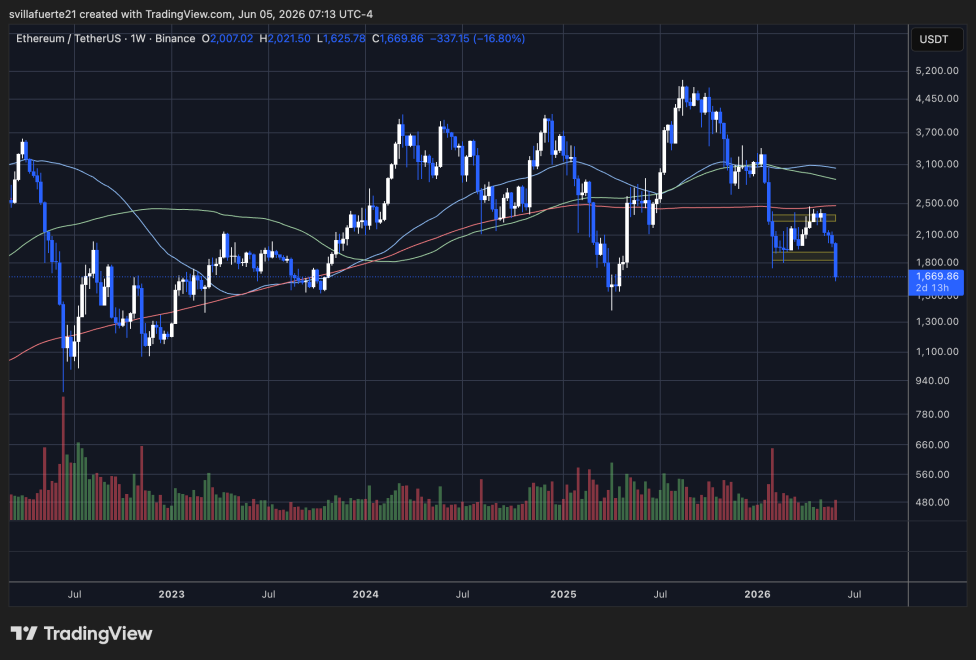
Ethereum loses key demand level | Source: ETHUSDT chart on TradingView
The technical structure has deteriorated significantly. The price is trading below the 50-week, 100-week, and 200-week moving averages, confirming a fully bearish trend on all major time frames. The rejection of the $2,200 to $2,300 resistance zone in May marked a lower high relative to previous rallies, and the subsequent collapse has accelerated bearish momentum rather than producing consolidation.
Volume has expanded during the sell-off, suggesting that the drop is accompanied by active participation and not a lack of buyers. This increases the importance of the current region around $1,600-$1,700, which now represents the first major support area visible on the chart.
If ETH fails to stabilize here, the next significant downside target lies near the 2023-2024 consolidation zone, around $1,400-$1,500. For bulls, reclaiming the broken $1,800 level is now essential. Until that happens, the weekly chart continues to favor sellers, with lower highs and lower lows and momentum firmly pointing down.
Featured image from ChatGPT, chart from TradingView.com

Editorial process for bitcoinist focuses on providing thoroughly researched, accurate and unbiased content. We maintain strict sourcing standards and every page undergoes diligent review by our team of technology experts and experienced editors. This process ensures the integrity, relevance and value of our content to our readers.