Opinion
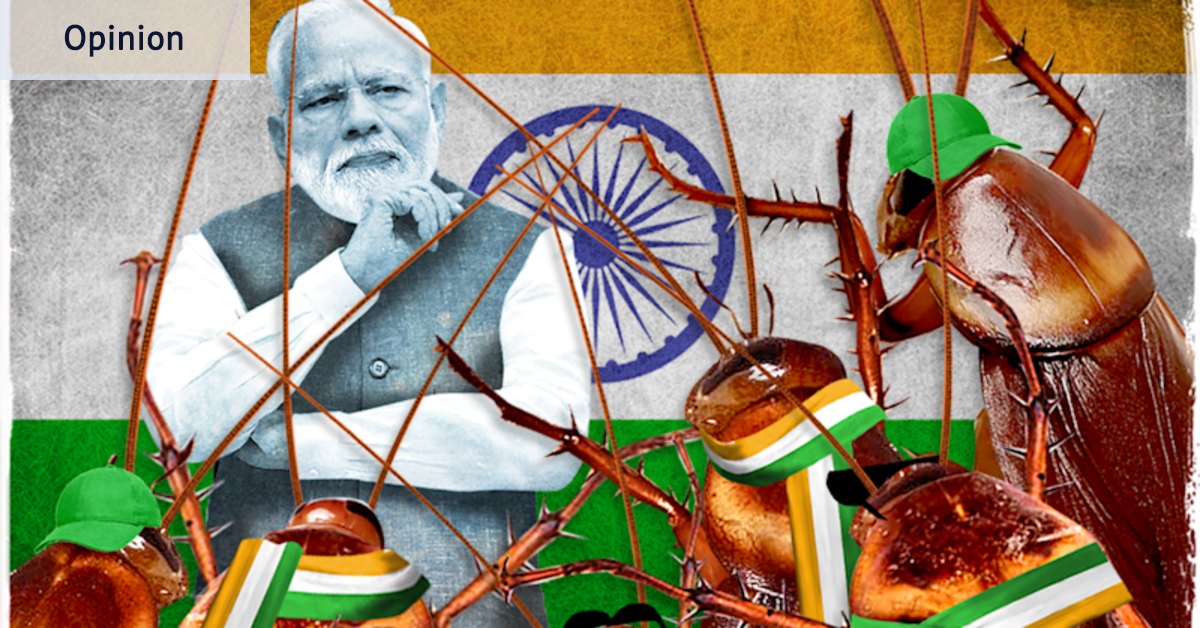
The saying goes that if you see one cockroach, it means there are many more that you can’t see yet. But when India’s top judge compared unemployed youth to cockroaches, he had no idea how many were about to swarm them.
Their condescension prompted a young man to create the satirical Cockroach Janta Party online last week with the question: “What would happen if all the cockroaches united?”
Within one day, more than 3 million people had joined the party. Within a week, more than 22 million followed him on social media. That’s twice as many as those who follow India’s ruling Bharatiya Janata Party, led by Prime Minister Narendra Modi.
The judge soon recanted, but it was too late. A new youth protest campaign had been born.
thirty years Abhijeet Dipke invited “the lazy and the unemployed” to join the movement with the hashtag #MainBhiCockroach, or “I am a cockroach too.”
Humanoid cockroaches in suits and ties soon began speaking at lecterns in AI-generated videos. In the campaign emblem, a cartoon cockroach wearing sunglasses chews on a lotus flower, a symbol of Modi’s BJP. “The government is going to be shaken,” said the upstart party.
And the Indian government was worried. His Intelligence Office raised “national security concerns,” evidently fearing an uprising, according to The Indian Express newspaper.
BJP leaders tried to discredit the movement by saying that most of its followers were from Pakistan, “the anti-India crowd,” as they called it. Dipke responded by publishing analytics showing that 94 percent of followers were from India.
Over the weekend, authorities shut down the Cockroach Janta Party’s website and pressured social media sites to block its accounts, only to see new ones emerge. “You forgot what cockroaches do best,” the group posted. “Survive.”
“It’s curious,” says Dr Teesta Prakash, a researcher at the Australia-India Institute, “but it’s based on real problems facing India’s Generation Z” – people born between 1997 and 2012.
“It brings out the key policy that the BJP campaigned for in 2014, 2019 and 2024: job creation,” he tells me. “There is massive youth unemployment, there is a lot of work pressure and they have not been able to generate jobs at the rate at which people turn 18.”
India’s unemployment rate for people aged 15 to 24 is 16 percent. Graduate unemployment is a staggering 40 percent. The country produces 5 million graduates a year, but only 2.8 million jobs for them.
“The BJP has seen this and it has them a little worried. They are not worried about Congress,” the ineffective main opposition party, “but what they are worried about is the mobilization of India’s youth.”
The Indian government is not at risk. But he is tormented by events in his region. The governments of three of India’s neighbors have been forced from power due to massive youth-led street protests since 2022: in Sri Lanka, Bangladesh and Nepal. In all three, high youth unemployment was a central cause, aggravated by inflation, high inequality and corruption. These three uprisings have been described as Generation Z revolutions.
There is a debate about the usefulness of generational labeling in sociology and politics studies. Today marks the fifth anniversary of a notable rejection of the practice. An American sociologist, Philip Cohen, complained that this is an arbitrary categorization that “promotes pseudoscience.”
However, for South Asian authorities, labeling Generation Z has real relevance as shock troops of political change. As youth have been in many countries throughout the centuries: the bearers of social conscience and the vanguard of reforms.
Beyond the subcontinent, in Southeast Asia, Generation Z has led massive political protests in Indonesia, Thailand and the Philippines in recent years, although none of them resulted in a change of government.
In China, Xi Jinping has led a denunciation of the Generation Z protest movement known as “staying still,” or choosing to fall out of the economic mainstream out of desperation. He accused them of endangering social order, the greatest fear of the Chinese Communist Party. Last month, the country’s top spy agency publicly worried that such people had been “brainwashed” by hostile foreign powers.
Pakistani activist and researcher Usama Khilji certainly thinks Generation Z has a distinctive political character: “Armed with digital technologies that can mobilize massive numbers of young people, they have catalyzed unprecedented levels of public discontent,” he wrote for the Carnegie Endowment for International Peace in March.
He argues that governments cannot “survive by doubling down on digital repression and keeping young people excluded from power. As the experiences of Nepal and Bangladesh have shown, these assumptions are flawed.”
Will the Modi government in India become another victim of a Generation Z revolt? Restless youth is a worrying phenomenon for Indian authorities because the majority of the population is under 30 years old.
“In Australia, where the average age is 38, I’m young,” says 33-year-old Prakash. “But in India I feel old because there are so many young people everywhere.” The average age is 28 years. And the unemployment problem seems to be getting worse as AI is “taking away a lot of the things that Indians were good at,” as Prakash puts it.
But he notes that India is larger and more culturally diverse than Sri Lanka, Bangladesh or Nepal, “so it is not impossible but much more difficult to mobilize” national protests on a scale capable of toppling the government.
The particular provocations may be different, but the Gen Z discontent roiling the Indo-Pacific has some resonance with Australia’s current concerns about “intergenerational inequality” and the Albanian government’s efforts to shift home-buying incentives from investors to first-home buyers.
In fact, Gallup published a poll in February in 107 countries that investigated the “world’s most important problem.” What is it? Personal economic circumstances. And it found that Generation Z is more concerned about this than older people around the world.
And that “this generational divide is most pronounced in rich nations. These disparities highlight how young people in many high-income countries can feel that the economy is failing them, despite living in relatively prosperous societies.”
The top three countries, according to Gallup, are Ireland, Australia and Canada. Their main concern, of course, is unaffordable housing. Generation Z here, as in India, is concerned about their material well-being. After all, it’s not so different. Are we all cockroaches now?
Peter Hartcher is political and international editor. His political column appears on Saturdays.
Get a weekly digest of views that will challenge, defend and inform yours. Subscribe to our Opinion newsletter.
 Peter Hartcher is political editor and international editor of The Sydney Morning Herald and The Age.Connect by email.