Single-cell variations can indicate whether the treatment is working or if it is time to change course.
Understanding the variability of individual cells in a tumor can be a valuable guide to the choice and course of treatment. NIBIB-funded researchers used photoacoustic imaging to rapidly measure the oxygen consumption rate of individual breast tumor cells, information that can help guide treatment strategies, monitor outcomes, and allow adjustments during the course of treatment.
Treating solid tumors is challenging because as they grow, each tumor cell acquires different genetic and metabolic characteristics, which can make them more or less susceptible to particular treatments. This makes killing all the cancer cells in a tumor extremely difficult.
“Obtaining as much information as possible about a tumor to enable effective treatment is a constant goal of cancer researchers,” explains Behrouz Shabestari, Ph.D., director of the Optical Imaging Program at the National Institute of Biomedical Imaging and Bioengineering, which funded the study. “The photoacoustic technique developed by these researchers was previously used to non-invasively observe human tissues for abnormalities such as tumors. Now they have advanced the technology to detect differences in each tumor cell, which brings us closer to developing personalized therapies based on the specific metabolic characteristics of each person’s tumor cells.”
Dr. Shabestari refers to the study’s principal investigator, Lihong Wang, Ph.D., Bren Professor of Medical and Electrical Engineering, and his colleagues at the California Institute of Technology. The technique is photoacoustic imaging, in which harmless pulses of laser light hit the target, creating vibrations that return as a detailed image of the target in the form of sound, similar to ultrasound images.
In this case, Dr. Wang and his group have modified their technique to determine how much oxygen each cell of a tumor that has been isolated individually in a tiny well of a laboratory dish is using. Each cancer cell sits in its own well surrounded by blood filled with oxygen-carrying hemoglobin. Each cell uses different amounts of oxygen in the well at a different rate, revealing differences in each cell’s metabolism.
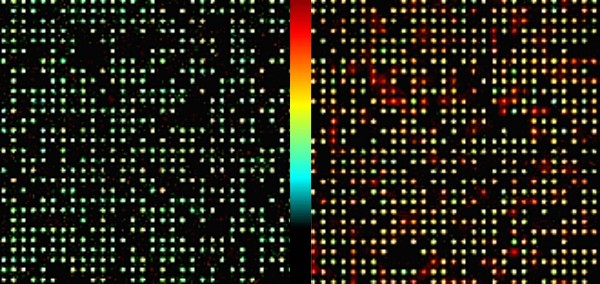
To measure oxygen levels with lasers and sound, the researchers modified their technique to develop single-cell metabolic photoacoustic microscopy (SCM-PAM). When the laser hits each well, it causes the hemoglobin in the well to vibrate. The technique works because hemoglobin bound to oxygen vibrates differently than hemoglobin without oxygen.
The different vibrations coming from each well ultimately create different colors that provide a measure of how much oxygen each individual cancer cell has consumed. The less oxygen left in the well of a cell, the higher the metabolic rate of that cell.
Another important aspect of this new technology is the speed at which it can measure the metabolic rate of a batch of cells isolated from a tumor. Using SCM-PAM, Wang and his team were able to measure the oxygen consumption rate of 3,000 cancer cells in just 15 minutes, which is about a hundred times faster than a method that uses individual oxygen sensors in each well and is extremely difficult and expensive to build and operate.
The technique was tested on a cancer cell line and on breast cancer cells obtained through patient biopsies. In both cases, the cancer cells had a higher oxygen consumption than normal cells, which correlates with faster growth of the cancer cells. The test also identified individual rates of oxygen consumption for each cell.
“This new technique allows us to evaluate an important aspect of cancer cells, which is how much the metabolic rate increases compared to normal cells from the same patient,” Wang explained. “We also observed a wide range of different metabolic activities in the population of cancer cells from the same tumor.”
The researchers hope that this new tool will be extremely valuable for cancer research as well as in the clinical setting. “A good example of the value of the technique is that we can observe the metabolic rate of a patient’s cancer cells before and after treatment,” says Wang. “If the rate is reduced, it is a good indicator that the chosen therapy is working. Otherwise, it provides the opportunity to switch to a different therapy much more quickly than is possible with current means, which can take up to several months to determine if a tumor is shrinking.”
The study appeared in the April issue of Nature Biomedical Engineering.1 The work was supported by the NIH Director’s Pioneer Award DP1 EB016986 through the National Institute of Biomedical Imaging and Bioengineering, the NIH Director’s Transformative Research Award R01 CA186567 through the National Cancer Institute, and a grant from the National Science Foundation.