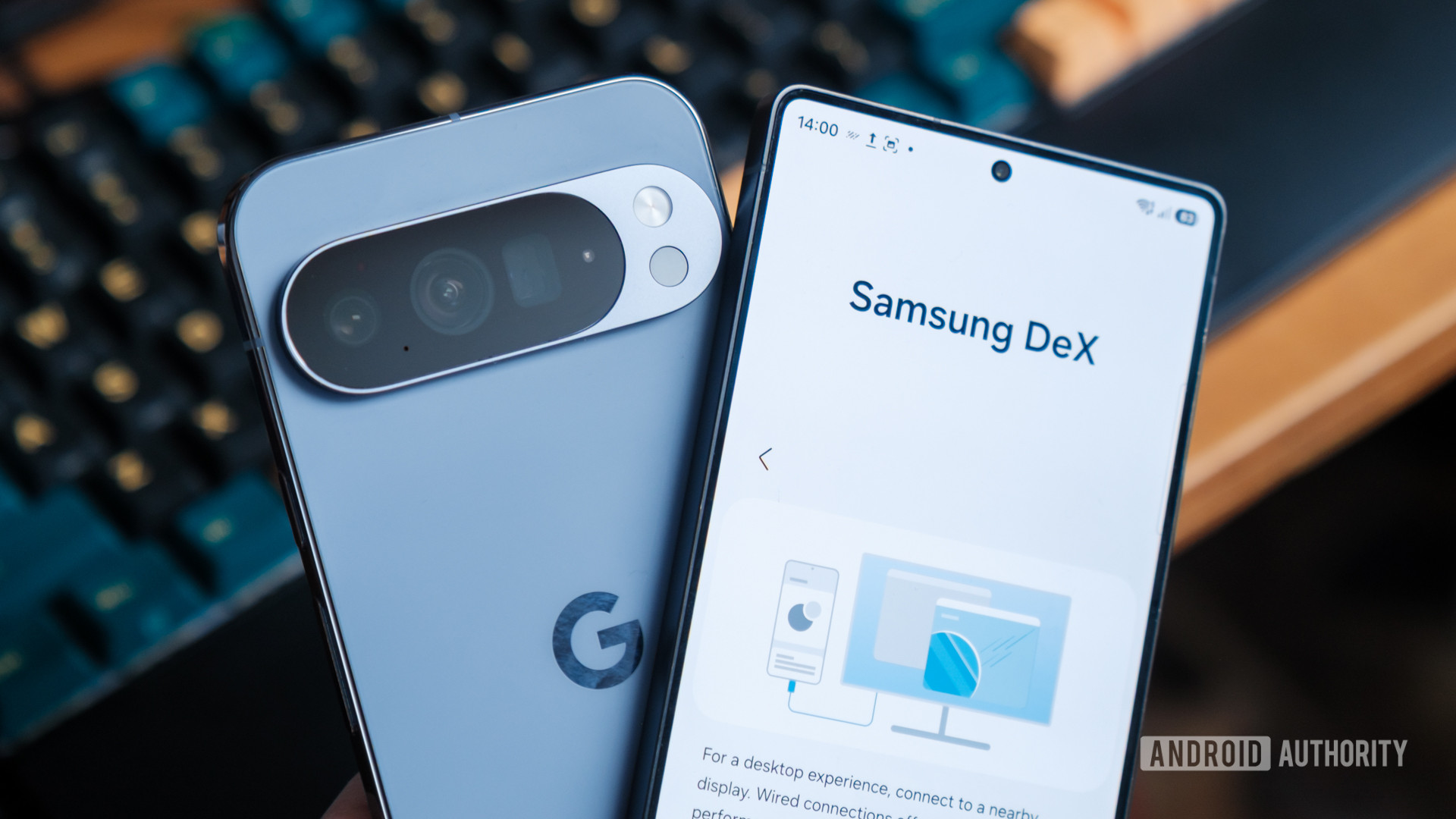
I’ve been enjoying Google’s new Pixel Desktop mode on my Pixel 10 Pro XL lately, to the point that it almost makes the smartphone world feel new again. However, Google is far from the first to combine smartphone and desktop experiences under one roof. American consumers have had access to Samsung’s DeX environment since 2017, and it has gradually improved the platform with several new features that have set a high bar for Google’s new system to achieve.
If anything, it’s surprising that it took Google this long to come up with its own version of the formula. But how do they compare? I spent some time testing everyday desktop tasks on both platforms to help answer the question: What are the differences between Pixel Desktop and Samsung DeX, and which is better?
Which Android desktop experience is better?
2206 votes
Pixel Desktop vs Samsung DeX at a glance
Robert Triggs / Android Authority
Before we get into the features, there is a fundamental difference between these two desktop platforms. Pixel Desktop Mode runs the exact same Android system that powers the phone’s interface, simply rendering a second window environment on the external display. Apps run on the same OS instance, but Android’s native window manager allows them to appear in resizable windows on the larger screen.
Samsung DeX takes a different approach. Instead of relying on Android’s new default desktop-style windows, Samsung places its own desktop interface on top of Android via One UI. Apps still run on the same instance of the Android operating system, but Samsung replaces much of the system’s window management and UI behavior with its own desktop shell. This slightly different architecture makes for some subtle differences in the experience, which we’ll get to in a minute, but the end result is still a native Android desktop experience.
DeX and Pixel desktop modes run your phone’s Android apps, but there are subtle differences.
Fortunately, getting started with any of the desktop options is equally simple. Both platforms support DisplayPort output over USB-C and you can easily connect over HDMI via a dongle adapter. However, older Samsung models had a few other ways to connect, such as a DeX cable or Wireless DeX, which the Pixel doesn’t have.
The phones I used support power transfer and hassle-free plug-and-play compatibility for Bluetooth and USB keyboards and mice. Needless to say, I had no problems getting started with either and they both serve the exact same purpose at a quick glance.
| Pixel Desktop Mode | Samsung DeX | |
|---|---|---|
| First release | 2025 (pixel 10) | 2017 |
| Platform | Native Android desktop windows | Samsung One UI Desktop Case |
| Connection | USB-C DisplayPort port | USB-C, HDMI docks, wireless |
| Desktop customization | Limited | Full desktop layout |
Same basic Android desktop experience
Sticking with peripherals for a second, both desktop environments support the same Bluetooth peripherals as in mobile mode, so you can keep your headphones paired when switching between modes. I also plugged in a microSD card, a USB stick, and an external USB SSD storage device, all of which were instantly detected with no issues, allowing for portability very easily.
Likewise, when launching Samsung DeX or Pixel Desktop Mode, you’ll be greeted with a very familiar desktop look and feel on both platforms. Both interfaces place a customizable app dock at the bottom, complete with an app drawer and three classic Android navigation buttons. The only difference is that DeX places them on the left and Pixel on the right. The two platforms also support up to four separate desktop environments, so you can keep even the busiest multitasking setups in order.
Perhaps the most important factor is how the two desktop modes handle running your standard set of Android apps, and again, the experience is very similar. Google has pushed developers to support a wider range of aspect ratios in recent years, from the standard phone portrait to wider user interfaces for foldable devices and tablets. Pixel Desktop mode takes advantage of these options and automatically updates the user interface to the most applicable mode when the window size changes. DeX works in a very similar way, allowing you to resize windows to any size and adapting the user interface wherever possible.
However, not all apps have been updated to support the widest range of UI options available in the current Android ecosystem. In the old days, DeX used to put older apps in fixed windows, but I couldn’t find any apps that defaulted to this mode; All the apps I tried were expandable and expandable. In fact, the DeX handled some older apps better than the Pixel, which defaulted to full screen and became unresponsive with a couple of older apps I tried that definitely weren’t designed for widescreen support. However, that’s a minor difference in the grand scheme.
Overall, the DeX and Pixel desktop modes provide very similar basic functionality and run today’s modern Android apps just as well in desktop mode as they do in phone mode.
Subtle Differences Make a Difference
Eagle-eyed readers will have already noticed some key differences when we first looked at the interfaces. DeX displays some desktop icons by default, along with the Dock, and you can add apps to the desktop grid by simply clicking and dragging them out of the app drawer. In fact, the DeX desktop is a fully customizable landscape, complete with the same widgets you can place all over your phone’s home screen. Importantly, the changes made here do not affect your phone’s home screen. Meanwhile, the Pixel desktop is essentially a glorified wallpaper. Unlike DeX, you can’t place app icons or widgets directly on it.
Another significant change is the way they both handle quick settings and notifications. DeX adds these options as more familiar “system tray” or “notification area” elements, along with a calendar and clock. Clicking on any of these icons opens the relevant settings, allowing quick access to check your phonebook, toggle Bluetooth connections, or reply to an incoming message. It is very similar to a PC. Google currently doesn’t have anything like this.
DeX has had a few more years to perfect the experience.
Instead, the Pixel opts for a top-down, phone-inspired approach to notifications and quick settings. While this is familiar in some ways, it’s at odds with muscle memory about how we expect desktop interfaces to work. For starters, the little clock or connectivity icons you have to click on at the top of the screen are too small. Even after you finally open the menu, it still takes up the entire screen, blocking your apps and limiting your multitasking. Compared to a small popup on the side of the screen, it’s not great.
However, it’s not a clean sweep for DeX. On my Samsung Galaxy S25 Ultra, DeX scaled Chrome so aggressively that browsing some pages became uncomfortable. Basically, it’s stuck in the mobile world, causing all sorts of formatting issues when viewing pages on a big screen. Requesting desktop versions of the sites helped, but not enough to make it a native experience; You’re better off sticking with Samsung Internet, which works perfectly. In comparison, Google has made some efforts to ensure a more desktop-like Chrome experience, although it still lacks extensions.
DeX is still the best Android desktop setup, for now
By now, you can probably see that I’m leaning more in favor of DeX than Pixel Desktop mode, but only for some small quality of life improvements rather than a core functionality difference.
For example, DeX does a better job of showing additional but very important external display settings. There’s a dedicated screen timeout option for PC mode, which is frustratingly the same for phone and desktop modes on the Pixel. Additionally, you can set PC-only wallpapers in DeX, while all customization settings are shared in Google’s implementation. My Galaxy S25 Ultra even features a small touch button at the bottom left of the phone’s screen, allowing me to easily navigate the external display without a mouse attached. Points for DeX here; The maturity of the platform and the additional years of refinement make it a little more pleasant to use.
The Pixel feels like a large phone, while the DeX is a more classic desktop.
I can best summarize the difference as the Pixel’s setup is more limited in one key respect: its UI is still very much tied to your phone’s interface. The phone-like notification panel and lack of persistent settings per interface are minor complaints, but they’re certainly enough to take the shine off the experience for power users. Once you peel back the packaging, it’s clear that you’re still working on a Pixel phone, while DeX has a clearer separation between your phone’s host and the desktop interface where you want to spend time doing serious work. They’re just small differences, but they add up.
Pixel Desktop mode shows where Android is headed: a single operating system that scales seamlessly from phone to desktop. After all, Google plans to acquire Aluminum OS desktops before the end of the year. But today, Samsung DeX still looks like the most complete desktop environment thanks to its additional refinement. However, the gap is not huge and if Google continues to iterate at the current pace, Pixel Desktop mode may not be left behind for long.
I don’t want to miss the best of Android Authority?


Thank you for being part of our community. Please read our Comment Policy before posting.