The Royal Saudi Naval Force will receive four C-27Js in the new Maritime Patrol variant, with deliveries expected to begin in 2029.
Leonardo has announced which will supply four C-27J in the new Maritime Patrol Aircraft (MPA) variant to the Ministry of Defense of Saudi Arabia. The aircraft will be operated by the Royal Saudi Naval Forces to counter modern underwater and sea surface threats, ensure effective search and rescue (SAR) services, and perform transport and airdrop missions.
The company says the service will receive the first aircraft in 2029, becoming the 21st operator of this type. It should be noted that these are not the first C-27s sold to the country, as two aircraft configured for multi-mission roles, including aerial firefighting and medical evacuation (MEDEVAC), were acquired in June 2025.
Leonardo highlighted that the new acquisition marks the first time that the C-27J MPA has been acquired with maritime weapons systems integration capability. Integrating this capability is part of the ongoing work Leonardo is doing to make the most of the platform’s versatility.
The US Coast Guard uses a similar, albeit unarmed, configuration as the HC-27. However, there are some key differences in aircraft-integrated systems due to different requirements.
C-27J Spartan MPA
In its press release, Leonardo explains that the new variant of the Maritime Patrol Aircraft (MPA) will be based on the C-27J Spartan Next Generation. The NG variant is an improvement of the original C-27J, providing greater performance and efficiency, state-of-the-art avionics, navigation, communication, identification and self-protection systems.
As part of the new C-27J MPA integrates a set of dedicated missions, including sensors optimized for the detection, identification and tracking of surface and underwater targets, managed by the Leonardo ATOS (airborne tactical observation and surveillance system) mission management system with data fusion capabilities. According to Leonardo brochureSensors include an Active Electronically Scanned Array (AESA) search radar, an electro-optical/infrared (EO/IR) system, an automatic identification system (AIS), electronic support measures (ESM) for intelligence, surveillance and reconnaissance (ISR) and signals/electronic intelligence (SIGINT/ELINT), a magnetic anomaly detector (MAD) and an acoustic subsystem.
To complete the maritime surveillance equipment, the aircraft is also equipped with two observation windows, two removable ten-barrel rotating sonobuoy launchers and two fixed single-barrel artillery launchers for underwater sound signals, flare and smoke markers, as well as a mission system with up to 5 operator stations. Additional capabilities are provided through the addition of search and rescue (SAR) kits and a self-protection system.
A complete communication system allows data to be shared in real time with other assets, also in Beyond Line Of Sight (BLOS) conditions thanks to satellite communications (SATCOM). The C-27J MPA can carry a weapons payload of 7,495 lb/3,600 kg on six wing pylons to counter multiple threats, including lightweight torpedoes, anti-ship missiles, and depth charges according to specific mission needs.
In this armed configuration, the aircraft has a range of more than nine hours, which can be extended with in-flight refueling. For longer duration missions, the C-27J MPA is also equipped with a crew rest area.
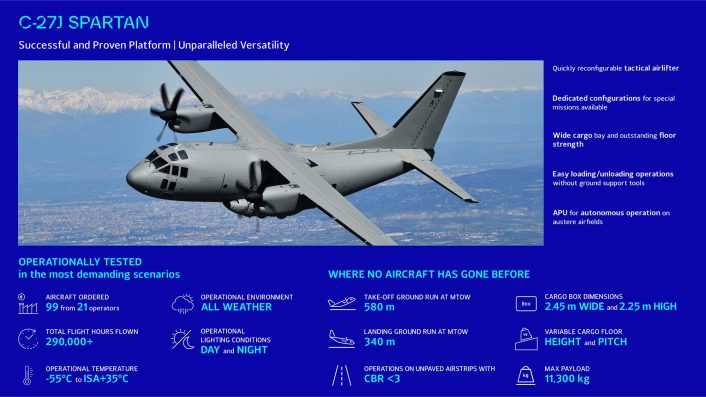
The MPA configuration can be assembled as a palletized roll-on/roll-off solution. This allows the aircraft to be easily reconfigured to perform the transport, airdrop and medical evacuation missions typical of the basic C-27J.
Next generation C-27J
The C-27J Next Generation was launched in 2020 as an upgrade to the base aircraft to improve its efficiency and performance. This is how Leonardo test pilot Matteo Maurizio, head of the Transport Aircraft Test Pilot, Special Versions and UAS project, described the improvements in 2020, who has been involved in the development of the new Spartan variant since its first test flights, as we reported in a previous article here on The aviationist:
“The main differences are related to the flight qualities and performance of the aircraft. In terms of quality, I must highlight that the new state-of-the-art avionics technology fully complies with the most updated international standard, called Performance Based Navigation and has new features in the cockpit such as FANS1/A+ Datalink, TCAS 7.1, ILS Cat II and Enhanced Video TAWS. This allows us to exploit all the capabilities offered by operation in civil airspace without limitations and improve interoperability in tactical military scenarios with the integration of Modo 5 IFF/ADS-B, tactical VNAV and Search and Rescue.
The new cockpit design includes five new multipurpose color display units, with new and improved LED lighting and panels that increase pilots’ efficiency during a flight, a dual redundant flight management system, two digital flight director and autopilot systems with autothrottle capabilities and a comprehensive communications suite. For in-theater operations, these features, along with the Spartan’s many large cockpit windows, full cockpit compatibility with NVIS/NVG night vision systems, and Head-Up Display availability, help minimize pilot workload while increasing the ability to effectively manage the mission during the day, night, and in adverse weather conditions.
In terms of performance, the new winglets offer us several advantages in terms of controllability of the aircraft, in particular flying at low speeds, as well as better payload capacity also in high and hot conditions.
While its cruise speed of 325 KTAS (602 km/h) and service ceiling of 30,000 feet (9,144 m) will not change with the new configuration, the winglets will improve the aircraft’s climb capabilities in terms of climb gradients or MTOW of approximately 1,000 kg. This will allow us to operate from those airports with particularly steep climb slopes, which are normally served by four-engine aircraft.”