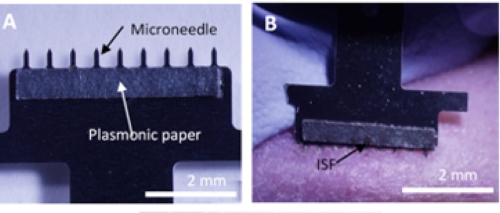
Many diagnostic tests require blood, but NIBIB-funded researchers have developed a skin patch with tiny needles that painlessly collects interstitial fluid (ISF) for testing. Diagnostic tests can measure traces of essential proteins or hormones in the blood called biomarkers. High or low levels of biomarkers are specific indicators of a disease. In the new test, a single paper in the patch backup stores small amounts of ISF, where it remains for analysis. Researchers believe the ISF patch will simplify diagnostic testing and allow for continuous monitoring of biomarkers. Tracking biomarkers is crucial because doctors routinely use them to diagnose and monitor patients at risk for cancer, heart disease, and diabetes.
Interstitial fluid fills the space between cells throughout the body and contains most of the same biomarkers found in blood. ISF lacks cells and clotting agents, which can complicate blood tests, making it an attractive target for diagnostic testing. Many groups have begun using ISF for diagnostic testing, but Mark Prausnitz, Ph.D., Regents professor of chemical and biomolecular engineering at the Georgia Institute of Technology, thought the procedure for analyzing ISF could be simplified.
Prausnitz and his team, in collaboration with Srikanth Singamaneni, Ph.D., professor of mechanical engineering and materials science at the University of Washington, used surface-enhanced Raman scattering (SERS) to speed up the analysis. This technique measures the quantity of the molecule by detecting its unique light scattering pattern. Negatively charged gold nanorods are incorporated into the paper on the backing of the patch and trap the positively charged biomarker of interest in the ISF.
Their results, published in ACS Sensors, show that the nanorods successfully attracted a positively charged molecule that the researchers had injected into the rats’ bloodstream and which was absorbed into their ISF. The interaction between the nanorods and the trapped molecules amplified the Raman scattering so they could analyze it with SERS with greater sensitivity. The researchers reported that the new procedure is as sensitive as previous multi-step methods.
Prausnitz said: “As a next step, we can adapt the methods we use to trap molecules in ISF to be more selective, using antibodies specific for a certain biomarker. In the future, we could create capture methods for multiple biomarkers, all on the same patch.” Researchers say the patch can speed up diagnostic testing, is designed to require less effort than previous methods and can be produced in mass quantities at low cost.
“This is a great example of how rethinking common medical tests can lead to new technology that can accelerate healthcare, especially continuous monitoring of important biomarkers,” said Tiffani Lash, Ph.D., director of the NIBIB programs in Point-of-Care Technologies and Connected Health (mHealth and Telehealth). The team’s next steps are to continue testing the patch to ensure its safety for human use and its effectiveness in reliably detecting biomarkers of medical interest.
The research was funded, in part, by a NIBIB grant (EB025499).
Chandana Kolluru, Rohit Gupta, Qisheng Jiang, Mikayla Williams, Hamed Gholami Derami, Sisi Cao, Richard Noel, Srikanth Singamaneni, Mark R. Prausnitz. Plasmonic Paper Microneedle Patch for On-Patch Detection of Molecules in Dermal Interstitial Fluid. ACS Sensors, 2019