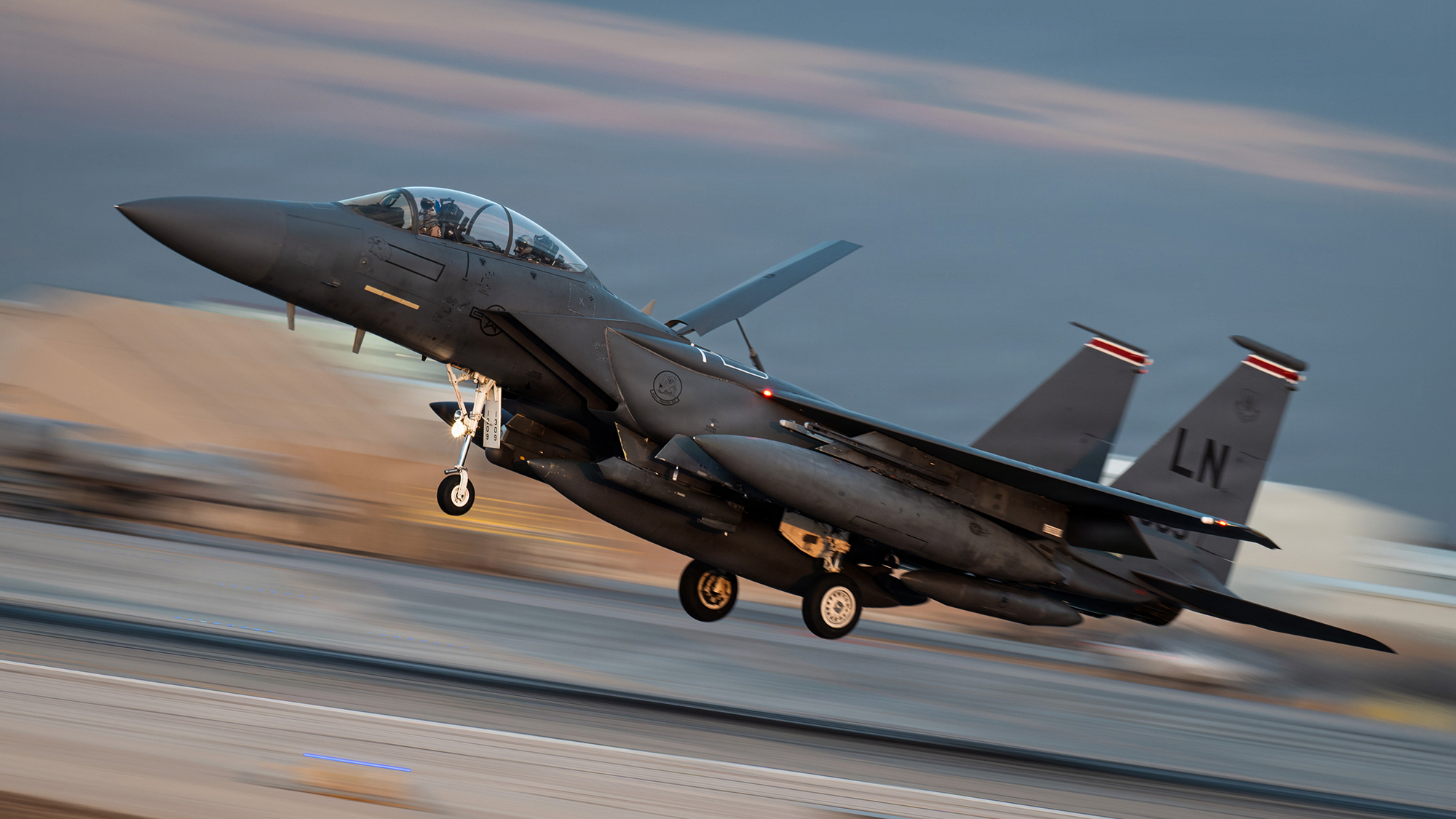
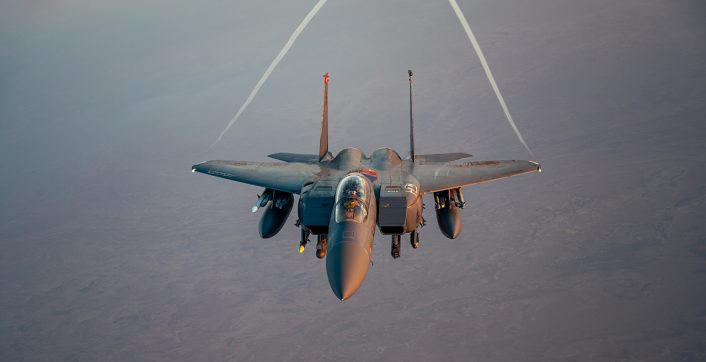
12 F-15E Strike Eagles from the 494th Fighter Squadron, based at RAF Lakenheath under the 48th Fighter Wing, have been deployed to the Middle East.
After US President Donald Trump promised that “Help is on the way” to protesters in Iran, facing violent repression by state authoritiesA series of what appear to be additional deployments of fighter and support aircraft have been observed in the US Central Command (CENTCOM) area of responsibility. The USS Abraham Lincoln (CVN 72) carrier strike group (CSG) has also been reassigned from operations in Southeast Asia to a position within CENTCOM.
On Sunday, January 17, 2026, a total of twelve F-15E Strike Eagles, supported by two spare aircraft, departed RAF Lakenheath in the United Kingdom with tanker support heading to the Middle East. Its arrival at the station was confirmed by the US Air Force on January 18 with an image of a Strike Eagle from the 494th Fighter Squadron (FS) landing at an undisclosed base in the Middle East.
Geolocation based on buildings visible in the background of the images, as well as the destinations of some C-17 Globemaster III flights that are likely support missions for deployed units, all but confirm the location of this undisclosed base as Muwaffaq Salti Air Base, Jordan.
US military reinforcements are steadily increasing at the Muwaffaq Salti air base in Jordan.
At least four additional USAF C-17A strategic transport aircraft recently arrived at or toured the base, along with the deployment of the F-15 fighter squadron and A-10 ground attack aircraft. https://t.co/c8U6QZwE8N pic.twitter.com/qmsThazSUe
— Egyptian Intel Observer (@EGYOSINT) January 21, 2026
Muwaffaq Salti is one of the most used bases in the Middle East for US fighter jet deployments, and has hosted F-15, F-16, F-22 and F-35 fighters, as well as MQ-9 Reaper drones. Notably, in addition to the F-15E Strike Eagles, the base also currently hosts a detachment of A-10C Thunderbolt II attack aircraft.
An A-10 can be seen in the background of the F-15E image released on January 18. The base’s location in Jordan provides an ideal launching point for ongoing missions over Iraq and Syria against Daesh, and it seems likely that the A-10s involved in Operation Hawkeye Strike in December 2025 would operate from here. It should be noted that although tensions with Iran have increased, US attacks against Daesh forces have also increased and it cannot be ruled out that this deployment is primarily intended for this purpose.
A U.S. Air Force F-15E Strike Eagle assigned to the 494th Expeditionary Fighter Squadron lands at a base in the Middle East, Jan. 18. The presence of the F-15 enhances combat readiness and promotes regional security and stability. pic.twitter.com/QTXgOsOozV
— US Central Command (@CENTCOM) January 20, 2026
Of the F-15Es that left Lakenheath, one is known to have diverted towards Chania International Airport, near Souda Bay, Crete, for unknown (presumably technical) reasons.
Alongside the 494th FS aircraft, 12 Strike Eagles most recently rotated through Lakenheath to continue their journey to Jordan. These aircraft came from the 4th Fighter Wing at Seymour Johnson Air Force Base, North Carolina. It was assumed that this was a rotation, intended to relieve the Mountain Home Air Force Base Strike Eagles already deployed with CENTCOM, but so far there has been no sign of these aircraft returning. Its deployment may have been expanded, at least for a brief period, to provide additional resources.
In addition to fighters, aircraft tracking enthusiasts have noted a steady flow of strategic airlift and refueling aircraft in transit to bases throughout the Middle East. Some C-17s have also indicated that their final destination is Diego Garcia, a base in the British Indian Ocean Territory that would theoretically present itself as an ideal and secure forward base for sustained operations in Iran. Diego García has had renewed airtime in the news as President Trump withdrew your previous support for the UK’s agreement to cede sovereignty of the territory to Mauritius to resolve a long-standing territorial dispute. In exchange, the joint base – used primarily by US forces – would remain under an initial 99-year lease.
Unusual departure from the RAF
Interestingly, on January 16, a day before the F-15s left the UK, a Royal Air Force Protector RG1 made an unusual sortie over Muwaffaq Salti AB. At about 12,000 feet, it appears as if the aircraft is acting in an intelligence, surveillance and reconnaissance (ISR) capacity. It is unclear whether it was part of a training exercise or not. As previously deployed RAF MQ-9A Reapers were not shown on flight tracking systems, it is impossible to know whether this type of mission was flown regularly before, and we are simply now seeing it for the first time because the new Protector aircraft transmits ADS-B at least some of the time.
An RAF protector over 🇯🇴 Muwaffaq al Salti AB? 🤨
🇬🇧 RFR7331 is RG.1 (MQ-9B) PR011 #43C973 pic.twitter.com/ennDAZ4jwy
— Evergreen Intel (@vcdgf555) January 16, 2026
The F-15E Strike Eagle
The F-15E Strike Eagle is one of the most versatile fighter aircraft in the US Air Force inventory. Although the F-15A was fielded and marketed – “not a pound from air to ground” – as an air superiority thoroughbred, McDonnell Douglas was confident in the design’s adaptability and began work on a strike fighter variant soon after the first Eagles entered service.
Taking advantage of the conformal fuel tanks (CFT, also known as FAST (Fuel and Sensor, Tactical) packages on the F-15) to gain additional range and a few more pylons for weapons or equipment, and adding a rear seat for a weapons systems officer (WSO), the F-15E eventually won opposition from air superiority purists and was selected as the replacement aircraft for the F-111 Aardvark. The first production Strike Eagle was delivered to the USAF in 1988 and more than 200 examples would be acquired.
Across 25 hardpoints, Strike Eagles can carry a staggering amount of weaponry, exceeding the total payload weight of a B-29 Superfortress bomber by comparison. Almost all weapons currently in service with the US Air Force have been integrated into the aircraft, including the GBU-28 and GBU-72 specialized bunker destroyers. The F-15E is the only tactical-sized aircraft in US service known to be capable of carrying these munitions.
Annotated side view of the F-15 carrying 5 B61 nuclear gravity bombs! pic.twitter.com/pF1oaGumeI
— Casillic (@Casillic) August 9, 2021
During its service life, the Strike Eagle has proven its usefulness as an attack aircraft and as an air-to-air fighter. Famously, during Operation Desert Storm, an F-15E air-to-air shot down an Iraqi Mi-24 ‘Hind’ helicopter using a 2,000-pound laser-guided bomb. Air-to-air weapons such as the AIM-9 Sidewinder and AIM-120 AMRAAM are at home under the Strike Eagle’s wings as bombs, and in recent times the type has also been one of those carrying Advanced Precision Kill Weapons System (APKWS) rocket pods for use against aircraft and small and unmanned weapons.
The F-15E was used as the basis for a number of foreign customer-specific variants, including the Israeli F-15I Ra’am, South Korea’s F-15K Slam Eagle, Saudi Arabia’s F-15S, and Singapore’s F-15SG. Although it now replaces the dedicated air-to-air F-15C in service, the new F-15EX Eagle II is also based on the Strike Eagle and is equipped with two seats and CFT by default.