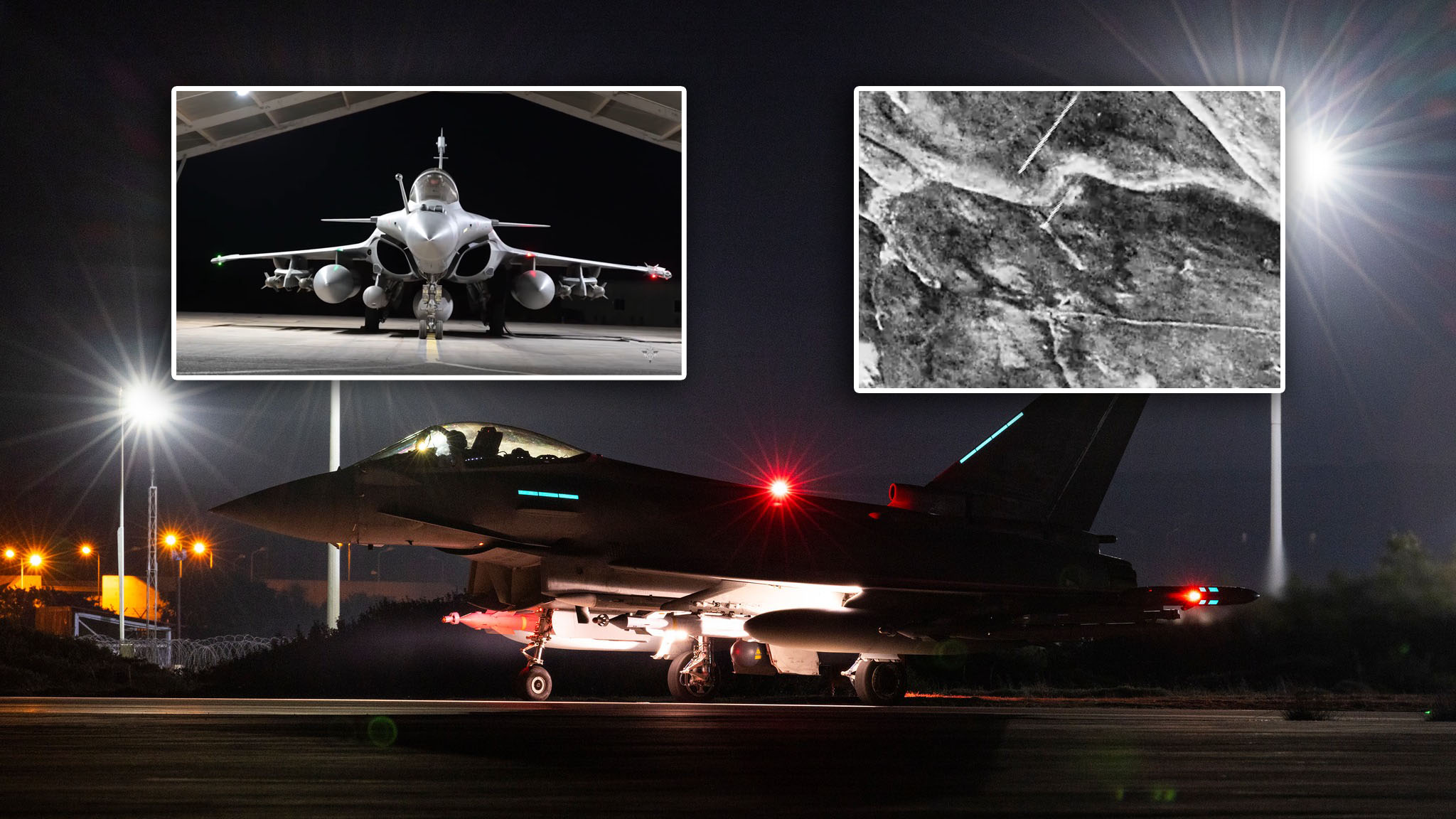
An underground facility operated by the terrorist group north of Palmyra, Syria, was hit by attack aircraft in a combined raid on January 3, 2026.
The UK Ministry of Defense (MoD) announced the operation on the evening of January 3, amid global news attention on the US operation in Venezuela, shortly after the mission was completed.
Secretary of State for Defense John Healey said: “This action shows our leadership in the UK and our determination to stand shoulder to shoulder with our allies to end any resurgence of Daesh and its dangerous and violent ideologies in the Middle East.”
This action shows our UK leadership – and our determination to stand shoulder to shoulder with our allies – to eradicate any resurgence of Daesh and its dangerous and violent ideologies in the Middle East. https://t.co/fJQE3I3ubQ
—John Healey (@JohnHealey_MP) January 3, 2026
The Royal Air Force contingent on the mission used Typhoon FGR4s, which deployed Paveway IV precision-guided bombs against the underground complex. They were supported by Voyager refueling aircraft, all flying from RAF Akrotiri within British territory on the island of Cyprus.
Unlike some recent missions, it is notable that the strike did not appear to enter through Syrian airspace, but instead took the historic route through Israeli and Jordanian airspace. The new flight route has been used more frequently since the change of leadership in Syria, which now apparently allows coalition aircraft to operate over its airspace with government permission.
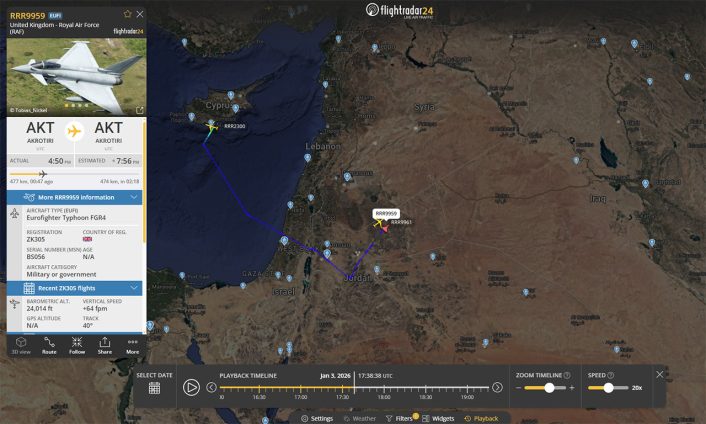
The aircraft almost certainly involved in the attack could be tracked entering Syrian airspace around 17:30 UTC before returning after 19:00 UTC. Routine Operation Shader missions (the operational code name given to the UK military intervention against Daesh, also known as ISIS or ISIL) can be regularly tracked in a similar manner, so this would not have impacted operational security to any degree more than usual. In fact, if they had been seen or heard preparing a mission but without ADS-B or Mode S enabled, it could alert adversaries that a more unusual attack was being planned.
The French Air Force participated with Rafale aircraft operating from a base in the Middle East. Video footage posted by official social media accounts shows aircraft carrying AASM Hammer weapons, which were presumably of the type used on the mission. It is likely that French refueling aircraft were also involved. Unlike RAF raids, French operations in the region can rarely be tracked using flight tracking apps.
📍Syria | Dans le cadre d’OIR (Operation Inherent Resolve) la 🇫🇷 et son there 🇬🇧 ont réalisé des frappes contre des positions du groupe terroriste de l’État islamique.
⁰➡️ Empêcher the resurgence of Daesh: a greater effort for the security of the region.
⁰➡️ La lutte contre le… pic.twitter.com/bllq9vSHA7— Armée française – Military operations (@EtatMajorFR) January 4, 2026
in your advertisementThe UK Ministry of Defense stated that careful intelligence analysis had identified the target, which was suspected to have been used to store weapons and explosive materials. It was located far from any civilian population and no risk to civilian life was identified during the attack. The Paveway IV bombs, which are based on 500-pound Mark 82 general-purpose bombs, were aimed at access tunnels leading to the facility. A more detailed battle damage assessment (BDA) had not yet been completed at the time of the statement, but initial assessments, likely captured through the LITENING targeting pods carried by the Typhoon FGR4s, indicated that the mission had been a success.
Our aircraft used Paveway IV guided bombs to target several facility access tunnels; While a detailed assessment is already underway, early indications are that the target was successfully attacked. pic.twitter.com/IPBOv3rCeR
— Ministry of Defense 🇬🇧 (@DefenceHQ) January 3, 2026
The facility was located on a mountain range north of the ancient city of Palmyra, a UNESCO World Heritage Site which became a hotly contested battlefield during the Syrian Civil War. In addition to the destruction suffered during fighting and aerial bombardment, Daesh deliberately demolished some of the city’s ancient features and beheaded the site’s head of antiquities in a public execution staged after he refused to reveal details and locations of some of the city’s most prized treasures.
Geolocations using open source data by analyst Samir (@obretix) indicate that the facility was about 40 kilometers north of Palmyra, far from the risk of causing damage to the historical fabrics around the site.
Coalition airstrike in Syria geolocated about 40 km north of Palmyra https://t.co/xdk47qAPNw https://t.co/HLznelESMm pic.twitter.com/v2rrR25nVp
– Samir (@obretix) January 4, 2026
Although Daesh has not controlled significant amounts of territory in Syria since the Battle of Baghuz Fawqani in 2019, pockets of the group’s influence still exist in small, focused areas. In September 2024, the United States announced that the military intervention against Daesh come to an end over the next 12 months and transition to a new phase, which was echoed by a UK statement. Even though more than 12 months have passed, operations against Daesh show little sign of slowing down compared to before the announcement, with both Operation Inherent Resolve and Operation Shader remaining active.
He official presence on social networks for the Combined Joint Task Force participating in Operation Inherent Resolve shared news of the mission and said: “Although Daesh no longer controls the territory, it continues to operate through remaining cells, particularly in remote desert areas. This operation demonstrates the continued unity, capability and determination of Operation Inherent Resolve (OIR) partners, including France and the United Kingdom, to disrupt ISIS’s ability to regroup, rearm and conduct attacks.”