Parisa Hafezi, Alexander Cornwell and Enas Alashray
Updated ,first published
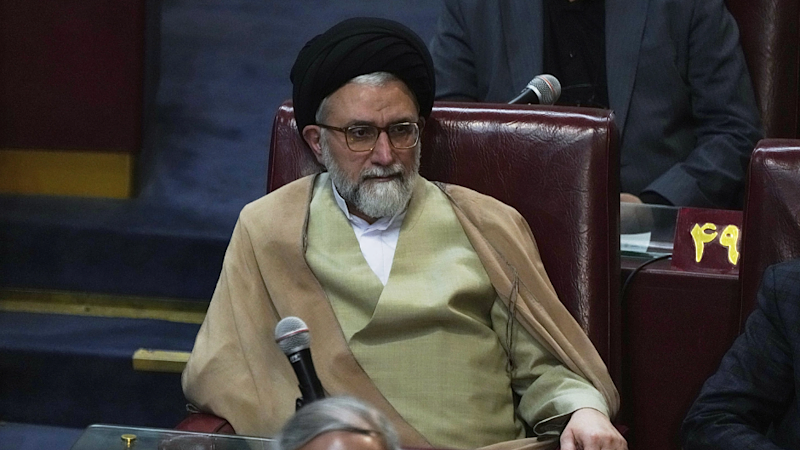
Dubai/Tel Aviv: Iranian Intelligence Minister Esmail Khatib has been killed by Israeli strikes, state television confirmed.
Israeli Defense Minister Israel Katz announced Khatib’s killing and said that “significant surprises are expected throughout this day on all fronts,” without giving further details.
Katz said he and Israeli Prime Minister Benjamin Netanyahu had authorized the military to kill any other senior Iranian officials who were under attack without needing additional approval.
The Israeli military said Khatib was killed in an “attack aimed at Tehran.” Iranian state television and Iranian President Masoud Pezeshkian confirmed the murder hours later.
Khatib’s killing follows Israel’s assassination of senior Iranian security official Ali Larijani and the head of the Revolutionary Guard’s all-volunteer Basij paramilitary force, Gholam Reza Soleimani.
Meanwhile, facilities associated with the huge South Pars offshore natural gas field, which Iran shares in the Persian Gulf with Qatar, were attacked on Wednesday local time, state media reported.
Iran then issued an evacuation warning for oil facilities, including Saudi Arabia’s Samref refinery and Jubail petrochemical complex, the United Arab Emirates’ Al Hosn gas field and Qatar’s Mesaieed petrochemical complex, Mesaieed holding company and Ras Laffan refinery.
“These centers have become direct and legitimate targets and will be attacked in the coming hours. Therefore, all citizens, residents and employees are requested to immediately leave these areas and move to a safe distance without delay,” the warning said.
Earlier, Iran attacked Tel Aviv with missiles carrying cluster warheads, and Iranian state television claimed the attacks were in retaliation for Israel’s killing of Larijani.
The attack on Tuesday (Israeli time) on densely populated Tel Aviv killed two people, raising the death toll in Israel from the war to at least 14.
The Iranian government has confirmed the killing of Larijani, the highest-ranking figure targeted since the first day of the US-Israel war, when an Israeli strike killed Iran’s supreme leader, Ayatollah Ali Khamenei.
Iran’s Supreme National Security Council, which Larijani led as secretary, said Larijani’s son and his deputy, Alireza Bayat, were also killed in an Israeli strike on Monday night.
The targeted killings came as the US-Israel war against Iran shows no signs of de-escalation. US President Donald Trump is still smarting from the lukewarm response to his requests for military aid from his allies to reopen the Strait of Hormuz.
Most U.S. allies in the North Atlantic Treaty Organization have told the United States that they do not want to get involved in the conflict, Trump said Tuesday, describing his position as “a very foolish mistake.”
“Due to the fact that we have had such military success, we no longer ‘need’ or want help from NATO countries. WE NEVER DID!” Trump wrote on social media, also singling out Japan, Australia and South Korea.
The European Union’s foreign policy chief, Kaja Kallas, said in an interview that no one was willing to risk the lives of their people to protect the strait.
“We have to find diplomatic ways to keep this open so that we don’t have a food crisis, a fertilizer crisis and also an energy crisis,” Kallas said.
The US military has attacked sites along Iran’s coast near the Strait of Hormuz because Iranian anti-ship missiles have posed a risk to international shipping there.
On Wednesday morning (US time), US Central Command said it had dropped several two-ton bombs – known colloquially as “bunker busters” – on Iranian missile sites near the strait, as it tries to reopen the waterway crucial to global shipping.
“U.S. forces successfully employed multiple 5,000-pound weapons [2270-kilogram] deep-penetrating munitions at hardened Iranian missile sites along Iran’s coast near the Strait of Hormuz,” the organization said.
The United States has made shifting arguments for joining Israel in attacking Iran and has struggled to explain the legal basis for starting a new war, underlined by Tuesday’s resignation of the head of the US National Counterterrorism Center, Joseph Kent. Kent wrote in his resignation letter to Trump that Iran “posed no imminent threat to our nation.”
Meanwhile, Iran’s new supreme leader Mojtaba Khamenei rejected proposals sent to Iran’s Foreign Ministry for “reduced tensions or a ceasefire with the United States,” a senior Iranian official, who asked not to be identified, told Reuters.
Khamenei, attending his first foreign policy meeting since his appointment, said it was not “the right time for peace until the United States and Israel kneel, accept defeat and pay compensation,” according to the official.
The official did not clarify whether the younger Khamenei, who has yet to appear in photographs or on television since he was named last week to replace his slain father, had attended the meeting in person or remotely.
The US-based Iranian human rights group HRANA has said that more than 3,000 people are estimated to have been killed in Iran since attacks between the US and Israel began in late February.
Iranian attacks have killed people in Israel, Iraq and the Arab Gulf states, which have faced more than 2,000 missile and drone attacks against US diplomatic missions and military bases, as well as oil infrastructure, ports, airports, ships and residential and commercial buildings.
Saudi Arabia will host a consultative meeting of foreign ministers from Arab and Islamic countries in Riyadh on Wednesday to discuss ways to support regional security and stability, the kingdom’s foreign ministry said.
Oil prices rose about 3 percent on Tuesday as Iran renewed its attacks on oil facilities in the United Arab Emirates, and have risen about 45 percent since the start of the war on February 28, raising concerns of a new rise in global inflation.
The World Food Program said tens of millions of people would face acute hunger if the war continued into June.
Global airlines sounded the alarm this week over rising jet fuel prices, warning of hundreds of millions of dollars in additional costs, higher fares and cuts to some routes. Global aviation has been thrown into turmoil, with flights cancelled, rescheduled or diverted while most of the Middle East’s airspace remains closed amid fears of missile and drone attacks.
Reuters, AP
Get the story straight from our foreign correspondents on what’s making headlines around the world. Subscribe to our weekly What in the World newsletter.