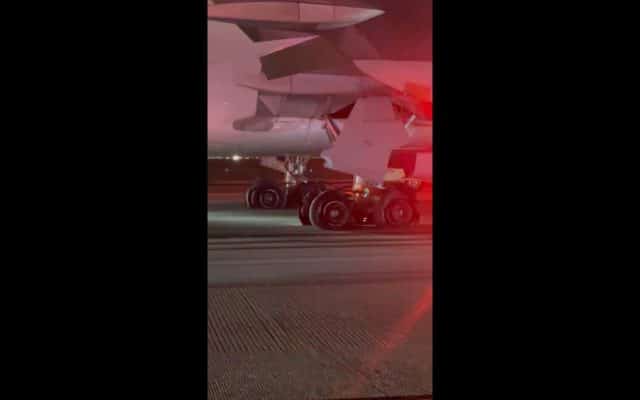
On Tuesday night, a routine commercial passenger flight landed at Atlanta’s Hartsfield-Jackson Airport. All eight main landing gear tires exploded upon impact.
The aircraft, a Boeing 767-316ER, registered in Chile as CC-CXF, was operating as LATAM flight 2482, a commercial flight from Lima, Peru to Atlanta, Georgia, United States. They left Lima at 12:14 local time with 221 passengers on board. The seven-hour flight to Atlanta was uneventful, and in fact they arrived almost twenty minutes early.
When they arrived to land at 26R, passengers commented that it was very turbulent. The plane landed. The sound of multiple loud explosions could be heard. In the cabin, the landing was felt extremely harsh and was quickly followed by violent vibrations. The flight crew reported that they could not taxi and that they had indications that the right main gear was not lowered. Emergency services rushed to the runway and surrounded the plane. They initially reported that the two right main tires had burst. A few minutes later they reported that all of the main tires had burst.
Inside the cabin, the roof panels had come off and the overhead compartments had opened. A bathroom door had broken off its hinges. Passengers were evacuated to the runway using moving stairs. Some passengers said They were left on the plane for almost two hours before the buses arrived to take them to the terminal. However, AVHerald reported that the plane was towed off the runway about an hour after landing. In any case, the runway was inspected for remains of foreign objects and remained closed for several hours.
The Boeing 767 is still in Atlanta, where it will undergo testing, not only to detect system failures but also to detect structural damage. The risk is that the landing force is transmitted through the landing gear to the aircraft structure, causing the skin or internal structures of the aircraft to deform or buckle. Although the plane appears normal from the outside, it is possible that the metal has suffered what they call “structural wrinkles.”
Having eight main tires fail at the same time is extremely unusual: something must have affected all of them, not just one wheel or one side.
Option 1: very hard landing
The force of the vertical impact at the time of landing exceeded what the tires could withstand; All eight tires hit the track with such force that they were damaged and burst.
Option 2: wheels locked during landing roll
The wheels stopped spinning (locked) while the aircraft was still moving down the runway. The tires skidded on the asphalt, accumulating enormous friction and heat until they shattered. This could be due to a failure of the anti-skid system, a rider applying the brakes too hard, or some other brake system malfunction.
Option 3: Both
The crash landing damaged the landing gear on impact, then locked brakes or hard braking destroyed what was left as the plane taxied down the runway.
The crew’s report that they had an indication of the correct main gear was probably caused by the strong impact; If they had seen the indication before landing, they would have turned around. Passengers reported an extremely rough landing, multiple hard hits and violent vibrations, along with a reference to the feeling that the wheels were “rattling on the asphalt” for a long time. Hard landing and initial bumps support a hard landing. Interior damage (hinged doors, falling panels) may mean that the G-forces during landing were significant or that they came loose due to the violent vibrations of the landing roll. The violent vibrations and rattles on the asphalt could be due to running on the tires or braking problems. Right now, I’m leaning heavily toward option three.
The flight data recorder will answer this question by telling us if the brake pressure was modulated.
When the anti-skid system is operating, the FDR trace for brake pressure looks like an irregular sawtooth wave (pressure increases, wheel decelerates, pressure decreases, wheel rotates, pressure increases again). You can stand on the brake pedals with both feet, scream in panic, and the wheels won’t lock. The computer will fight you.
If the FDR trace simply stops at full pressure while the speed drops, it means that the wheels locked and the system did not do its job to release the brakes. If the strong impact broke something in the system, then that malfunction could have caused the wheels to lock. Or equally, it could simply be that the surprised pilots stepped on the brakes, hoping that the anti-skid system would modulate that braking for them.
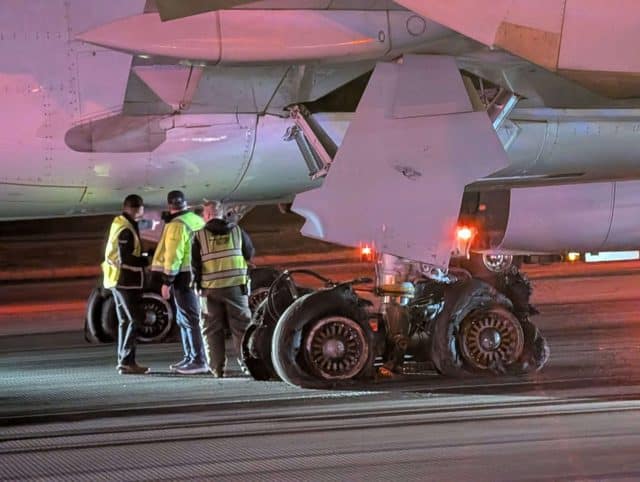
The National Transportation Safety Board (NTSB) will lead the investigation, which will be joined by the Chilean authorities (DGAC), since the aircraft was registered in Chile. Your main goal will be to analyze the flight data and determine exactly which systems failed and when. For now, the Boeing 767 remains grounded in Atlanta, not for the tires, which can be changed in an afternoon, but to see if the airframe survived the G-forces of the impact without permanent structural deformation. If the impact caused critical structural damage, this landing may have been the 767’s last.