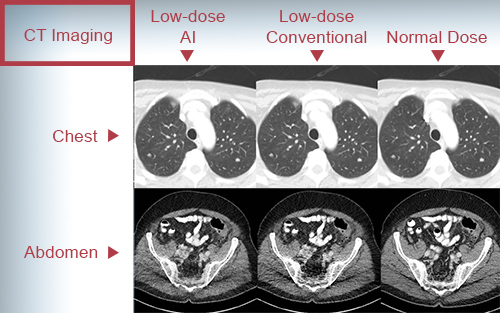
Radiologists rate low-dose CT processed with novel deep learning technique highly
A team of bioengineers at Rensselaer Polytechnic Institute (RPI), with funding from the National Institute of Biomedical Imaging and Bioengineering (NIBIB), has developed an artificial intelligence (AI) technique that uses image post-processing to quickly convert low-dose computed tomography (CT) scans into higher quality images, compared to low-dose scans that do not use the AI technique. CT has become a commonly prescribed imaging service in modern medicine, providing a non-invasive, detailed, close-up view of internal anatomy and pathology. Low-dose CT minimizes x-ray radiation to the patient.
“This hybrid deep learning image reconstruction technique integrates low radiation dose CT images with emerging neural network methods and delivers comparable images at a much faster rate than those produced with iterative reconstruction methods,” said Behrouz Shabestari, Ph.D., NIBIB program director in Artificial Intelligence, Machine Learning and Deep Learning. “Dr. Wang’s team has advanced deep learning techniques for tomographic imaging and continued this research with the support of an NIH grant to improve image quality and computational efficiency for low-dose CT.”
With its increasing use, CT scanning contributes to 62% of the radiation dose received by people in the United States from all imaging modalities. Although the risk of developing cancer from such radiation exposure is small, public concern has increased with the increasing use of CT scans, making CT dose reduction a clinical goal. Medical imaging engineers are working to develop technologies that reduce the radiation dose of CT without compromising its diagnostic performance.
CT scans are reconstructed from combinations of many x-rays taken from different angles. In their study published June 10, 2019, Nature Machine Intelligence, the team led by Ge Wang, Ph.D., Clark & Crossan Professor in the Department of Biomedical Engineering at RPI, and Mannudeep Kalra, MD, associate professor of radiology at Harvard Medical School and radiologist at Massachusetts General Hospital, compared standard image reconstruction methods from commercial CT machines with a new method, called a modularized neural network. The new method is a type of AI that researchers refer to as machine learning or deep learning.
The modularized neural network for CT image reconstruction progressively reduces data noise so that radiologists can interactively participate in optimizing the reconstruction workflow. Radiologists can evaluate each small increment of improved image quality based on the medical diagnosis they want to make.
The researchers obtained low-dose CT scans of 60 patients; 30 that represented the abdominal anatomy and the other 30 that represented the anatomy of the thorax. The scans represented three commercial CT scanner products, all of which already use iterative image reconstruction algorithms (the conventional approach) to reduce image noise. Noise causes a decrease in image quality as a result of CT scanning with low radiation doses. The iterative reconstruction approach refers to the repeated steps that medical imagers attempt to generate CT images consistent with some prior knowledge about the physics of the images and the content of the images. The researchers compared image reconstruction with currently used iterative methods and their novel deep neural network for image post-processing.
Three radiologists evaluated and graded the images based on two characteristics: structural fidelity and image noise suppression. Structural fidelity is the ability of the image to accurately represent anatomical structures in the field of view, which may be diminished by noise. Image noise appears as random patterns in the image that detract from clarity.
For abdominal images, radiologists gave higher ratings to images produced with the modularized neural network method on two of the three scanning devices and considered the images from the third device to be of comparable quality to that of the iterative reconstruction method. For chest imaging, the experts found that image quality was comparable between the two methods for all devices. Overall, the modularized neural network had favorable or comparable performance relative to the iterative method when radiologists evaluated structural fidelity and noise suppression.
The researchers add that their new method is much faster than current commercial methods and that institutions that have current CT scanners from various brands can use their technique to produce similar imaging results. Wang said the study results confirm that deep learning could help produce high-quality CT images at lower doses, and at the same time, this novel approach is much more efficient than the iterative process, which is time-consuming and subject to image noise artifacts.
The research was funded, in part, by a NIBIB grant (EB017140) to investigate the development of low-dose CT systems.
H Shan, A Padole, F Homayounieh, U Kruger, RD Khera, C Nitiwarangkul, MK Kalra and G Wang. Competitive performance of a modularized deep neural network compared to commercial algorithms for low-dose CT image reconstruction. Nature’s machine intelligence. June 10, 2019.