Pioneering Dr. Charlotte Gaydos helps companies create point-of-care (POC) technologies – technologies that deliver care to the patient, rather than bringing the patient to care – to improve public health around the world. His interest in public health arose during a high school course, where he learned the basics of microbiology. This experience led her to complete a bachelor’s degree in medical technology and a master’s degree in medical microbiology from West Virginia University. During his first appointment at Johns Hopkins University (JHU), he participated in an HIV research fellowship. While Dr. Gaydos was working on the HIV project, she recognized that a career in public health was her perfect fit. He returned to the classroom to add two additional degrees to his repertoire, an MPH and a DrPH in Immunology and Infectious Diseases from the JHU School of Public Health.
“Dr. Gaydos’ remarkable leadership has helped the JHU POCTRN Center be exceptionally successful in advancing the development of POC technologies,” emphasized Tiffani Bailey Lash, Ph.D., director of the NIBIB programs in POC Technologies and Connected Health (mHealth and Telehealth).
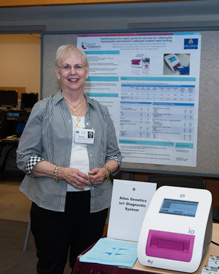
As director of the center, Dr. Gaydos provides funding to startups conducting research on POC technologies. It can be difficult for companies to obtain funding without preliminary studies resulting in positive data showing that their technology is feasible. But how do companies get the money to carry out preliminary studies? This is where Dr. Gaydos and her team step in and help provide struggling businesses with a small budget to get initial studies underway. Dr. Gaydos has also participated in more than 42 FDA clinical trials and helps grantees navigate important regulatory considerations throughout their study and technology design process.
After nearly twelve years of leading the JHU Center, Dr. Gaydos is still excited and committed to helping companies translate their promising POC technologies into the clinic.
Dr. Gaydos described her primary research goal as translating new diagnostics for sexually transmitted infections (STIs) and respiratory pathogens. Through this work she has published more than 500 research articles and is the author of 29 book chapters. She conceptualized and launched the I Want The Kit program, which she considers her greatest achievement. The program delivers an STI testing kit to the doors of women and men in Maryland, Washington DC, and Alaska. Dr. Gaydos explained, “My goal is to eliminate the stigma around STI testing and get people to receive healthcare in the privacy of their homes. Increasing POC testing in ways like this will have a positive impact on healthcare.”
“At JHU, applicants for admission to medical programs are equal proportions of women and men or more women than men,” exclaimed Dr. Gaydos.
Dr. Gaydos predicted a bright future for women in science. She believes that women have proven that they are equal to men in science and medicine, and many universities are progressive in providing equal opportunities to students and faculty. She considers herself fortunate in her institution and has felt supported throughout her career.
“As progress has been made and continues to be made on gender equality and minorities, we are beginning to see changes. I don’t think women feel the same family pressures and discouragement from pursuing a career in science as they did 30 years ago. Young girls are now encouraged to pursue science. We are moving in the right direction,” proclaimed Dr. Gaydos.
Her advice to future female scientists is to pursue their passions. She feels that if you love your job, you will never feel like you are “working.” He ended by stating: “Don’t be afraid to go after what you want. Go for your dream!”
Read more inspiring stories from NIBIB beneficiaries.