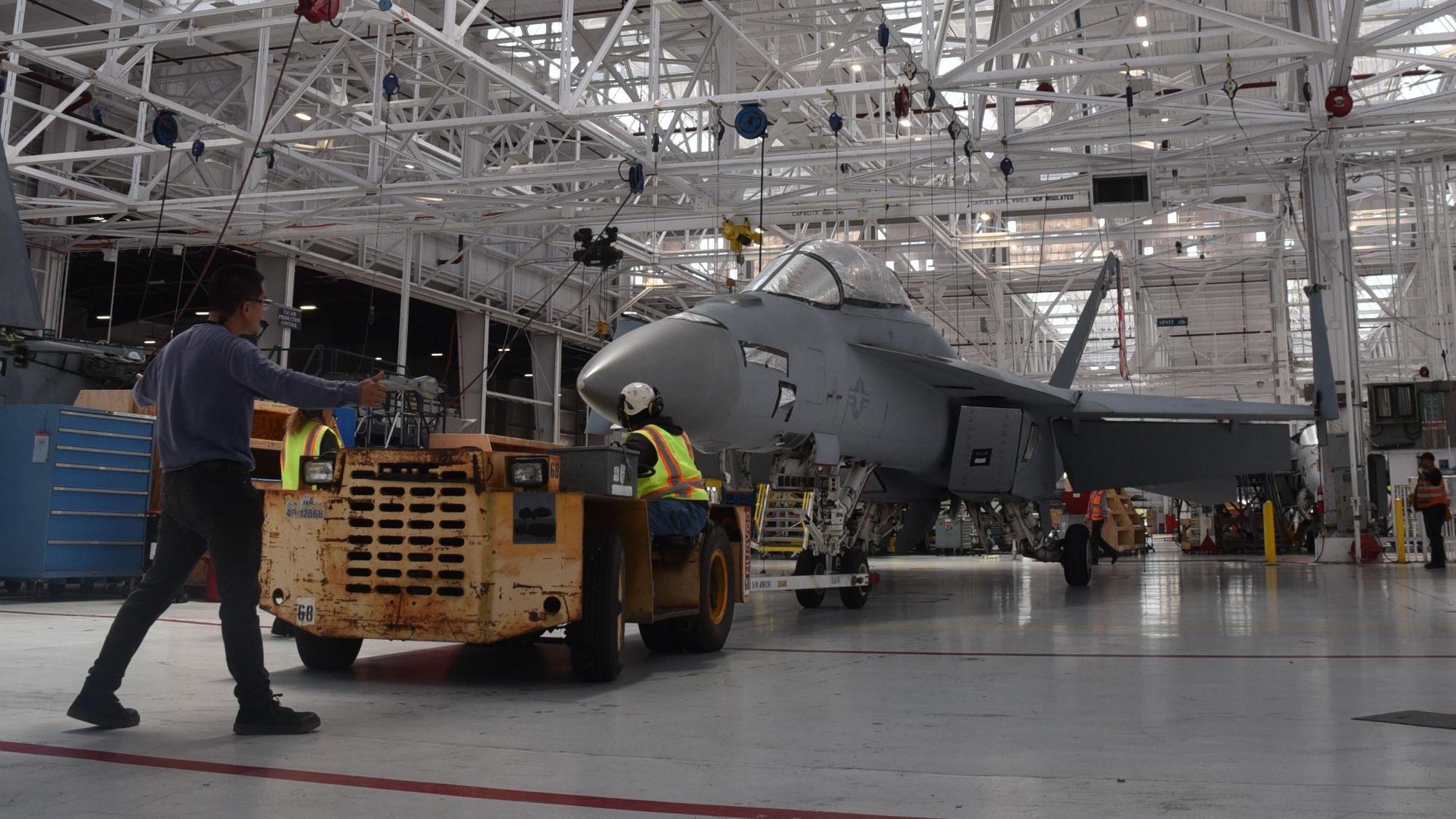
The Fleet Readiness Center Southwest completed its first all-in-house upgrade of the Block III Super Hornet, combining the work with the ongoing service life modification effort.
Fleet Readiness Center Southwest (FRCSW) announced On April 21, 2026, it completed the first all-internal modification of an F/A-18E/F Super Hornet for the naval aircraft Block III program. The Block III modification is the third and most advanced phase of the Service Life Modification (SLM) effort for the US Navy’s Super Hornet fleet, the service says, which would allow the fighter to serve well into the 2040s.
FRCSW highlighted how years of preparatory efforts made this possible. This included coordination with Boeing, the F/A-18E/F and E/A-18G PMA-265 Growler program office, repairing unexpected damage, while meeting strict technical specifications and synergizing the work of multiple engineers and technicians from multiple branches.
With Boeing planning to end production of the Super Hornet by 2027, the fighter and its electronic warfare derivative, the E/A-18G Growler, will remain the US Navy’s primary multirole platforms, until the arrival of the F/A-XX.
SLM and Block III Programs
The Block III upgrades are part of the Super Hornet Service Life Modification (SLM). The first phase of the SLM is the Service Life Extension (SLE), which initially extended the service life of the Super Hornet from 6,000 to 7,500 flight hours and, starting in 2023, is further extending the service life to 10,000 flight hours.
The first two modified aircraft were returned to the US Navy on June 27, 2024, less than a year later and ahead of schedule. In December 2025, Boeing received a $931 million contract to continue the SLM program on 60 aircraft, which would join the approximately 125 Super Hornets already covered by a series of contracts since 2018.
The end of Super Hornet production is expected to not impact the Navy’s current fleet of approximately 550 F/A-18E/F fighters, and its modernization and maintenance will allow them to remain relevant in modern scenarios. The FRCSW, which can modify up to 40 aircraft a year, is one of three locations carrying out Block III upgrades, two others are in St. Louis.
The VX-9 F/A-18E Block III Super Hornet left Fort Worth Alliance on Sunday. The most obvious external sign of a Block III appears to be the small hump at the top of the spine toward the tail. Maybe one day we will see them with CFTs. 169971XE-360 pic.twitter.com/NTNQdhmSq7
– Sam Combs (@pressxtolive) July 17, 2023
Block III Features
The Block III upgrade primarily features a new cockpit display, electronics, avionics and computer architecture. At one point, the program also envisioned conformal fuel tanks (CFT) that would add an additional 3,500 pounds of fuel capacity, however, that plan was later scrapped.
Super Hornets under Block III would receive an Advanced Cockpit System (ACS) with a 10×19-inch large-area touchscreen; a modern Distributed Targeting Processor Network (DTP-N) and Tactical Targeting Network Technology (TTNT); open mission systems; reduced radar signature; and the AN/ASG-34 IRST (infrared search and track).
Block III super hornet for context. There is also nothing more than mirrors, necessary lights and a backup magnetic compass in the canopy frame, unlike the Su-57, which has a selector of sorts in the canopy frame. You can see the different shapes, sizes and different positions of… pic.twitter.com/iQIkGbsXxm
— Heat loss (@heatloss1986) November 19, 2025
The FRCSW press release shed more light on the avionics upgrades, ACS and its benefits, as part of the Super Hornet Block III configuration:
- Advanced Cabin System (ACS) Installation
- A new large-area cockpit display
- Comprehensive avionics suite upgrades
- Enhanced aircraft networking capability
- Electrical system modernization to support improved systems.
“The ACS fundamentally transforms the cockpit. Aircraft that once relied on older display technology are now equipped with modern, easy-to-use, large-screen interfaces. This upgrade allows pilots to take full advantage of the aircraft’s enhanced capabilities, bringing this fourth-generation platform significantly closer to fifth-generation performance at a fraction of the cost,” the FRCSW statement said.
CVN-71 USS Theodore Roosevelt
ROKFLT, Busan
F/A-18E Buno.169953
VFA-25 “Fist of the Fleet” NH400I’m glad to meet the new Block III Super Hornet! pic.twitter.com/gKULgztBab
— Hornet (@hornetysfs) June 23, 2024
The FRCSW further added that the completion of its first fully organic modification of the F/A-18 Super Hornet Block III marks an important milestone as it was “the first time U.S. military craftsmen and engineers executed the entire upgrade in-house, marking a critical step forward in naval aviation readiness.”
FRCSW divided the work into three phases: the structural SLM, Block III upgrades for network and mission enhancements, and Block III ACS and avionics modernization. “This phased approach allowed FRCSW craftsmen and engineers to refine processes, sequence work efficiently, and reduce costs and turnaround time (TAT),” the statement said.
FRCSW further distinguished between the SLM and Block III upgrades: “The modification does not extend the physical life of the aircraft – that is the purpose of the structural SLM – but it ensures that the avionics and mission systems remain tactically relevant to the service life of the aircraft.” However, together, they form a “life extension and capability enhancement strategy” that ensures the Super Hornet will remain a key component of the Navy’s carrier air wing well into the 2040s.
U.S. Navy F/A-18 Super Hornets aboard USS Abraham Lincoln (CVN 72) prepare for a night combat mission during Operation Epic Fury, March 25. pic.twitter.com/glxEH2qlNO
— US Central Command (@CENTCOM) March 29, 2026
Technical efforts
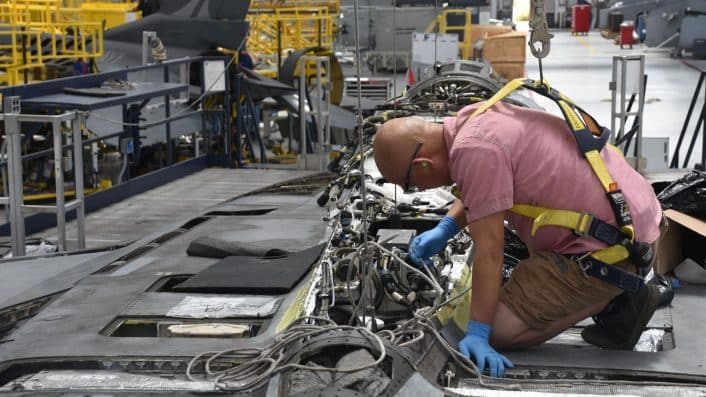
For “technically complex avionics upgrades” as part of the Block III modification, which “essentially gutted the cockpit,” FRCSW engineers and technicians had to remove and replace structural components; remove and reinstall wiring and fiber optics; installation of new displays and interface systems; and undertake electrical improvements to support modern avionics.
Avionics technicians, sheet metal mechanics, ordnance specialists and engineers and quality control personnel had to comply with the more than 350-page Technical Directive (TD), which dictates “down to how cabling and fiber optics must be routed and secured.” FRCSW and Boeing worked together to ensure each step meets current safety and quality standards.
Unexpected additional “corrosion, frayed wiring or legacy damage” may also be encountered as aircraft are disassembled, which “must be corrected before modernization can continue,” further complicating intricate efforts. “This adds layers of complexity to an already complex effort,” FRCSW explained.