{“preview_thumbnail”:”/sites/default/files/styles/video_embed_wysiwyg_preview/public/video_thumbnails/yGmEid3byDc.jpg?itok=dGrLsWaU”,”video_url”:”https://youtu.be/yGmEid3byDc“,”settings”:{“responsive”:1,”width”:”854″,”height”:”480″,”autoplay”:0},”settings_summary”:[“Embedded Video (Responsive).”]}
An international team of researchers with partial support from the National Institute of Biomedical Imaging and Bioengineering (NIBIB) developed a new MRI technique that can capture an image of a thinking brain by measuring changes in tissue stiffness. The results show that brain function can be tracked on a time scale of 100 milliseconds, 60 times faster than previous methods. The technique could shed new light on altered neuronal activity in brain diseases.
The human brain responds almost immediately to stimuli, but non-invasive imaging techniques have not been able to keep up with the brain. Currently, several noninvasive brain imaging methods measure brain function, but all have limitations. Most commonly, doctors and researchers use functional magnetic resonance imaging (fMRI) to measure brain activity through fluctuations in blood oxygen levels. However, much vital information about brain activity is lost with fMRI because it takes about six seconds for blood oxygen levels to respond to a stimulus.
Since the mid-1990s, researchers have been able to generate maps of tissue stiffness using an MRI scanner, with a non-invasive technique called magnetic resonance elastography (MRE). Tissue stiffness cannot be measured directly, so researchers use MRE to measure the speed at which mechanical vibrations travel through tissue. Vibrations move faster through stiffer tissues, while vibrations travel more slowly through softer tissues; therefore, the stiffness of the tissue can be determined. MRE is most commonly used to detect hardening of liver tissue, but more recently it has been applied to other tissues such as the brain.
“This study has the potential to revolutionize the way scientists study brain diseases,” says Krishna Kandarpa, M.D., Ph.D., director of scientific research and strategic directions at NIBIB. “The development of a new MRI technique relies heavily on physics and engineering principles, which are areas in which NIBIB researchers excel. The results would have been difficult to achieve without the collaboration of this team of experts.”
Sam Patz, Ph.D., a professor of radiology at Harvard Medical School and a physicist in the Department of Radiology at Brigham and Women’s Hospital, explained that his initial plan was to use MRE in combination with another MRI method to study scar tissue in the lung. “I had no experience with MRE, so I turned to my colleague who is a pioneer in MRE, Dr. Ralph Sinkus,” Patz said.
Sinkus, a professor of biomedical engineering at King’s College London and co-corresponding author of the journal Science Advances, helped Patz set up the MRE lung imaging experiments in his Boston lab. As the team worked to launch the lung experiments, they encountered numerous complications and decided it was easier to start with the mouse brain. Due to their interesting results, the team continued studying the mouse brain.
Patz and Sinkus were excited about the first MRE images of a mouse brain: they were of excellent quality. “We noticed that the auditory cortex, which the mouse uses to hear, was a little stiffer than other parts of the cortex. We looked for an answer but came up empty-handed,” Patz said. “We hypothesized that perhaps the auditory cortex had increased blood flow due to the noise of the MRI scanner. The idea was that the capillaries in the auditory cortex were under greater pressure when stimulated; similar to when you turn on a garden hose, the hose becomes stiffer.”
Patz followed up with experiments to confirm the hypothesis by blocking one or both ear canals of a mouse with a gel to silence the noise from the MRI scanner. “The results were dramatic,” exclaimed Patz. “It was clear that removing the stimulus resulted in softer tissue and that the variation in stiffness was real.”
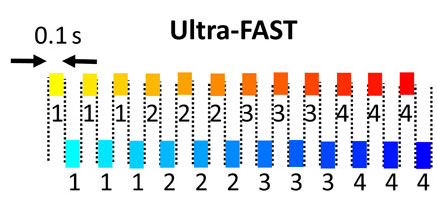
Initially, it took researchers about 20 minutes to obtain an MRI scan. The team was concerned that the long stimulus time would lead to a reduced response after prolonged or repeated exposures, a phenomenon called habituation.
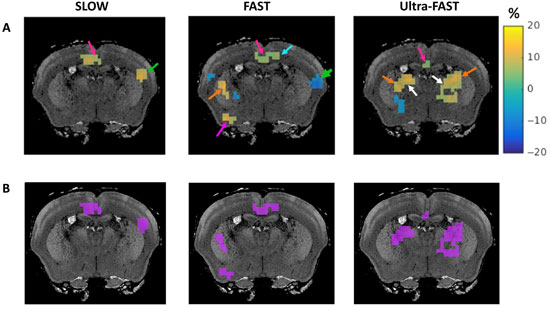
At first, the team thought the changes in tissue stiffness were due to changes in blood supply, another manifestation of what traditional fMRI detects. So, they decided to switch between the two stimulus states much faster than the blood system could respond. Surprisingly, the data showed the same strong change in stiffness after a one-second stimulus, and the researchers concluded that the changes they had observed in the mice had nothing to do with blood flow.
After this result, colleagues urged researchers to test even faster speeds. The published results show approximately a 10% change in stiffness even after the stimulus states were varied every 100 milliseconds. These results are the closest to real-time brain MRI that researchers have achieved to date.
Now, the group is conducting a similar study in healthy human brains to establish a robust protocol. Preliminary results from human brains show alterations in tissue stiffness in times as short as 24 milliseconds.
Once the technology has been translated into human use, the pair will be able to research brain diseases. The technique could provide new ways to diagnose and understand the variation in brain activity in diseases such as Alzheimer’s, dementia, epilepsy or multiple sclerosis.
Additionally, the technology can also be applied to cancer patients with large brain tumors. Sometimes a large tumor mass will block the blood flow that traditional fMRI detects, so it is not possible to get a good image. Since the new methods are not thought to be dependent on blood flow, they may be able to obtain better images in these patients and help inform treatment strategies.
The research was funded, in part, by a NIBIB grant (EB020757).
Patz, Samuel, et al. “Imaging localized neural activity on fast time scales using biomechanics.” Science Advances, American Association for the Advancement of Science, April 1, 2019, advanceds.sciencemag.org/content/5/4/eaav3816/tab-article-info.