Women receiving treatment for ovarian cancer are examined for tumor cells that may have spread to surrounding tissues, but current technologies miss very small metastatic areas. Now a laser microscopy technique is capable of identifying these regions with great precision.
Microscopic technologies that use lasers to fire photons at target tissues and then receive and interpret information about the metabolic and structural characteristics of the tissue are advancing at a rapid pace.
An important use of these microscopes is the ability to noninvasively detect metabolic and structural “signatures” of small micrometastases from original tumors that are too small to be detected by traditional light microscopy.
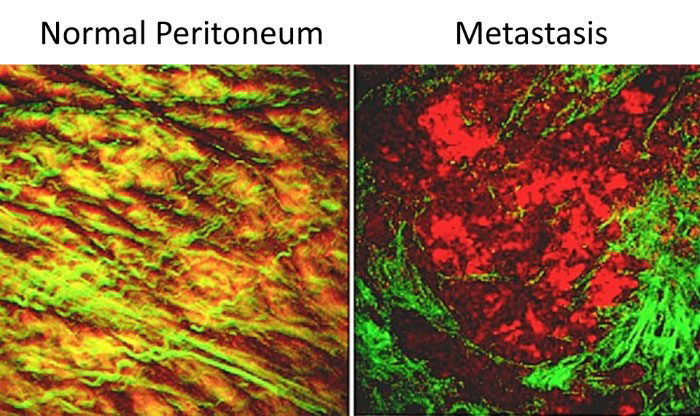
Now, researchers led by Irene Georgakoudi, Ph.D., professor in the Department of Biomedical Engineering at Tufts University, and Thomas Schnelldorfer, M.D., Ph.D., of Lahey Hospital, Burlington, Massachusetts, have combined advanced microscopy and computational analysis in hopes of quickly identifying ovarian metastases in the operating room. The work appears in the September issue of Biomedical Optics Express.1.
“This is extremely high-impact work,” says Behrouz Shabestari, Ph.D., Director of the NIBIB Program in Optical Imaging and Spectroscopy. “The ultimate goal of using this technology during surgery – detecting and removing commonly missed metastases – promises to significantly improve surgical outcomes for women being treated for ovarian cancer. Additionally, the technology will also be applicable to other types of cancer.”
The multiphoton laser scanning technique involves shooting short bursts of laser light into tissue. Laser light reflects off different tissue components, which have different shapes and textures and therefore emit different signals. The signals are captured by the microscope and analyzed by algorithms that interpret the different signals to ultimately determine whether the tissues are normal or cancerous.
The combination of laser microscopy and the calculations performed by the algorithms allows the identification of each type of tissue without any type of labeling or chemical processing of the tissue. This is a critical aspect of the technology because it opens up the possibility of using the system in the operating room to scan tissues during surgery, where small metastatic areas, not visible with current technologies, could be removed along with the removal of primary ovarian tumor tissue.
The current experiments evaluate the feasibility of using the microscope during a laparoscopy, a minimally invasive procedure that allows doctors to visualize the peritoneum, the compartment that surrounds the ovaries. This is a procedure used to evaluate the stage of disease progression in order to make treatment decisions. So, as a first step, the researchers tested their system on biopsies taken from ovarian peritoneal metastases and from the healthy peritoneum of women undergoing laparoscopy and surgery for ovarian cancer.
The research team took images of healthy and diseased biopsies from 8 patients. Surprisingly, the technique correctly classified 40 of the 41 images, 11 of 11 were correctly classified as metastatic, and 29 of 30 were classified as healthy. “The results of this study are extremely encouraging,” says Dimitra Pouli, M.D., Ph.D., lead author of the study. “Next steps include verifying our results with a larger sample from a wider variety of patients.”
Another critical aspect of the group’s work is integrating the microscope into the repertoire of surgical instruments to achieve the ultimate goal of tissue analysis during an operation. This would allow immediate removal of areas of metastatic cancer that were previously undetectable.
The work was funded by the National Institute of Biomedical Imaging and Bioengineering (NIBIB) (NIBIB-R21 EB023498); the Hellenic Medical Society of New York (Stavros Hartofilis scholarship); and the American Society of Gastrointestinal and Endoscopic Surgeons (SAGES) (2013 SAGES Research Award).