What you should know
- The reality check: In PGH Looking back 20 years, the verdict is harsh: the technology worked in workflows but failed in economics. Since HGP was founded, U.S. healthcare spending has doubled to $5.3 trillion, proving that digitalization alone does not equal efficiency.
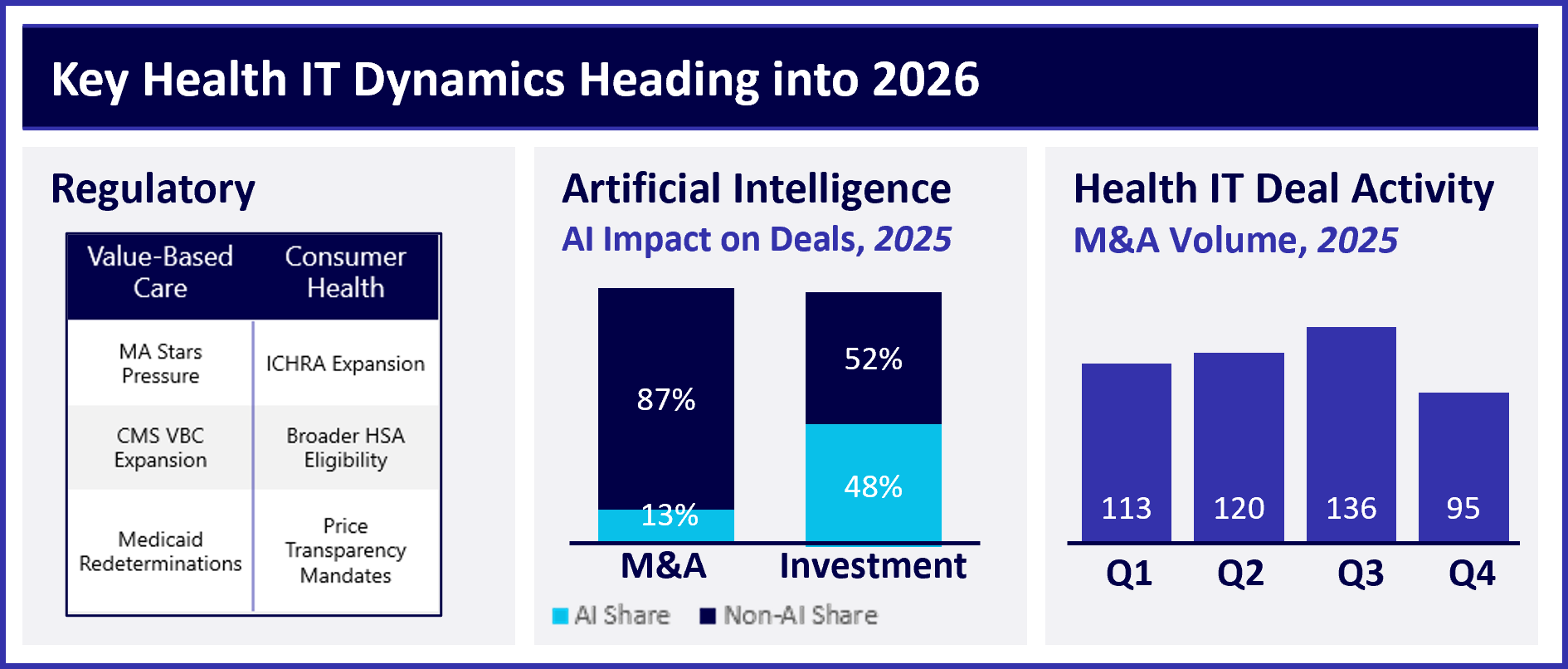
- The market rebound: Despite the cynicism, the deal market is making a strong comeback. The third quarter of 2025 saw a record 136 M&A deals, and valuations have stabilized comfortably above pre-pandemic levels (approximately 5.1 times revenue), indicating that the “Great Reset” is over.
- The AI division: There is a huge gap between enthusiasm and output. While 50% of investment capital went to native AI companies in 2025, only 13% of M&A deals involved them. Strategic buyers are buying core workflow companies, not just algorithms.
HGP Market Review 2026: M&A Hits Record Highs as AI Investment Captures 50% of Capital
According to the January 2026 Market Review of Healthcare Growth Partners (HGP)The industry has achieved “near universal” adoption of the technology, but the economic benefits remain elusive. Since HGP’s founding two decades ago, U.S. health care spending has nearly doubled, from $2.5 trillion to $5.3 trillion.
“Healthcare IT has significantly modernized workflows and data capture,” the report notes, “while its impact on outcomes and economic value has been limited.”
However, as we head into 2026, the report suggests that the industry is not collapsing – it is maturing. With inflation moderating to 2.6% and interest rates falling, the market is moving from “regulatory compliance” to “economic responsibility.”
The era of AI “add-ons”
Perhaps the most counterintuitive finding for 2026 is the role of Artificial Intelligence. The prevailing narrative is that AI startups will disrupt incumbents (like Epic or Oracle). HGP data suggests the opposite: Traditional companies are eating up innovation.
“So far, AI is proving to be additive, not existential, to incumbents,” the analysts write.
The figures reveal a bifurcated market:
- The hype: Investors are pouring money into the dream. By 2025, 50% of US health IT investment dollars will flow to native AI companies.
- The reality: Buyers are becoming useful. Only 13% of M&A and acquisition transactions involved companies heavily marketing AI capabilities.
Strategic acquirers are prioritizing “revenue durability” and “integrated workflows” over generative magic. They are buying the track, not the train.
The Regulatory Fork in the Road
The report identifies a critical divergence in the way the government is shaping the market. Regulation is dividing healthcare into two different economic models:
- Value-based institutional care: CMS is doubling down on long-term accountability (e.g., the new ACCESS model for chronic care). This favors platforms with deep data moats and capital capacity.
- Consumer-directed health: At the same time, affordability pressures are pushing markets toward transactional dynamics (ICHRA, HSA, price transparency). This favors tools designed to deliver retail-like speed, access and efficiency.
Companies that straddle these two worlds can see themselves separated. “The result is two parallel investment theses,” says HGP.
Mergers and acquisitions: the healthy “new normal”
After the “COVID sugar high” of 2021 and the subsequent crisis, 2025 marked the return of a healthy middle class in trading. Quarterly M&A volume hit an all-time high in Q3 2025 with 136 deals. Software company valuations have stabilized at 5.1 times revenue, less than the COVID peak of 8.1 times, but notably higher than the pre-pandemic average of 4.6 times.
However, achieving these agreements requires creativity. The report highlights a rise in “flexible deal structures,” in which buyers use proceeds and renovation capital to bridge the gap between buyers’ caution and sellers’ optimism.
The verdict
2026 feels different not because the problems are solved, but because the industry has stopped pretending that software solves everything.
As HGP concludes, the next decade will not be determined by “regulatory incentives” (such as Meaningful Use), but by “responsibility and economics.” The winners will not be those who digitize the letter; They will be the ones who finally – after twenty years – discover how to reduce the bill.