
CoinFund President Christopher Perkins is betting that 2026 will be defined less by shiny new token narratives and more by balance sheets, regulatory-enabled product launches, and the messy maturation of cryptocurrencies in an industry that buys, sells, and consolidates. On December 31 thread about X, Perkins presented seven predictions:
#1 Crypto ‘M&A Summer’ and One-Year $25 Billion Deal
Perkins’ first and loudest call: 2026 will be “the year of cryptocurrency M&A.” It pegged M&A activity in 2025 at about $8.6 billion in total deal value, then projected that 2026 “will reach $25 billion,” framing it as a sea change rather than a modest rise.
He described consolidation pressure on multiple fronts, from “DAT/Labs/Foundation Consolidation” to “DAT vs DAT (mNAV calculation),” as well as a two-way bridge between traditional finance and cryptocurrencies. The direction of travel, in his telling, is simple: TradFi companies playing catch-up and crypto companies buying their way into regulated capabilities.
“TradFi → Crypto (ugh, I’m behind and need to catch up),” he wrote. “Crypto (DAT, Exchanges) → TradFi (we also need operating companies, securities capabilities and licenses!)”. He also pointed to “Asia→United States” as a theme, arguing that a clearer regulatory environment will attract international players to the US market.
“2021 was the summer of stablecoins; 2026 will be the summer of mergers and acquisitions,” Perkins concluded.
#2 stablecoins for $600 billion
Perkins’ second prediction is that the market capitalization of stablecoins will double, “exceeding $600 billion (2x).” Their reasoning depends less on retail use and more on the economics of issuers and the market.
“For every stablecoin, someone earns net interest income. Who wouldn’t want one?” he wrote. “As markets become tokenized, you will need stablecoins to buy and sell them. Watch the growth accelerate in 2026.”
The subtext is that stablecoins become the default settlement asset for on-chain financial activity, especially if more real-world assets and market structures migrate to the chain, while incentives for issuers remain strong.
#3 A $2B+ Crypto Hack as a Policy Catalyst
Perkins also predicted a major security event: “A major >$2 billion hack will shake confidence, lead to downsizing, and catalyze policy changes.” He pointed to what he described as worsening trends, citing $3.4 billion in piracy over 2025, “a 51% increase,” and then argued that the attack surface is growing as tokenization and stablecoins bring “hundreds of billions more” to the chain.
He went beyond the usual call to improve security practices and raised a provocative historical reference as a possible political direction. “Maybe it’s time for a new policy change, like Letters of Marque and Retaliation,” he wrote. “I’m just saying…” The implication: If losses increase, the policy response could become more aggressive and less abstract.
#4 Profitability of regulated derivatives
As for market structure, Perkins predicted that American crypto derivatives will “come back to the US in a big way,” with a “big battle for market share” as “new players enter the space.” Although he expects the U.S. share of global derivatives volume to triple, he argued that CME’s share of U.S. crypto futures could fall amid broader competition.
His thesis is based on regulatory momentum and institutional business behavior. “Now that the regulatory path is clear, there will be a proliferation of new regulated futures products launched in the United States,” Perkins wrote. “As cryptocurrencies enter their institutional era, demand will be off the charts because basic trading will be their first step. This will bring life back to alternatives.”
#5 No market structure bill
Not everything is acceleration. Perkins’ fifth prediction: A comprehensive market structure bill “won’t pass,” blaming the severity of the political calendar. “Sorry guys, this is going to be too hard. The midterm elections will take the oxygen out of the room,” he wrote.
#6 new ATHs for Bitcoin and ETH
Despite that, he still expects new highs in major currencies, expecting bitcoin to reach $150,000 and ether to surpass $5,000. “BTC and $ETH will hit ATHs,” Perkins wrote. “BTC reaches $150,000; ETH surpasses $5,000. Institutional adoption makes it possible.”
#7 NFTs are coming back, but not as JPEG files
Finally, Perkins predicted a resurgence of NFTs with a change in format. “NFTs will return, but version 2.0 won’t be jpeg,” he wrote, creating an exception for CryptoPunks and ruling out a broader JPEG-led resurgence. Instead, it expects “non-fungible financial tokens,” potentially tied to “individualized and tokenized security/yield vaults.”
At the time of this publication, the total crypto market capitalization amounted to $2.94 trillion.
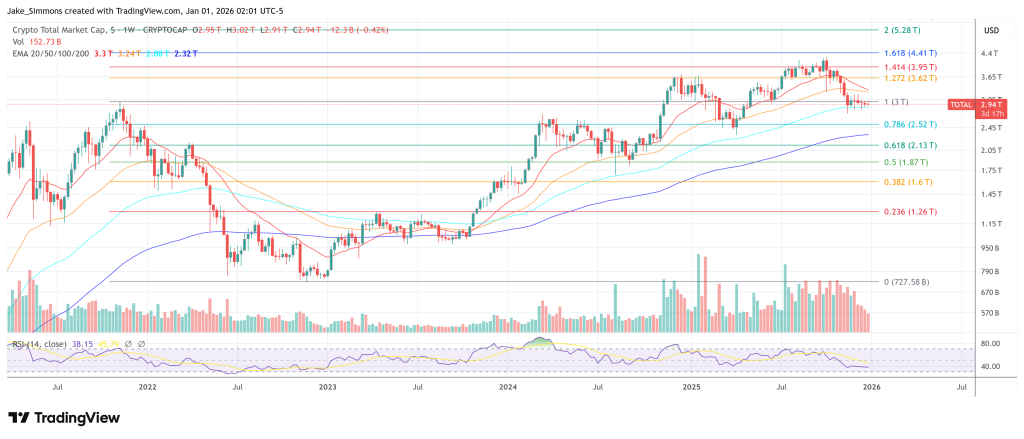
Featured image created with DALL.E, chart from TradingView.com

Editorial process for bitcoinist focuses on providing thoroughly researched, accurate and unbiased content. We maintain strict sourcing standards and every page undergoes diligent review by our team of technology experts and experienced editors. This process ensures the integrity, relevance and value of our content to our readers.