What you should know
- The data source: Zocdoc released “The patient informed by AI” report, Based on a February 2026 survey of 1,186 US adults and 1,000 US healthcare providers.
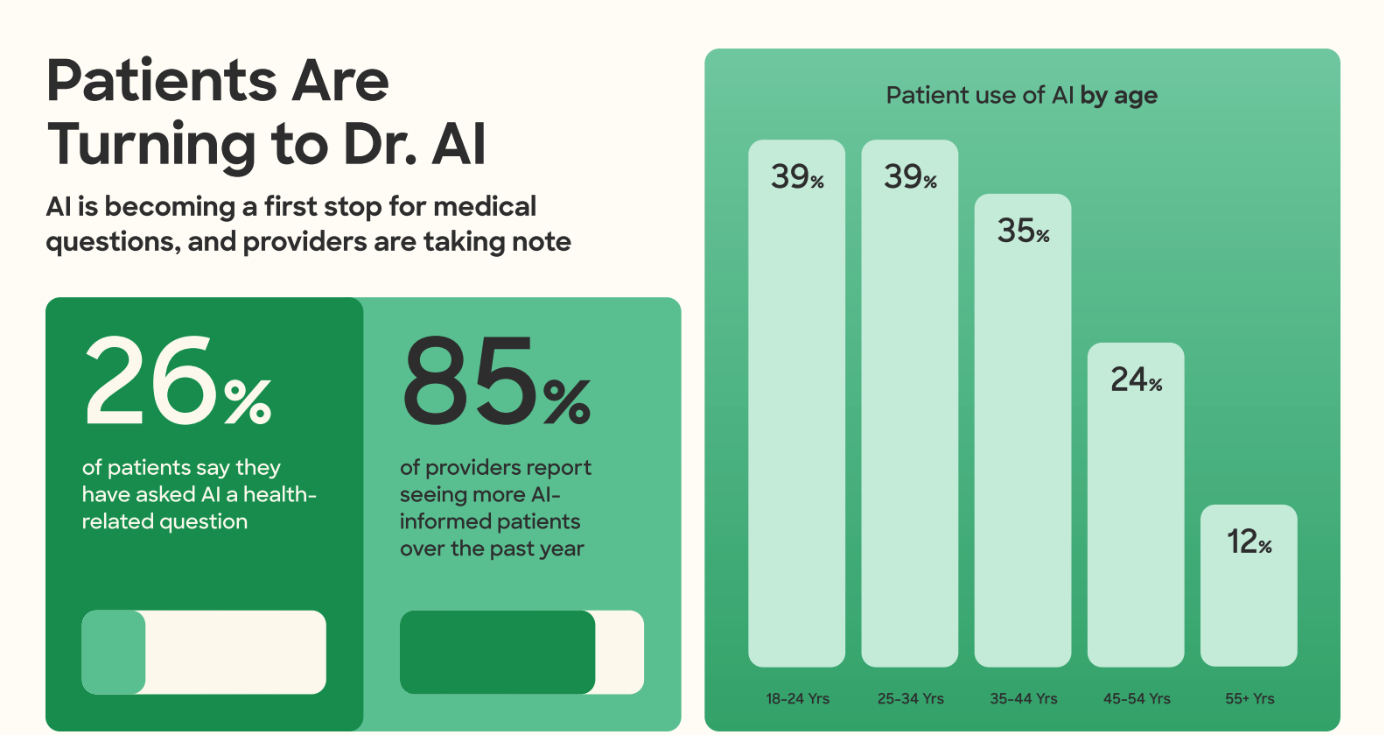
- Adoption and the problem of access: More than a quarter (26%) of patients have already used AI to ask a health-related question. A major factor is poor access to healthcare: 65% of patients say they use AI simply because it is easier than trying to see a doctor.
- The secret patient: Patients largely hide their use of AI from their doctors. More than 1 in 5 (23%) have hidden it, and another 24% say they haven’t done so yet, but would. The main reason is fear of judgment (39%). Generation Z is the most secretive demographic: 77% say they have hidden or would hide their use of AI.
- The supplier paradox: Despite the secrecy, the suppliers are very aware and surprisingly supportive. 85% say they have seen more patients informed about AI over the past year and 72% say they can tell when a patient has used it. Surprisingly, 77% of providers have a positive opinion of patients’ use of AI, and 60% actually prefer it to a standard Google search.
- The “Time Tax”: This enthusiasm comes with a huge operational caveat. 83% of providers report having to actively correct a patient’s AI-generated misinformation, and 63% admit this requires more time during the actual appointment.
- The new model: While 70% of patients still prefer to receive guidance from a human doctor, an emerging cohort (23%) wants to consult both, indicating a shift toward a new “triangle of care.”
Why Doctors Are Secretly Delighted You’re Using ChatGPT
According “The AI-Informed Patient ReportJust released by Zocdoc, 26% of patients now use AI to answer health-related questions. And the healthcare industry is feeling the impact immediately: 85% of providers report seeing an increase in the number of patients informed by AI over the past year.
The data reveal a fascinating disconnect between patient anxiety and clinical reality. Nearly half of all patients are actively hiding their AI use from their doctors or plan to do so. The driving force is pure stigma. Patients worry that their doctor will judge them (39%), dislike them (38%), or dismiss their concerns entirely (31%). This anxiety is hyper-focused on younger demographics, with a staggering 77% of Gen Z patients hiding their technology use.
But the irony is that doctors already know this and, in fact, as he. 78% of providers want their patients to disclose when they have consulted AI, and 77% view the trend positively. Because? Because despite the technology’s flaws, an AI-informed patient is a engaged patient. More than 75% of providers noted that these patients ask more thoughtful questions and are more involved in their own care plans. If given the choice, 60% of doctors would prefer a patient to use AI rather than perform a blind Google search.
The cost of commitment: the “time tax”
This clinical optimism, however, comes with a brutal operational side effect that healthcare administrators must address: the “time tax.” While AI makes patients more engaged, it also makes them overconfident. The survey found that 88% of patients feel confident about their next steps after consulting an AI.
When that AI hallucinates or misinterprets a symptom, the burden of deprogramming that overconfidence falls squarely on the doctor’s shoulders. A staggering 83% of providers report that they need to actively correct AI-generated misinformation during a visit. Consequently, 63% of doctors say that AI-informed patients require more time in the exam room to correct that erroneous data.
In a fee-for-service health system where doctors are already hired in grueling 15-minute increments, adding a “time tax” to correct an algorithm’s errors is a recipe for massive schedule delays and physician burnout.
“More and more patients are turning to AI for answers and guidance, but many don’t tell their doctors, often for fear of being judged,” said Dr. Oliver Kharraz, founder and CEO of Zocdoc.